ToolMage
Sign in

Best 1 Trust Building AI tools for Marketing

Popular Trust Building AI tools in Marketing include Yourwebsitescore, helping you work more efficiently.

Yourwebsitescore
Freemium

Yourwebsitescore

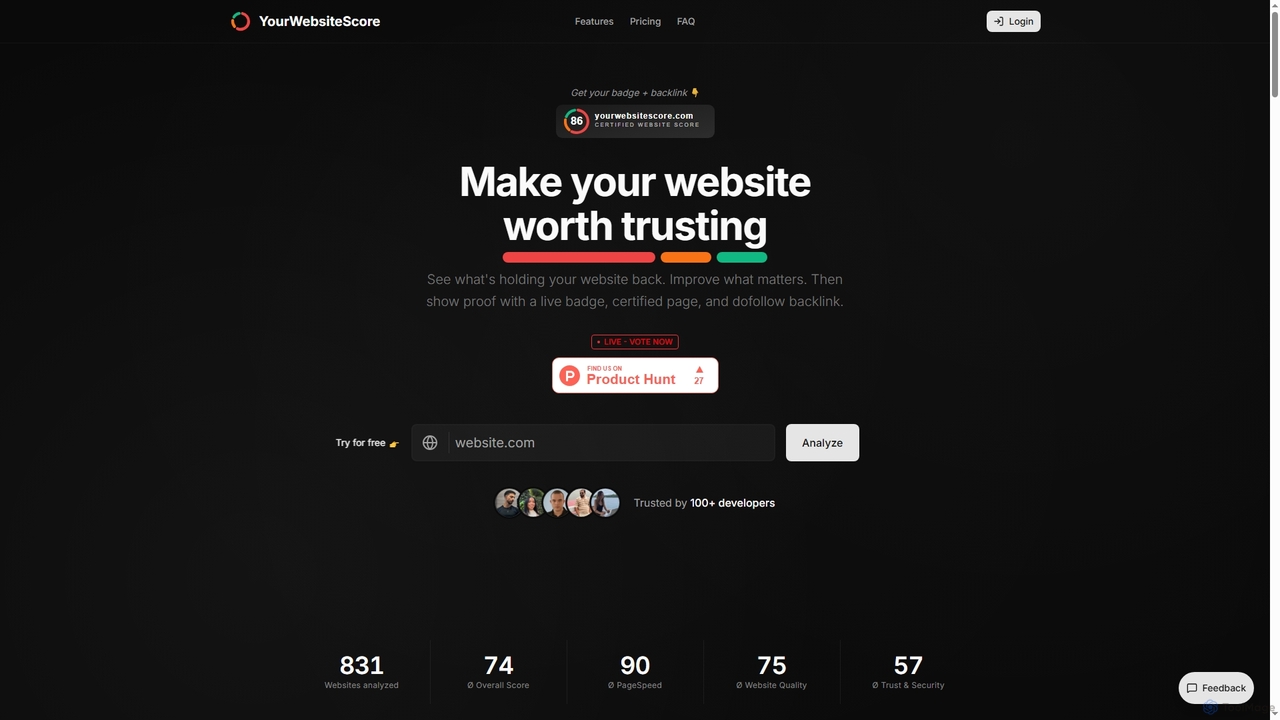
An all-in-one website analysis tool that evaluates performance, quality, and security. It provides a detailed score, an embeddable trust badge, daily monitoring, and a dofollow backlink to enhance your site's credibility and SEO.

Performance
Visits 6.6KFavorites 153Likes 118

About Trust Building

Trust Building tools are AI-powered solutions designed to enhance and maintain credibility, transparency, and positive reputation for businesses and individuals. These tools leverage advanced AI algorithms to analyze sentiment, verify information, manage online reviews, and personalize communication, fostering stronger relationships with audiences. By automating aspects of reputation management and ethical communication, they help cultivate loyalty and long-term customer engagement within the broader marketing landscape.

Core Features

  • Sentiment Analysis: Automatically detects and interprets emotional tones in customer feedback and online mentions to gauge public perception.
  • Reputation Monitoring: Tracks brand mentions, reviews, and social media activity across various platforms to identify potential trust issues.
  • Content Authenticity Verification: Uses AI to detect deepfakes, misinformation, or AI-generated content, ensuring transparency and credibility.
  • Personalized Ethical Communication: Generates tailored, empathetic responses and content that aligns with brand values and builds rapport.
  • Review Management Automation: Streamlines the process of collecting, responding to, and analyzing customer reviews to improve trust signals.

Use Cases

Businesses use Trust Building AI tools to proactively manage their online presence and customer relationships. For instance, e-commerce brands employ them to analyze product reviews and address negative feedback swiftly, while service providers use them to ensure consistent, trustworthy communication across all customer touchpoints. These tools are vital for maintaining brand integrity and fostering a loyal customer base.

How to Choose

When selecting Trust Building AI tools, consider the breadth of monitoring capabilities across platforms, the accuracy of sentiment analysis, and the robustness of content authenticity verification features. Evaluate integration options with existing CRM or marketing platforms, the level of customization for communication styles, and the scalability to handle growing data volumes. Prioritize tools that offer actionable insights and align with your specific industry's compliance and ethical standards.

Trust Building use cases

1

Managing Online Reviews for E-commerce Brands

An e-commerce manager uses AI-powered Trust Building tools to monitor product reviews across multiple platforms. The AI automatically identifies critical feedback, categorizes common issues, and suggests personalized, empathetic responses, allowing the manager to address customer concerns rapidly and publicly, thereby demonstrating responsiveness and building shopper confidence.

2

Detecting Misinformation in Brand Communications

A corporate communications team employs AI tools to verify the authenticity of user-generated content or external news articles mentioning their brand. The AI can detect deepfakes, manipulated images, or misleading text, enabling the team to swiftly correct inaccuracies and maintain a truthful and credible public image, protecting brand integrity.

3

Enhancing Customer Service Credibility

A customer support department integrates Trust Building AI into their communication channels. The AI analyzes customer interactions for sentiment and suggests responses that are not only helpful but also empathetic and transparent, ensuring consistent, trustworthy communication. This builds customer confidence and reduces churn by fostering a sense of being understood and valued.

4

Building Thought Leadership Through Authentic Content

A B2B content marketer utilizes AI to ensure the originality and factual accuracy of their thought leadership articles and whitepapers. The AI can cross-reference information, identify potential plagiarism, and flag any content that might appear misleading or unverified, helping the marketer publish authoritative and trustworthy content that establishes industry expertise.

5

Proactive Reputation Monitoring for Public Figures

A public relations specialist for a celebrity or politician uses AI-driven Trust Building tools to continuously monitor online mentions, news articles, and social media sentiment. The AI provides real-time alerts on potential reputational threats or emerging crises, allowing the PR team to respond strategically and maintain a positive public perception.

6

Ensuring Ethical AI Usage in Marketing Campaigns

A marketing ethics officer employs Trust Building AI to audit AI-generated marketing content (e.g., ad copy, personalized emails) for fairness, bias, and transparency. The tool helps ensure that AI outputs are not misleading, discriminatory, or opaque, thereby upholding ethical standards and building consumer trust in AI-driven campaigns.

Trust Building FAQ

What are Trust Building AI tools?

Trust Building AI tools are specialized software solutions that leverage artificial intelligence to help organizations and individuals cultivate and maintain credibility, transparency, and a positive reputation. They achieve this by analyzing public sentiment, verifying content authenticity, managing online feedback, and facilitating ethical communication, all crucial for fostering long-term relationships and brand loyalty.

How do Trust Building AI tools differ from general Marketing AI tools?

While both fall under the broader Marketing category, general Marketing AI tools focus on tasks like campaign optimization, audience targeting, or content generation for reach and conversion. Trust Building AI tools, however, specifically concentrate on the qualitative aspects of marketing: ensuring authenticity, managing reputation, fostering transparency, and building genuine rapport, which are foundational for sustainable marketing success.

What are the key benefits of using AI for Trust Building?

The primary benefits include enhanced efficiency in monitoring online sentiment and reputation, improved accuracy in detecting misinformation or inauthentic content, and the ability to scale personalized, ethical communication. These tools help businesses proactively address issues, demonstrate transparency, and build stronger, more credible relationships with their audience, ultimately leading to increased customer loyalty and brand value.

How can AI help verify content authenticity?

AI assists in content authenticity verification by employing advanced algorithms to analyze various data points. This includes detecting patterns indicative of deepfakes in images or videos, identifying inconsistencies in text that suggest AI generation or manipulation, and cross-referencing information against vast databases to flag potential misinformation. This ensures that the content a brand produces or interacts with is credible and truthful.

What should I consider when integrating Trust Building AI into my existing marketing stack?

When integrating Trust Building AI, consider its compatibility with your current CRM, social media management, and content creation platforms. Evaluate the ease of data flow, the level of automation it provides for tasks like review responses, and its ability to offer actionable insights that can be integrated into your overall marketing strategy. Ensure the tool's ethical guidelines align with your brand's values and compliance requirements.