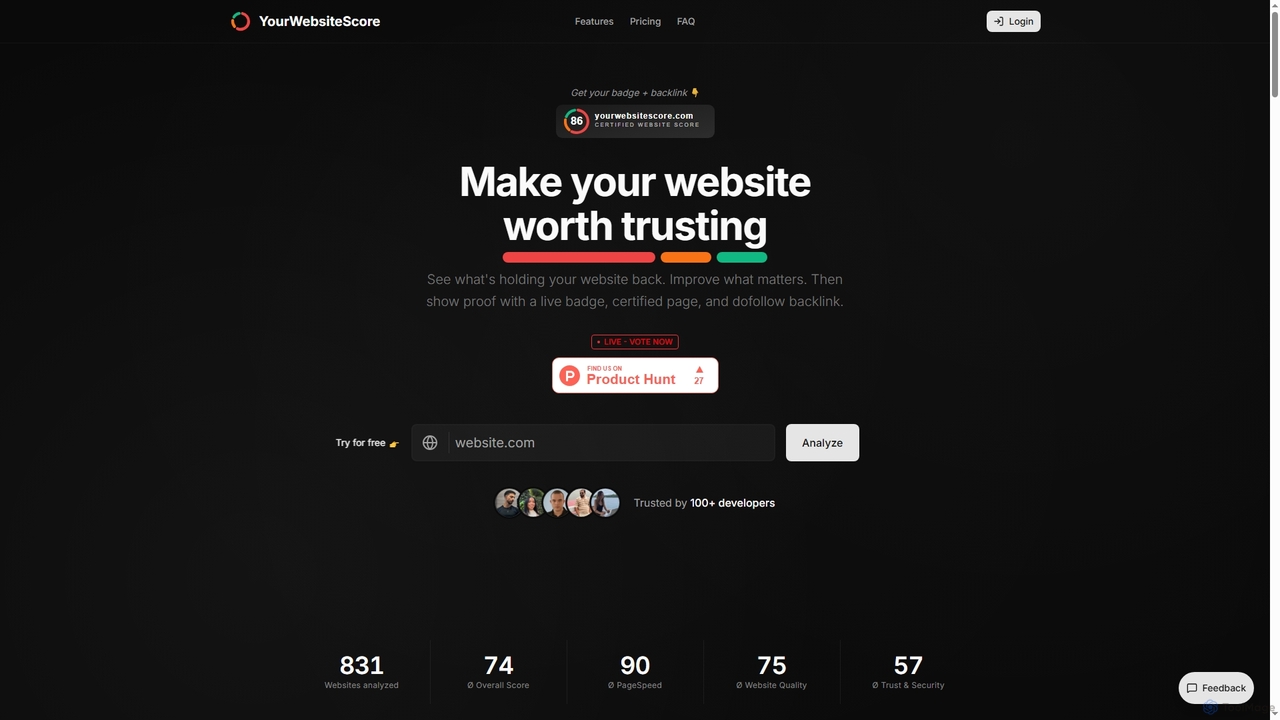
Yourwebsitescore
An all-in-one website analysis tool that evaluates performance, quality, and security. It provides a detailed score, an embeddable …
An all-in-one website analysis tool that evaluates performance, quality, and security. It provides a detailed score, an embeddable trust badge, daily monitoring, and a dofollow backlink to enhance your site's credibility and SEO.
About Performance
Performance tools are AI-powered solutions designed to optimize the speed, efficiency, and responsiveness of software applications and systems. These tools leverage advanced analytics and machine learning to identify bottlenecks, monitor resource usage, and predict potential issues before they impact users. They are crucial for developers and operations teams aiming to deliver fast, reliable, and scalable digital experiences, ensuring applications run smoothly under various loads and conditions.
Core Features
- Code Profiling: Analyzes code execution paths to pinpoint CPU, memory, and I/O inefficiencies.
- Application Performance Monitoring (APM): Provides real-time insights into application health, response times, and error rates across distributed systems.
- Load & Stress Testing: Simulates high user traffic to evaluate system stability and scalability under peak conditions.
- Database Query Optimization: Identifies slow database queries and suggests improvements for faster data retrieval.
- Frontend Performance Analysis: Assesses web page load times, rendering efficiency, and user interaction responsiveness.
Use Cases
Performance tools are essential for ensuring software quality and user satisfaction. Developers use them to debug slow code, while operations teams rely on them for proactive monitoring and incident prevention. They are vital in pre-launch testing for new features, continuous optimization in production environments, and scaling infrastructure to meet growing user demands.
How to Choose
When selecting performance tools, consider the scope of analysis (code, application, infrastructure, frontend), integration capabilities with your existing CI/CD pipelines and monitoring stacks, and the clarity of reporting and visualization. Evaluate scalability for your projected load, the level of automation offered, and the support for your specific technology stack (e.g., programming languages, databases, cloud providers).

PerformanceUse Cases
Optimizing Web Application Load Times
A web development team uses performance tools to analyze the loading speed of their e-commerce platform. By profiling frontend assets, identifying slow API calls, and optimizing database queries, they reduce page load times by 30%, significantly improving user experience and conversion rates. The tools help pinpoint large image files, inefficient JavaScript, and unoptimized server responses.
Identifying Backend API Bottlenecks
A backend engineering team deploys performance monitoring tools to track the response times of their microservices architecture. When a specific API endpoint shows degraded performance, the tools automatically highlight the exact code function or database query causing the slowdown, enabling developers to quickly diagnose and fix the issue before it affects many users.
Ensuring Scalability for High Traffic Events
Before a major marketing campaign or product launch, a DevOps team uses load testing tools to simulate thousands of concurrent users accessing their application. This helps them identify breaking points, assess server capacity, and optimize infrastructure scaling policies, ensuring the application remains stable and responsive even under extreme load.
Continuous Performance Regression Testing
In a CI/CD pipeline, performance tools are integrated to automatically run baseline tests with every new code commit. If a new feature or bug fix introduces a performance degradation (e.g., increased memory usage or slower response times), the pipeline flags the issue, preventing performance regressions from reaching production and maintaining code quality.
Optimizing Database Query Performance
A data engineering team utilizes performance tools specifically designed for database analysis. These tools monitor query execution plans, identify missing or inefficient indexes, and suggest schema optimizations. By implementing these recommendations, they reduce query times for complex reports from minutes to seconds, improving data access efficiency.
Troubleshooting Production System Latency
When users report intermittent slowness in a live production system, SRE (Site Reliability Engineering) teams use APM and distributed tracing tools. These tools visualize the entire request flow across multiple services, pinpointing the exact service, component, or external dependency introducing latency, allowing for rapid incident resolution and minimal downtime.