Openfabric
Openfabric is a decentralized Layer-1 blockchain protocol designed for building, connecting, and monetizing AI applications. It creates a …
Openfabric is a decentralized Layer-1 blockchain protocol designed for building, connecting, and monetizing AI applications. It creates a planetary-scale network that unites AI innovators, data providers, infrastructure providers, and users in a collaborative and fair marketplace, aiming to make AI accessible to everyone.
The Forge AI
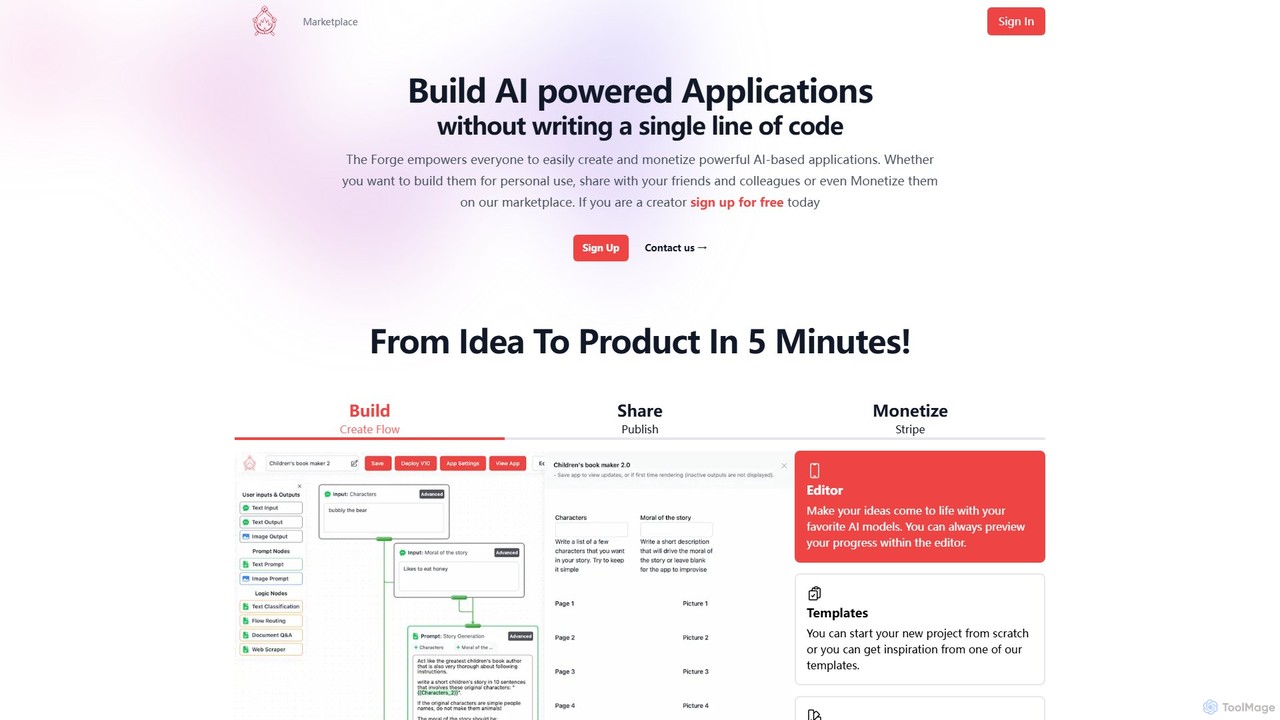
A no-code platform that empowers anyone to build, share, and monetize AI-powered applications. Turn your ideas into functional …
A no-code platform that empowers anyone to build, share, and monetize AI-powered applications. Turn your ideas into functional web apps, APIs, or embedded tools in minutes, and distribute them on a dedicated marketplace.
About Ai Applications
AI Applications are a diverse category of ready-to-use software and platforms that integrate artificial intelligence technologies to perform specific tasks and solve real-world problems. These tools leverage advanced AI models, such as natural language processing, computer vision, and machine learning, to automate complex processes, generate creative content, and provide intelligent insights. They empower individuals and businesses across various sectors to enhance productivity, streamline operations, and unlock new capabilities without requiring deep AI expertise.
Core Features
- Intelligent Automation: Automate repetitive tasks, workflows, and decision-making processes across various domains.
- Content Generation: Create high-quality text, images, audio, and video content based on user prompts and specifications.
- Data Analysis & Insights: Process large datasets to identify patterns, predict trends, and generate actionable business intelligence.
- Personalization: Tailor user experiences, recommendations, and communications based on individual preferences and behaviors.
- Enhanced Interaction: Facilitate natural language communication through sophisticated chatbots, virtual assistants, and voice interfaces.
Use Cases
AI Applications are widely adopted in various professional and personal contexts. For instance, marketing teams use them for automated content creation and targeted advertising, while customer service departments deploy AI chatbots for instant support. Educators utilize AI for personalized learning paths, and designers leverage AI for rapid concept generation and image editing.
How to Choose
Selecting the right AI Application involves evaluating several key factors. Consider the specific problem you need to solve and ensure the tool's core functionality aligns with your requirements. Assess its ease of integration with your existing software ecosystem, evaluate the pricing model against your budget, and review its scalability to accommodate future growth. Additionally, prioritize tools with robust data security and privacy features, and check for user-friendly interfaces that minimize the learning curve.

Ai ApplicationsUse Cases
Automated Content Creation for Marketing
Marketing professionals use AI applications to generate blog posts, social media updates, ad copy, and email newsletters. By inputting keywords and desired tones, they can quickly produce diverse content variations, significantly reducing the time spent on copywriting and ensuring consistent brand messaging across multiple platforms. This allows teams to scale their content output and maintain an active online presence with minimal effort.
Personalized Customer Support
Businesses deploy AI-powered chatbots and virtual assistants to provide instant, 24/7 customer support. These applications can understand natural language queries, answer frequently asked questions, guide users through troubleshooting steps, and even process simple transactions. This enhances customer satisfaction by offering immediate assistance and frees up human agents to handle more complex issues, improving overall service efficiency.
Data-Driven Business Intelligence
Data analysts and business leaders utilize AI applications to process vast amounts of data from sales, operations, and customer interactions. These tools can identify hidden trends, predict market shifts, and generate actionable insights through advanced machine learning algorithms. This enables more informed strategic decision-making, optimizes resource allocation, and helps businesses stay competitive by proactively responding to market dynamics.
Rapid Design Concept Generation
Graphic designers and artists leverage AI applications to quickly generate multiple design concepts, mood boards, and visual assets. By providing text prompts or reference images, they can explore various styles, layouts, and color palettes in minutes, accelerating the initial ideation phase of projects. This allows for faster iteration and experimentation, significantly boosting creative productivity and expanding design possibilities.
Efficient Code Generation & Development Assistance
Developers use AI applications as coding assistants to generate code snippets, suggest improvements, debug errors, and translate code between languages. These tools integrate directly into IDEs, providing real-time suggestions and automating repetitive coding tasks. This streamlines the development workflow, reduces coding errors, and allows developers to focus on more complex problem-solving and innovative features.
Personalized Learning & Education
Educators and students employ AI applications to create tailored learning experiences. These tools can adapt content difficulty, recommend resources, and provide instant feedback based on individual progress and learning styles. For students, it offers a personalized tutor experience, while for educators, it automates assessment and helps identify areas where students need additional support, making education more engaging and effective.