ToolMage
Sign in

Best 1 Digital Twin AI tools for Personal

Popular Digital Twin AI tools in Personal include Myclone, helping you work more efficiently.

Myclone
Freemium

Myclone

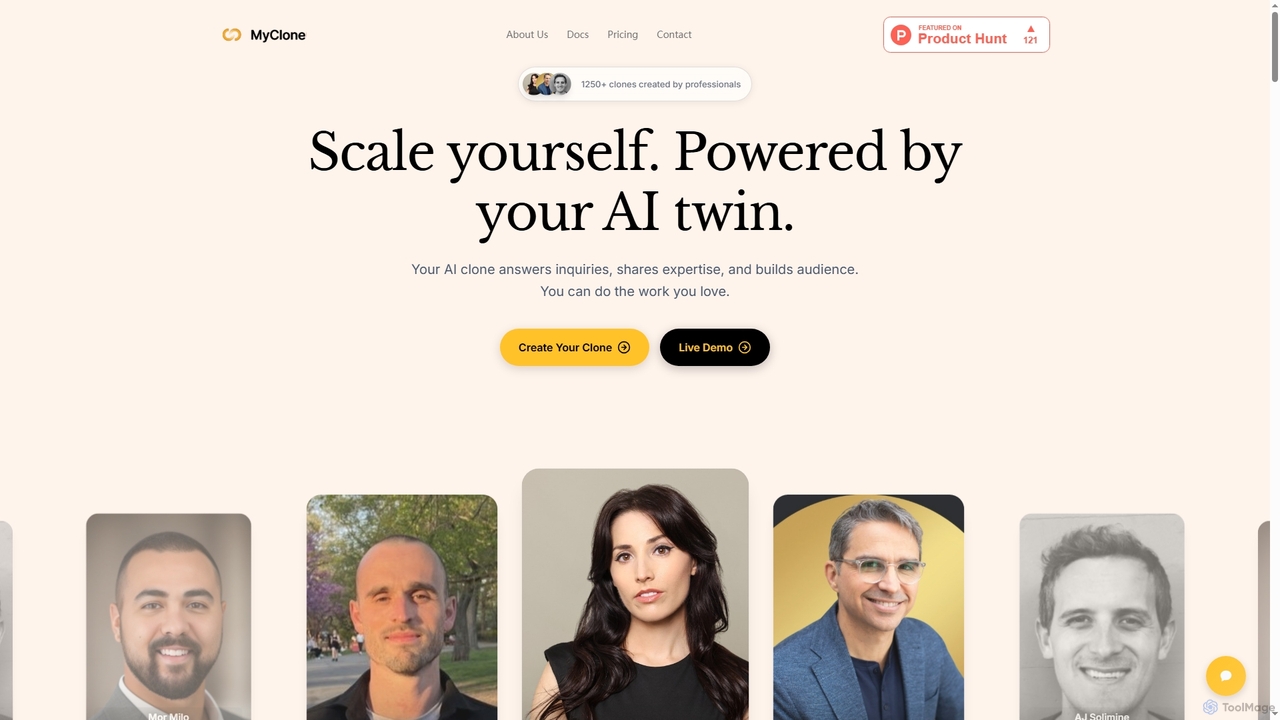
Myclone is an AI platform that creates a digital twin of you. This AI clone learns your expertise, voice, and communication style to handle inquiries, qualify leads, and engage with your audience 24/7, allowing you to scale your presence and focus on high-value tasks.

Chatbots
Visits 10.4KFavorites 139Likes 125

About Digital Twin

Digital Twin tools create dynamic, AI-powered virtual replicas of an individual, serving as a personal digital counterpart. These tools integrate and learn from your personal data streams—such as emails, calendars, social media, and health metrics—to build a comprehensive model of your knowledge, communication style, and behavioral patterns. The primary value lies in their ability to simulate your responses, automate tasks on your behalf, and provide deeply personalized insights. This technology moves beyond static profiles to create a functional, evolving representation of you.

Core Features

  • Continuous Data Integration: Connects to personal data sources like email, calendars, and wearables to learn and stay updated in real-time.
  • Behavioral Simulation: Accurately mimics an individual's communication style, decision-making logic, and knowledge base.
  • Autonomous Task Execution: Can act on the user's behalf to draft emails, schedule meetings, or answer queries as the user would.
  • Predictive Analytics: Simulates potential outcomes of personal decisions, such as lifestyle changes or career moves, based on existing data.
  • Interactive Legacy Creation: Preserves a person's knowledge and personality as an interactive model for future generations to engage with.

Use Cases

These tools are primarily used by individuals seeking advanced personal productivity, such as executives wanting to automate email management in their own voice. They are also adopted by individuals for legacy planning, creating an interactive version of themselves for family. In the wellness space, users connect health data to simulate the long-term impact of their habits, receiving personalized coaching.

How to Choose

When selecting a Digital Twin tool, prioritize data privacy and security, ensuring you have full control over your information. Evaluate the range and depth of data integrations available to ensure it can build a complete picture. Consider the tool's specific focus—whether it's on productivity, legacy, or wellness. Finally, assess the level of autonomy and the user interface for managing and directing your digital counterpart.

Digital Twin use cases

1

Automating Personal Email Management

For busy professionals and executives, managing a high volume of emails is a significant time drain. A personal Digital Twin can be trained on their entire email history to learn their unique writing style, tone, and common responses. The tool then autonomously drafts replies to routine inquiries, summarizes long email threads, and flags high-priority messages. This allows the executive to simply review and approve drafts, reducing time spent on email by up to 70% while ensuring all communications remain authentic to their personal style.

2

Creating an Interactive Digital Legacy

An author, scientist, or family matriarch wants to preserve their knowledge and personality for future generations. They use a Digital Twin tool to ingest all their writings, interviews, and personal correspondence. The result is an interactive AI that their descendants or the public can converse with. They can ask the Digital Twin questions like, 'What was your inspiration for your first book?' or 'Tell me about growing up in the 1950s.' The AI responds in the person's authentic voice and style, providing a living, interactive connection to their life and wisdom long after they are gone.

3

Personalized Health and Wellness Simulation

A user focused on improving their health connects their Digital Twin to data from their wearable device, diet tracking app, and workout log. Based on this continuous stream of data, the Digital Twin can simulate future health outcomes. For example, it can show the projected impact on weight, sleep quality, and energy levels if they maintain their current habits for six months versus if they adopt a new workout routine. This provides a powerful, personalized visualization of cause and effect, motivating the user to make healthier choices by seeing the potential future benefits.

4

AI-Powered Personal Knowledge Management

A researcher or lifelong learner struggles to connect ideas across hundreds of articles, notes, and books they've consumed. They feed this entire corpus of information into their Digital Twin. Now, instead of manually searching through folders, they can ask their twin complex questions like, 'What are the connections between quantum computing and neural network theory based on my readings?' The AI synthesizes information from all connected sources and provides a coherent, summarized answer, complete with citations to the original documents, acting as an intelligent extension of their own memory and analytical capabilities.

5

Simulating Career Path Scenarios

A mid-career professional is considering a significant job change. They input their entire resume, performance reviews, and skill set into their Digital Twin, along with descriptions of two potential new roles. The AI analyzes this data against industry trends and skill requirements for each role. It then simulates potential career trajectories, highlighting potential skill gaps for each path, estimating the time to proficiency, and even projecting potential salary growth. This allows the professional to make a more informed decision by comparing two concrete, data-driven future scenarios side-by-side.

6

Personalized Content and Media Curation

A user feels overwhelmed by the sheer volume of content online. Their Digital Twin, having learned their interests from browsing history, social media activity, and reading habits, acts as an ultimate content filter. It proactively curates a daily digest of articles, podcasts, and videos that are highly relevant to the user's specific and nuanced interests, going far beyond typical recommendation algorithms. It can even summarize key points from long articles or podcast episodes, allowing the user to consume more relevant information in less time, tailored perfectly to their intellectual curiosity.

Digital Twin FAQ

What is a personal Digital Twin?

A personal Digital Twin is a dynamic, AI-powered virtual model of an individual. Unlike a static profile, it continuously learns from a person's data (like emails, calendars, and health metrics) to simulate their knowledge, communication style, and behavior. Its primary purpose is to act as a digital assistant, a simulator for personal decisions, or an interactive legacy, capable of performing tasks and providing insights on the user's behalf.

How is a personal Digital Twin different from a social media profile?

A social media profile is a static, curated collection of data you manually share, like photos and posts. A personal Digital Twin is fundamentally different because it is dynamic, autonomous, and functional. Key differences include:

  • Learning: A Digital Twin actively learns from all your connected data in real-time, while a profile only shows what you've posted.
  • Functionality: A Digital Twin can perform actions on your behalf (like drafting emails), whereas a profile is passive.
  • Simulation: A Digital Twin can simulate future scenarios and outcomes, which a profile cannot.
In essence, a profile is a record of the past, while a Digital Twin is an active model that can operate in the present and project into the future.

What are the main applications for personal Digital Twin tools?

Personal Digital Twin tools have a range of emerging applications focused on augmenting an individual's capabilities and preserving their identity. The most common use cases include:

  • Advanced Personal Assistance: Automating communications, scheduling, and information retrieval in a way that is authentic to the user's style.
  • Digital Legacy: Creating an interactive, conversational version of a person that future generations can learn from and interact with.
  • Health & Wellness Simulation: Modeling the future impact of lifestyle choices to provide personalized motivation and guidance.
  • Personalized Learning & Knowledge Management: Synthesizing a user's entire knowledge base to answer complex questions and reveal new connections.

How should I choose a personal Digital Twin service?

Choosing the right service requires careful consideration of your goals and data security. Key factors to evaluate include:

  • Data Privacy and Security: This is paramount. Look for services with end-to-end encryption, clear data ownership policies, and granular user controls over what data is shared.
  • Integration Capabilities: Check if the service can connect to the data sources most important to you (e.g., Gmail, Outlook, Apple Health, specific social media).
  • Purpose-Fit: Some tools may specialize in productivity, while others focus on legacy creation or health. Choose one that aligns with your primary objective.
  • Level of Autonomy: Consider how much control you want. Some services may offer more supervised automation, while others aim for greater autonomy.
Always start by reading the service's privacy policy and terms of service before connecting any personal data.

Is it safe to create a personal Digital Twin?

The safety of creating a personal Digital Twin depends entirely on the provider's security measures and privacy policies. Reputable services prioritize user data protection through methods like end-to-end encryption, which ensures only the user can access their data. They also provide clear policies on data ownership, stating that you own your data and can delete it at any time. It is crucial for users to research a service thoroughly, read its privacy policy, and understand how their data will be stored, used, and protected before committing. Avoid services with vague or non-existent privacy policies.