ToolMage
Sign in

Best 1 Guidance AI tools for Personal

Popular Guidance AI tools in Personal include Afreetarot, helping you work more efficiently.

Afreetarot
Free

Afreetarot

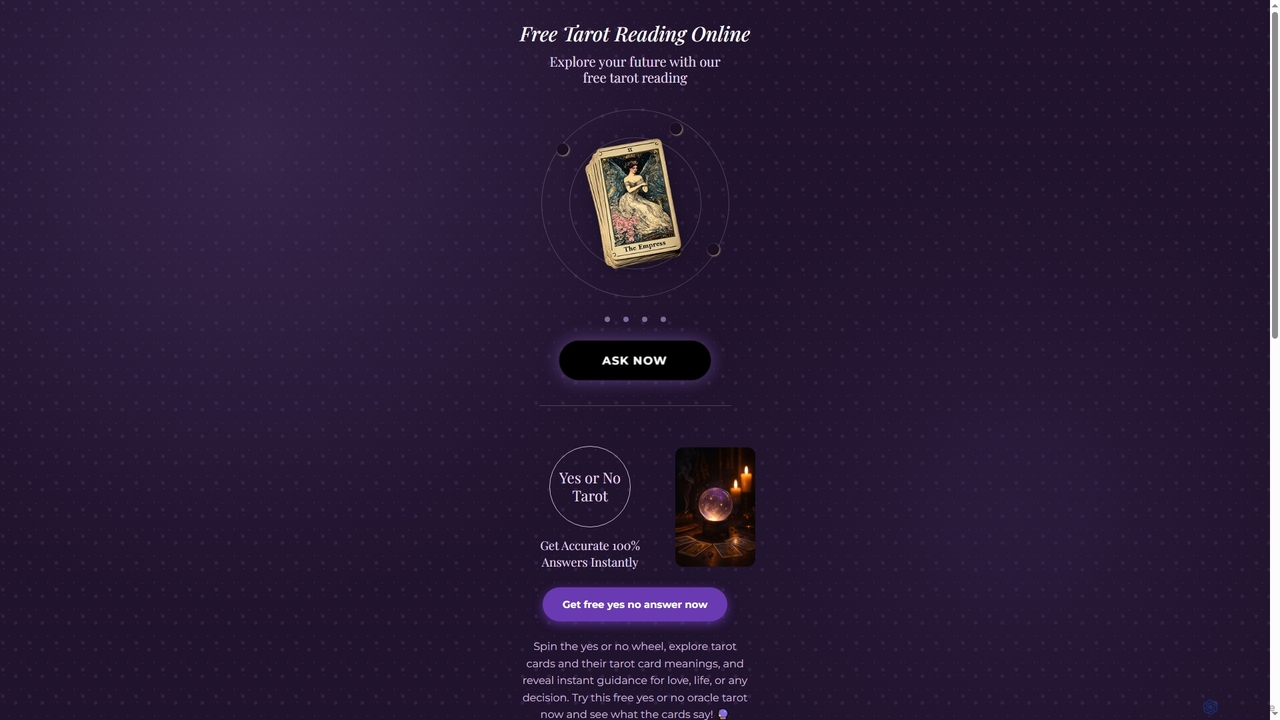
Afreetarot is a free online platform for instant, personalized tarot card readings. It offers guidance on love, career, and life decisions through various readings, including a Yes or No oracle and specialized Love Tarot. No prior knowledge of tarot is needed to get clear answers.

Divination
Visits 6.8KFavorites 106Likes 126

About Guidance

AI Guidance tools are a class of applications designed to provide personalized advice, mentorship, and step-by-step plans for personal development. Leveraging machine learning models, these tools analyze user goals, preferences, and progress to offer tailored recommendations and actionable insights. They serve as digital coaches, helping users navigate complex decisions, acquire new skills, or build positive habits. Unlike generic productivity apps, AI Guidance tools focus on the 'why' and 'how' behind personal growth, offering structured pathways to achieve specific outcomes.

Core Features

  • Personalized Roadmaps: Generates custom plans and step-by-step actions for career, learning, or wellness goals.
  • AI-Powered Recommendations: Suggests relevant resources, courses, and strategies based on user profiles and progress.
  • Interactive Feedback Loop: Provides real-time feedback, motivational prompts, and plan adjustments to keep users on track.
  • Decision Support Frameworks: Offers structured analysis for complex choices, such as pros and cons or risk assessment.
  • Progress Tracking & Analytics: Visualizes achievements, tracks key metrics, and identifies areas for improvement.

Use Cases

These tools are ideal for individuals at a career crossroads, students planning their academic path, or anyone seeking to build new habits in fitness or finance. Professionals use them for continuous skill enhancement, while entrepreneurs might leverage them for strategic decision-making and maintaining a work-life balance.

How to Choose

When selecting an AI Guidance tool, consider its area of specialization (e.g., career, finance, wellness). Evaluate the depth of personalization and the underlying methodology (e.g., based on cognitive science or data analytics). Also, carefully review its data privacy policy, user interface design, and its ability to integrate with other personal apps like calendars or trackers.

Guidance use cases

1

Plan a Career Transition

For a marketing professional feeling stagnant, an AI Guidance tool can map a transition into data science. The user inputs their current skills, interests, and career goals. The AI analyzes job market trends and identifies skill gaps, then generates a personalized learning roadmap with recommended online courses, books, and projects. It provides weekly check-ins and adjusts the plan based on progress, simulating a career coach's role and providing a clear, actionable path to a new profession.

2

Planning a Career Transition

A mid-level marketing professional feeling stagnant in their role uses an AI Guidance tool to explore a transition into data analytics. They input their current skills, career goals, and interests. The AI analyzes this data and generates a personalized roadmap. This plan includes:

  • Identifying key skill gaps, such as SQL and Python.
  • Recommending specific online courses and certifications.
  • Creating a 6-month project plan to build a portfolio.
  • Suggesting networking strategies within the target industry.
The tool acts as a 24/7 career coach, breaking down a daunting career change into a structured, actionable process, boosting the user's confidence and clarity.

3

Creating a Personal Financial Plan

A user wants to save for a down payment on a house within three years but doesn't know where to start. They use an AI Guidance tool focused on personal finance. The tool prompts them to securely link their bank accounts and input their savings goal and timeline. Based on their income and spending patterns, the AI crafts a detailed plan. It automatically categorizes expenses, identifies areas for potential savings (e.g., subscriptions, dining out), and suggests a monthly savings target. It also provides guidance on opening a high-yield savings account and sets up weekly check-ins to track progress and adjust the plan if needed.

4

Build a Consistent Fitness Habit

An individual struggling to maintain a regular exercise routine can use an AI Guidance tool as a digital fitness coach. The tool assesses current fitness levels, preferences (e.g., home vs. gym), and time availability. It then creates a dynamic workout plan that adapts daily based on user feedback and energy levels. By providing motivational prompts, tracking streaks, and offering advice on overcoming plateaus, it helps build long-term consistency and accountability, making fitness a sustainable part of their lifestyle.

5

Master a New Language for Travel

A user planning a trip to Japan wants to learn conversational Japanese. The AI Guidance tool designs a structured learning path, breaking the process into manageable daily tasks. It recommends specific learning apps, YouTube channels, and practice exercises tailored to a beginner's level. The tool tracks vocabulary acquisition and conversational practice, offering personalized quizzes and feedback to reinforce learning and ensure the user is travel-ready by their departure date, acting as a personalized language tutor.

6

Mastering a New Skill with a Learning Roadmap

A graphic designer wants to learn 3D modeling to expand their services but finds the topic overwhelming. They turn to an AI Guidance tool for skill acquisition. After selecting '3D Modeling' as their goal, the AI assesses their current knowledge level (beginner). It then generates a 12-week structured learning path, breaking the skill down into modules like 'Introduction to Blender Interface', 'Polygon Modeling Basics', 'Texturing and Shading', and 'Lighting and Rendering'. Each week includes curated video tutorials, practical exercises, and a small project to complete. The tool tracks their completion rate and offers quizzes to reinforce learning, acting as a personal tutor that structures the entire learning journey.

7

Building and Maintaining Healthy Habits

A user wants to establish a consistent morning routine that includes exercise, meditation, and reading, but struggles with consistency. They use an AI Guidance tool for habit formation. The tool helps them design a realistic routine, starting small (e.g., 10 minutes of exercise instead of 60). It integrates with their calendar to schedule these activities and sends personalized reminders. The AI provides motivational messages based on their progress and offers advice when they miss a day, suggesting strategies to get back on track instead of giving up. Over time, it helps them gradually increase the duration and complexity of their habits, ensuring sustainable change.

8

Improve Personal Financial Literacy

A recent graduate looking to manage their finances effectively uses an AI Guidance tool. The AI analyzes spending habits and helps set realistic budget goals. It provides personalized guidance on saving, investing basics, and debt management strategies. The tool acts as a financial mentor, explaining complex concepts in simple terms and offering actionable tips to build a strong financial foundation without the high cost of a human advisor, empowering the user to make smarter financial decisions.

9

Enhance Productivity with Mindfulness

A busy entrepreneur experiencing burnout turns to an AI Guidance tool focused on mental wellness. The tool provides guided mindfulness exercises and meditation sessions to reduce stress. It helps the user identify productivity-draining habits through interactive journaling and pattern analysis. Based on this data, it suggests personalized strategies, such as the Pomodoro Technique or time-blocking, integrating wellness practices directly into the daily work schedule to foster a sustainable and focused workflow.

10

Improving Public Speaking and Communication Skills

A project manager needs to improve their presentation skills for client meetings. They use an AI Guidance tool that functions as a communication coach. The user can upload a script or record themselves practicing a speech. The AI analyzes their delivery, providing instant feedback on:

  • Pacing and speaking rate.
  • Use of filler words like 'um' and 'ah'.
  • Clarity of speech and tone of voice.
  • Body language and eye contact (if using video).
The tool offers targeted exercises to address weak points, such as breathing exercises to control pace or drills to reduce filler words. This allows for private, iterative practice with objective feedback, building confidence before important presentations.

11

Structuring a Complex Personal Project

An author planning to write their first novel feels overwhelmed by the scope of the project. They use an AI Guidance tool to structure the entire process. The AI helps them break down the project into key phases: 'Concept & Outline', 'First Draft', 'Revision', and 'Editing'. Within each phase, it suggests specific, actionable tasks, such as 'Develop main character profiles', 'Write 1,000 words daily', or 'Complete a chapter-by-chapter review'. The tool can also help set realistic deadlines for each phase and track word count progress. By transforming a massive creative endeavor into a structured project plan, the AI acts as a project manager, keeping the author focused and on track.

12

Navigate Complex Academic Decisions

A high school student choosing a university and major uses an AI Guidance tool for decision support. The student inputs their academic records, extracurricular activities, and personal interests. The AI cross-references this with data on universities, program requirements, and future career prospects. It presents a shortlist of suitable options, complete with pros and cons, potential career paths, and estimated return on investment, helping the student and their family make a well-informed decision about their future.

Guidance FAQ

What are AI Guidance tools?

AI Guidance tools are applications designed to act as personalized digital mentors. They use artificial intelligence to provide users with structured, actionable advice and step-by-step plans to achieve specific goals. Unlike simple task managers, these tools actively help you strategize and navigate challenges in areas like career development, financial planning, skill acquisition, and personal wellness. They analyze your unique situation and goals to create a customized roadmap, breaking down large ambitions into manageable daily or weekly tasks.

What are AI Guidance tools?

AI Guidance tools are applications that use artificial intelligence to offer personalized advice, plans, and support for personal or professional development. They act like digital mentors or coaches, analyzing your goals and data to create customized roadmaps for learning, career changes, or habit formation. Unlike passive content, they provide interactive feedback and adapt to your progress over time.

How do I choose the right AI Guidance tool?

Choosing the right AI Guidance tool depends on your specific needs. Consider these factors:

  • Specialization: Does the tool focus on your goal area, such as career coaching, financial planning, fitness, or skill learning? A specialized tool often provides more nuanced advice.
  • Personalization Level: How well does the tool adapt to your personal data and progress? Look for features that allow for deep customization and dynamic adjustments.
  • Data Privacy: Since you'll be sharing personal information, review the tool's privacy policy and security measures to ensure your data is protected.
  • User Experience: The interface should be intuitive and motivating. A tool you enjoy using is one you're more likely to stick with.
Start by identifying your primary goal, then look for a tool that excels in that specific domain and aligns with your preferences for interaction and data security.

How do I choose the right AI Guidance tool?

To choose the right tool, first identify your primary goal (e.g., career, fitness, finance). Then, consider these key factors:

  • Specialization: Does the tool focus on your specific area of need?
  • Methodology: Is its advice based on data science, psychological principles, or expert knowledge?
  • Personalization: How well does it adapt to your unique inputs and progress?
  • Data Privacy: Ensure it has a clear and strong policy for protecting your sensitive personal data.
What is the difference between AI Guidance and a productivity app?

The key difference lies in their focus. Productivity apps (like to-do lists or calendars) help you manage tasks and time—the 'what' and 'when'. AI Guidance tools focus on the 'why' and 'how'. They help you set the right goals, create a strategic plan to achieve them, and provide expert-like advice along the way. A productivity app manages your daily execution, while a guidance tool shapes your long-term direction.

What's the difference between AI Guidance and a standard productivity app?

The key difference lies in proactivity and intelligence. A standard productivity app, like a to-do list or calendar, is a passive tool that requires you to input and organize your own tasks and plans. It helps you manage what you've already decided to do. In contrast, an AI Guidance tool is an active partner. It helps you strategize *what* to do and *how* to do it. It analyzes your goals, suggests a plan, breaks it down into steps, and adapts based on your progress. Essentially, productivity apps help you execute a plan, while AI Guidance tools help you create and navigate the plan itself.

Can AI Guidance tools replace human mentors or coaches?

AI Guidance tools are best viewed as powerful supplements, not replacements, for human mentors. They offer 24/7 accessibility, data-driven insights, and structured planning at a lower cost. However, they lack the nuanced understanding, emotional intelligence, and real-world experience of a human coach. They are excellent for building foundational plans and maintaining consistency, while human mentors excel at providing deep, contextual advice and networking opportunities.

Is the advice from AI Guidance tools reliable?

The reliability of advice from AI Guidance tools varies. Reputable tools are often built on large datasets, expert-curated knowledge bases, and established principles in their respective fields (e.g., financial planning best practices or proven learning methodologies). They can provide excellent, data-driven suggestions and structure. However, it's crucial to remember that they are not a substitute for certified human professionals, especially for critical decisions in health, finance, or legal matters. It is best to use these tools as a powerful assistant to help structure your thinking and planning, but always apply your own judgment and consult a human expert when stakes are high.

Who can benefit most from using AI Guidance tools?

AI Guidance tools are beneficial for a wide range of individuals, but they are particularly valuable for:

  • Self-starters and Lifelong Learners: People who are motivated to improve but need structure and a clear path to follow.
  • Young Professionals: Individuals navigating early career decisions, seeking promotions, or looking to build new skills.
  • Individuals Facing Complex Decisions: Anyone planning a major life change, such as a career transition, financial goal, or personal project, who would benefit from a structured approach.
  • People on a Budget: Those who want access to coaching or expert-level guidance without the high cost of a personal human coach or consultant.
Essentially, anyone who wants to turn an abstract goal into a concrete, actionable plan can find significant value in these tools.

Who are AI Guidance tools best suited for?

These tools are ideal for self-motivated individuals seeking structure and direction for their personal growth. This includes students planning their future, professionals considering a career change, and anyone looking to build positive habits in areas like health or finance. They are particularly useful for those who want expert-level guidance but may not have access to or the budget for a personal coach, providing an accessible first step towards structured self-improvement.