Rentoor
Rentoor is an AI-powered photo enhancement tool designed to restore old, blurry, and low-quality face photos. It uses …
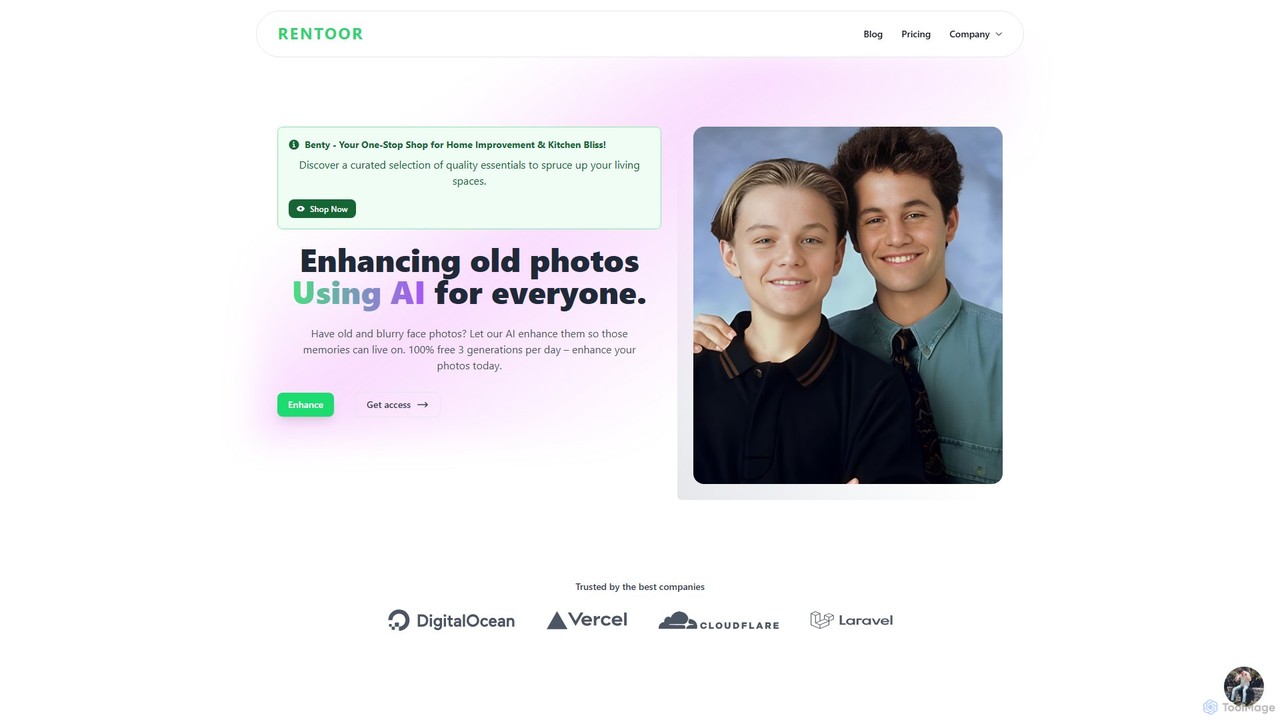
Rentoor is an AI-powered photo enhancement tool designed to restore old, blurry, and low-quality face photos. It uses advanced algorithms for super-resolution, noise reduction, and sharpening to bring clarity and life back to your cherished memories. With a generous free plan, anyone can easily enhance their photos and see the stunning results in seconds.
About Memories
AI Memories tools are a class of personal applications designed to capture, organize, and interact with your life experiences in a dynamic way. They utilize artificial intelligence, particularly natural language processing (NLP) and machine learning, to analyze and connect your photos, notes, voice recordings, and other digital inputs. The primary value of these tools is transforming a static archive into a searchable, interactive personal database, allowing you to rediscover insights, preserve your legacy, and explore your personal history conversationally. They go beyond simple storage by creating meaningful connections within your data.
Core Features
- Conversational Interface: Interact with your memories through a chat-like interface, asking questions about past events or people.
- Semantic Search: Find information based on concepts, emotions, or themes, not just exact keywords.
- Automatic Tagging & Organization: AI automatically categorizes and links related entries, photos, and notes to build a coherent timeline.
- Data Synthesis: Combines various data points (e.g., a photo, a calendar event, a journal entry) to create rich, contextual narratives.
- Digital Legacy Creation: Enables the preservation of your life story in an interactive format for future generations.
Use Cases
These tools are ideal for individuals focused on personal reflection, such as journal writers, biographers, and family historians. They are also used by professionals who need to recall vast amounts of personal interaction details, like therapists or coaches. Families use them to collaboratively build and preserve a shared history, creating a digital heirloom.
How to Choose
When selecting an AI Memories tool, first consider its privacy and security policies, as you'll be entrusting it with sensitive personal data. Evaluate the types of data it can import (text, audio, images) and the quality of its search and conversational features. Also, check the data export options to ensure you are not locked into one platform. Finally, compare pricing models, whether it's a one-time purchase or a subscription based on storage amount.

MemoriesUse Cases
Creating an Interactive Digital Biography
A writer or family member can use an AI Memories tool to document a person's life story. By uploading old letters, photos, and recording audio interviews, the AI organizes this content chronologically and thematically. The user can then ask specific questions like, 'What were grandpa's thoughts on moving to a new city?' The tool synthesizes information from various sources to provide a comprehensive, narrative answer, turning a collection of files into a living, interactive biography that can be explored by future generations.
Journaling with AI-Powered Insights
An individual who journals regularly can use an AI Memories tool to gain deeper self-understanding. As they input daily thoughts, feelings, and events, the AI identifies recurring themes, emotional patterns, and connections between different life areas. For example, the user could ask, 'When do I typically feel most productive?' The AI would analyze past entries related to work, mood, and activities to provide data-driven insights, helping the user understand their personal triggers and optimize their routines for better well-being.
Preserving Family History and Stories
A family can create a collaborative digital archive. Different members can contribute photos from various decades, scan old documents, and record voice notes of elders recounting family tales. The AI tool acts as a central hub, automatically organizing submissions and creating connections. A younger family member could later ask, 'Tell me the story of how our family came to this country,' and the AI would compile a narrative using the recorded stories, document dates, and photo captions, preserving the collective family memory in an accessible and engaging format.
Building a Personal Knowledge Base
A lifelong learner or researcher can use an AI Memories tool as a 'second brain'. They can save articles, voice memos with fleeting thoughts, and notes from books or meetings. Instead of relying on a folder structure, they can later ask complex questions like, 'What are the connections between my notes on stoicism and project management?' The AI's semantic search capabilities would surface relevant concepts from different sources and times, revealing non-obvious connections and fostering creative insights that would be difficult to find with traditional note-taking apps.
Augmenting Recall for Professionals
A therapist, coach, or consultant who interacts with many clients can use an AI Memories tool to privately log key details from each session. Before a follow-up meeting, they could ask, 'Summarize my last three conversations with Client X, focusing on their stated goals.' The AI would provide a concise summary, refreshing their memory on crucial details and ensuring continuity of care. This enhances their professional effectiveness by allowing them to recall specific nuances of past interactions accurately and efficiently, without manually sifting through pages of notes.
Creating a Digital Twin for Legacy
An individual looking to preserve their essence for future generations can create a 'digital twin'. Over years, they feed the AI tool with their journals, emails, voice recordings, and opinions on various subjects. After their passing, family members can interact with this digital representation. They could ask, 'What advice would grandma have given me about starting a business?' The AI, trained on her lifetime of data, could generate a response consistent with her personality, values, and known thought processes, offering a unique way to connect with and learn from a loved one's wisdom.