Personal Best in category 1 results Study AI Tool

Popular AI tools in the Study field of Personal include flashcard_generator, etc., helping you quickly improve efficiency.

flashcard_generator

flashcard_generator

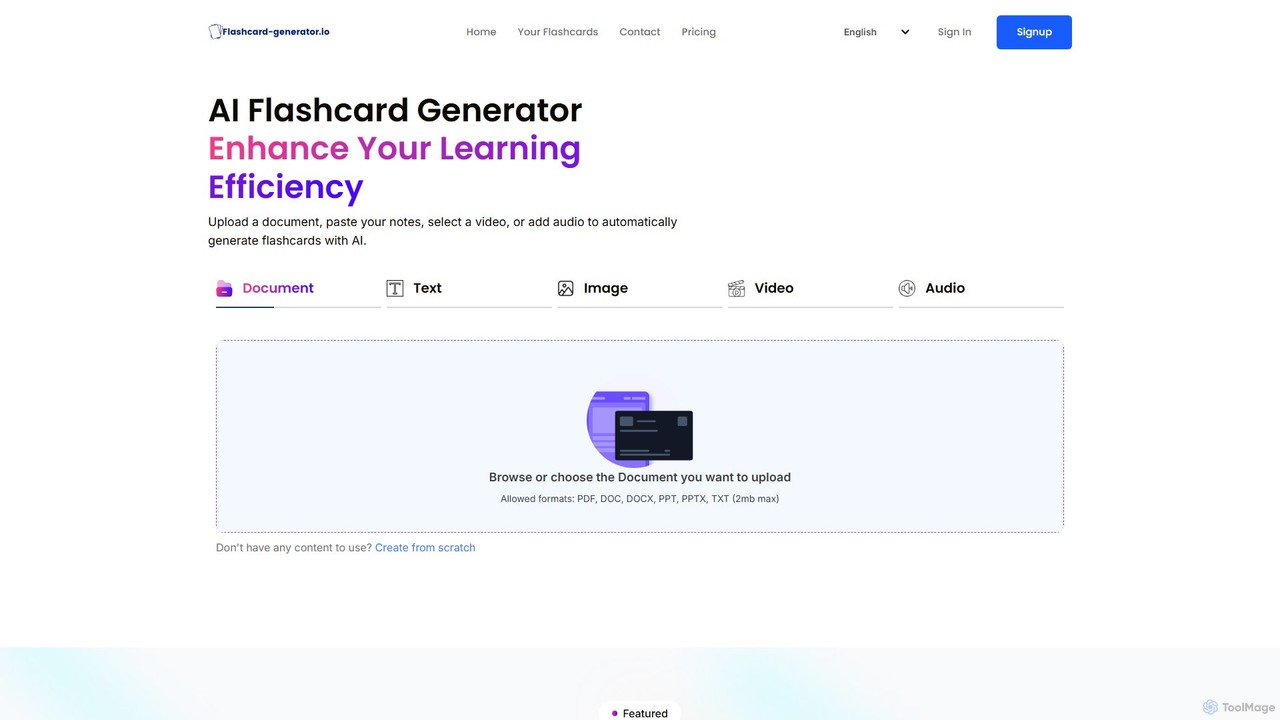
An AI-powered tool that automatically creates flashcards from various sources like documents, text, images, videos, and audio. It's …

3.5K

About Study

AI Study tools are a specialized category of personal AI assistants designed to optimize learning processes and enhance knowledge retention. They leverage natural language processing (NLP) and machine learning to analyze educational materials, automatically summarize complex texts, and generate interactive learning aids. These tools help students, professionals, and lifelong learners to grasp difficult concepts more quickly, prepare for exams efficiently, and manage study materials with greater organization. Many also offer features like AI-powered tutoring and concept clarification to provide personalized learning support.

Core Features

  • Automated Summarization: Condenses lengthy documents, articles, or lecture notes into concise summaries, highlighting key points.
  • Interactive Quiz Generation: Creates practice questions, multiple-choice tests, and flashcards directly from your study materials.
  • AI-Powered Tutoring: Explains complex concepts in simple terms and answers specific questions about the provided content.
  • Research Assistance: Helps find, organize, and extract key information from academic papers and other sources.
  • Note Structuring: Automatically organizes unstructured notes into coherent outlines and mind maps.

Use Cases

These tools are widely used by university students preparing for exams, professionals undertaking certification courses, and researchers conducting literature reviews. For instance, a medical student can upload a dense textbook chapter to generate flashcards for key terminology, while a software developer can use an AI tutor to understand complex code libraries for a new project.

How to Choose

When selecting an AI Study tool, consider the types of content it supports (PDF, URL, text, audio). Evaluate the depth of its features—do you need simple summarization or interactive, AI-driven tutoring? Also, check for integrations with note-taking apps like Notion or Obsidian, and compare the pricing models based on your expected usage volume.

StudyUse Cases

1

Efficient Exam Preparation for University Students

A university student facing final exams can upload lecture notes, textbook PDFs, and research papers into an AI Study tool. The tool automatically generates concise summaries for quick review, creates flashcards for key terms and concepts, and produces practice quizzes to test understanding. This process allows the student to identify knowledge gaps and focus their revision efforts effectively, saving dozens of hours of manual note-taking and quiz creation. The result is a more structured and efficient study routine, leading to better retention and higher exam scores.

2

Mastering New Skills for Professional Development

A professional aiming to learn a new technical skill, such as a programming language or a data analysis framework, can use an AI Study tool as a personalized tutor. By providing documentation or online tutorials as source material, they can ask the AI specific questions like 'Explain this function with an analogy' or 'Generate a simple code example for this concept.' This interactive approach accelerates the learning curve, provides instant clarification on complex topics, and helps build practical, applicable knowledge faster than passive reading or watching videos alone.

3

Streamlining Academic Research and Literature Reviews

A graduate researcher working on a thesis can use an AI Study tool to manage and synthesize dozens of academic papers. After uploading the papers, the tool can extract key hypotheses, methodologies, and findings from each source. The researcher can then ask comparative questions like 'Which papers support this theory?' or 'Summarize the counterarguments to this finding.' This transforms the literature review process from a manual, time-consuming task into a dynamic, analytical dialogue, enabling deeper insights and a more comprehensive understanding of the research landscape.

4

Interactive Language Learning Practice

A language learner can use an AI Study tool to supplement their traditional studies. By feeding it articles or dialogues in the target language, they can ask for translations of specific phrases, explanations of grammatical rules in context, or even engage in a practice conversation. The AI can act as a patient, always-available conversation partner, correcting mistakes and suggesting more natural phrasing. This provides a safe environment to practice and build confidence, which is crucial for developing fluency.

5

Simplifying Complex Topics for Lifelong Learners

An individual curious about a complex subject like astrophysics or philosophy can use an AI Study tool to make it more accessible. They can input a dense article or book chapter and ask the tool to 'explain this to me like I'm a high school student' or 'create a timeline of these key events.' The tool breaks down intimidating walls of text and jargon into digestible concepts, fostering curiosity and enabling self-directed learning on virtually any topic without the need for formal enrollment in a course.

6

Creating Engaging Corporate Training Materials

A corporate trainer or Learning & Development specialist can use an AI Study tool to accelerate the creation of training content. By providing source documents like policy manuals or technical specifications, the AI can generate a structured course outline, key learning objectives, and a set of assessment questions. This significantly reduces content development time, ensures accuracy and consistency with the source material, and allows the trainer to focus on delivering a more engaging and interactive learning experience for employees.

StudyFrequently Asked Questions