
nuraaihealthscreening
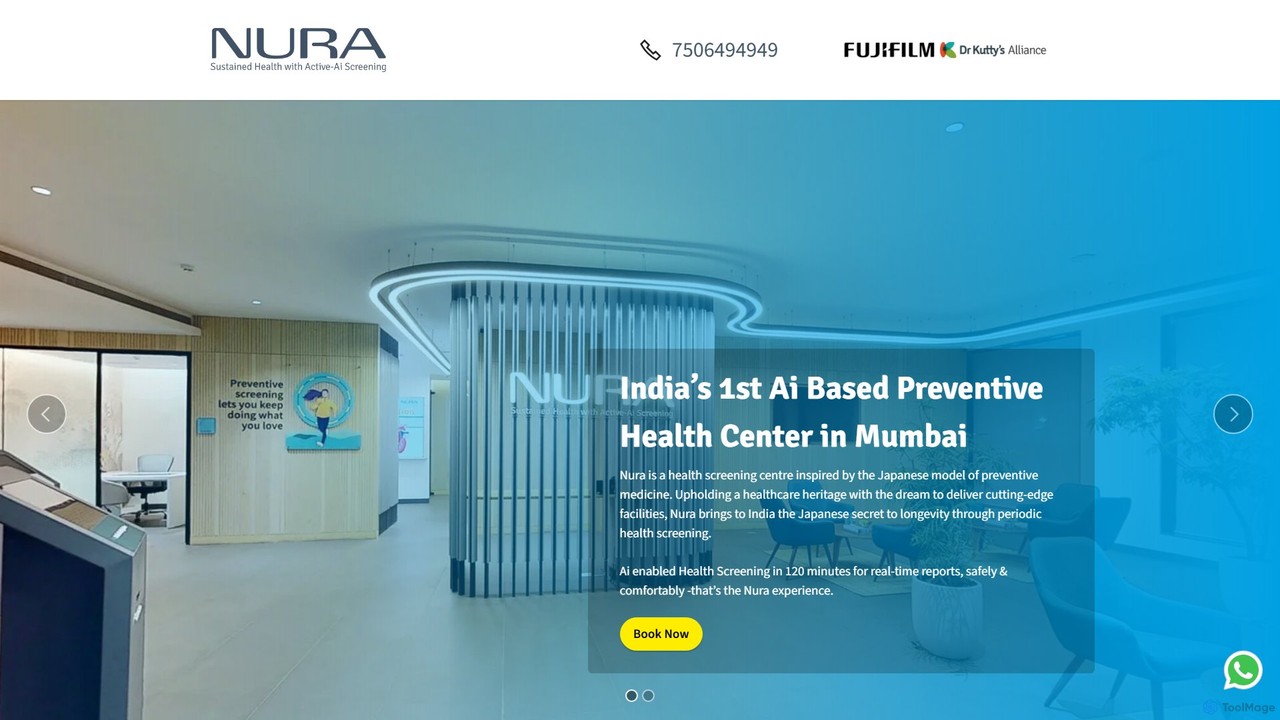
Nura provides advanced AI-powered health screening services in India. Utilizing ultra-low-dose CT scans and AI-enhanced image analysis, Nura …
Nura provides advanced AI-powered health screening services in India. Utilizing ultra-low-dose CT scans and AI-enhanced image analysis, Nura offers comprehensive, rapid, and safe detection of early-stage cancers, heart conditions, and lifestyle diseases. The entire process, from screening to a doctor's consultation, is completed within 120 minutes, focusing on preventive care and early diagnosis with minimal radiation exposure.
About Image Analysis
Image Analysis tools are a class of AI applications designed to interpret and understand visual content, extracting meaningful information from pixels. These tools leverage computer vision and deep learning models to identify objects, people, text, and scenes within an image. Their primary value lies in automating tasks that traditionally require human visual inspection, enabling scalable data extraction and pattern recognition. This technology transforms static images into structured, searchable data for analysis and decision-making.
Core Features
- Object Detection: Identifies and locates specific items within an image, often drawing bounding boxes around them.
- Facial Recognition & Analysis: Detects human faces, identifies individuals, and can analyze attributes like emotion or age.
- Optical Character Recognition (OCR): Extracts printed or handwritten text from images, converting it into machine-readable text.
- Image Tagging & Categorization: Automatically generates descriptive keywords and classifies images based on their content.
- Scene Understanding: Provides a high-level description of the context, setting, and activities depicted in an image.
Applicable Scenarios
Image Analysis is critical in various sectors. In healthcare, it assists radiologists by highlighting anomalies in medical scans like X-rays and MRIs. Retailers use it for automated inventory management by analyzing shelf photos. In security, it powers surveillance systems for threat detection. The automotive industry also relies on it for developing self-driving car perception systems.
Selection Criteria
When choosing an Image Analysis tool, consider the model's accuracy and specialization for your specific domain (e.g., medical vs. general). Evaluate its API accessibility and ease of integration into existing workflows. Assess processing speed and scalability for your expected volume. Finally, review data privacy and security policies, especially when handling sensitive visual information.
Image AnalysisUse Cases
Automated Retail Inventory Management
A retail operations manager can use an Image Analysis tool to streamline stock counting. Instead of manual checks, staff can take photos of shelves. The AI processes these images to identify each product, count the units, and compare the data against inventory records. This system can automatically flag low-stock items for reordering and identify misplaced products, significantly reducing labor hours and improving inventory accuracy by over 95%.
Medical Imaging Diagnosis Assistance
Radiologists and medical professionals can leverage AI Image Analysis to enhance diagnostic accuracy. When analyzing medical scans like MRIs, CT scans, or X-rays, the AI can act as a second pair of eyes. It is trained to detect subtle patterns, anomalies, or potential tumors that might be missed by the human eye. The tool highlights areas of interest for the specialist's review, speeding up the diagnostic process and potentially improving early detection rates for critical conditions.
Automated Insurance Claim Processing
Insurance adjusters can accelerate vehicle damage assessment using Image Analysis. Customers can upload photos of their damaged vehicle after an accident. The AI analyzes these images to identify the parts affected, classify the severity of the damage (e.g., scratch, dent, break), and provide an initial repair cost estimate. This automates the initial assessment, reduces the need for immediate on-site inspections, speeds up claim processing times, and helps in detecting fraudulent claims by flagging inconsistencies.
Social Media Content Moderation
Social media platforms and online communities can deploy Image Analysis tools to maintain a safe environment. The AI automatically scans all uploaded images in real-time to detect and flag inappropriate content, such as violence, hate symbols, or adult material, based on community guidelines. This allows moderation teams to focus on nuanced cases rather than manually reviewing every single image, enabling content moderation at a massive scale and ensuring a faster response to policy violations.
Manufacturing Quality Control Inspection
A quality control engineer in a manufacturing plant can use high-speed cameras paired with an Image Analysis system to automate product inspection. As products move along a conveyor belt, the system captures images and analyzes them in milliseconds to detect defects like cracks, scratches, or misaligned components. Any defective item is automatically flagged or removed from the line. This process provides consistent, 24/7 quality monitoring, improves defect detection rates, and reduces waste compared to manual inspection.
Organizing Digital Asset Libraries
Marketing teams and media companies with vast libraries of images can use Image Analysis for efficient digital asset management (DAM). When a new image is uploaded, the AI automatically analyzes its content and generates relevant tags (e.g., 'sunset', 'beach', 'person smiling', 'laptop'). This eliminates the need for manual tagging, making the entire library instantly searchable. A content creator can quickly find the perfect image for a campaign by searching for specific objects or concepts, saving hours of manual browsing.