
CarBeast
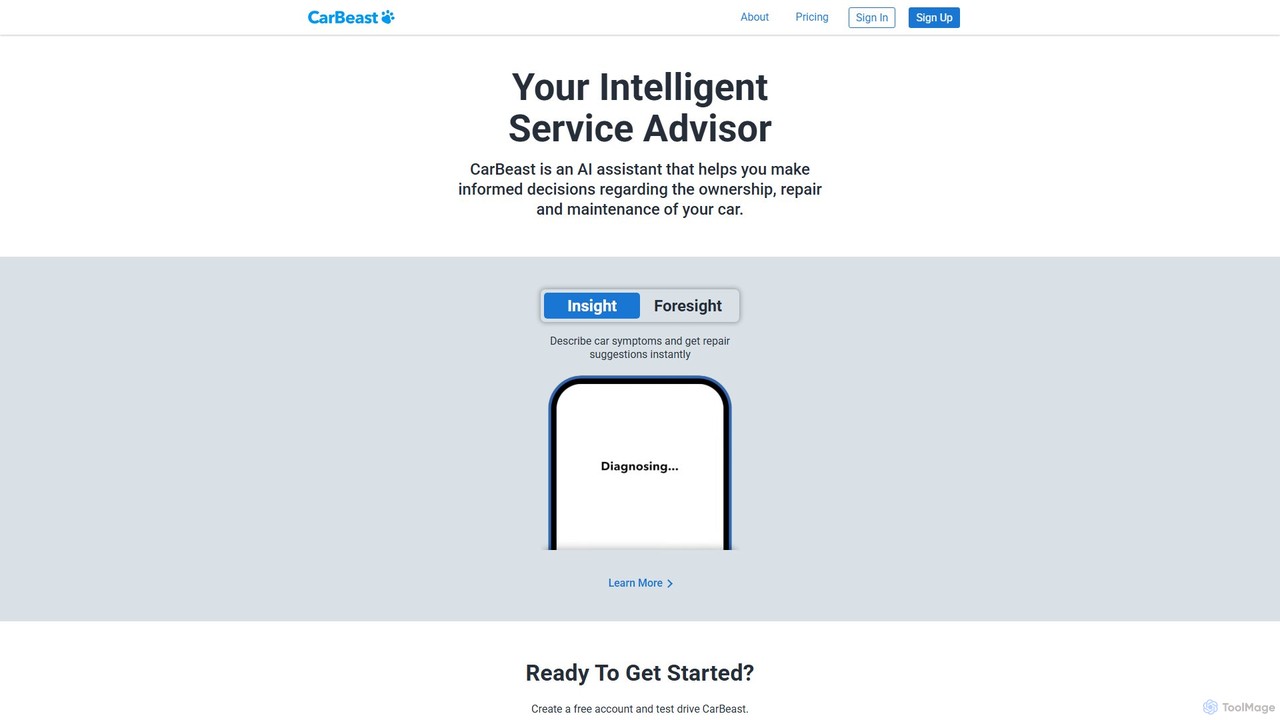
CarBeast is an AI-powered intelligent service advisor for car owners. It helps you diagnose vehicle problems, get repair …
CarBeast is an AI-powered intelligent service advisor for car owners. It helps you diagnose vehicle problems, get repair suggestions and cost estimates, and forecast future maintenance needs. By analyzing millions of repair records, CarBeast empowers you to make informed decisions about your car's health and save money on repairs.
About Diagnostics
AI Diagnostics tools are a class of software that uses machine learning to analyze complex data, identify anomalies, and determine the root causes of problems. These tools employ advanced algorithms to recognize patterns and deviations that are often invisible to human analysis, processing vast amounts of information with high speed and accuracy. Their primary value is in converting raw data into actionable insights for predictive maintenance, system optimization, and rapid troubleshooting. They are specifically focused on answering 'what is wrong?' or 'what might fail?' across various domains.
Core Features
- Anomaly Detection: Automatically identifies unusual patterns or outliers in data that do not conform to expected behavior.
- Root Cause Analysis (RCA): Traces symptoms back to their origin, pinpointing the fundamental reason for a failure or issue.
- Predictive Analysis: Forecasts potential future failures or events based on historical and real-time data patterns.
- Pattern Recognition: Discovers meaningful trends, correlations, and clusters within large and complex datasets.
- Symptom Correlation: Maps observed symptoms and error codes to a ranked list of probable underlying problems.
Use Cases
AI Diagnostics tools are widely used in sectors requiring high reliability and proactive problem-solving. In IT operations (AIOps), they predict server failures and network outages. In manufacturing, they are used for quality control by detecting product defects on assembly lines. Healthcare professionals use them to assist in analyzing medical images like X-rays and MRIs to spot early signs of disease.
How to Choose
When selecting an AI Diagnostics tool, consider several key factors. Evaluate its compatibility with your specific data sources (e.g., logs, metrics, images). Assess the accuracy and explainability of its diagnostic models. Check its integration capabilities with your existing workflow and monitoring systems. Finally, consider its scalability to handle your data volume and the level of automation it provides for analysis and reporting.
DiagnosticsUse Cases
Predictive IT System Failure Detection
For a Site Reliability Engineer (SRE) managing a large-scale cloud infrastructure, preventing downtime is critical. They use an AI Diagnostics tool to continuously analyze terabytes of server logs, application metrics, and network traffic data in real-time. The tool's machine learning model, trained on historical failure data, identifies subtle patterns and precursor signals that indicate a potential hardware failure or software crash. Instead of reacting to alerts after a system goes down, the SRE receives a predictive warning, allowing them to proactively migrate services or replace components, thus avoiding a service outage and maintaining system reliability.
Automated Medical Image Screening
A radiologist in a busy hospital needs to review hundreds of MRIs and CT scans daily. To improve accuracy and efficiency, they use an AI diagnostics tool specialized in medical imaging. The AI analyzes each scan, automatically highlighting regions of interest that show potential anomalies, such as tumors or lesions, which might be missed by the human eye under time pressure. The tool provides a preliminary analysis and a confidence score for its findings. This allows the radiologist to prioritize the most critical cases and focus their expert attention on the areas flagged by the AI, leading to faster, more accurate diagnoses and improved patient outcomes.
Real-time Production Line Quality Control
A quality control manager in a manufacturing plant is responsible for ensuring zero defects in electronic components. They deploy an AI diagnostics tool connected to high-speed cameras on the assembly line. The tool uses computer vision to inspect every component in real-time, comparing it against a 'golden standard' model. It can detect microscopic cracks, soldering errors, or misaligned parts that are impossible to spot manually at production speed. When a defect is identified, the tool instantly flags the faulty unit and can even signal the production line to halt, preventing a large batch of defective products and saving significant costs in rework and recalls.
Identifying Sophisticated Financial Fraud
A fraud analyst at a financial institution works to uncover complex fraud schemes that bypass traditional rule-based detection systems. They use an AI diagnostics tool that analyzes millions of transactions, customer behaviors, and network connections. The AI builds a dynamic graph of relationships and identifies anomalous patterns, such as a network of new accounts making coordinated, small-value transfers to a single destination. This 'graph analytics' approach reveals sophisticated fraud rings that would otherwise appear as unrelated, legitimate activities. The analyst receives a detailed report on the suspicious network, enabling them to block the accounts and prevent further financial losses.
Static Code Security Vulnerability Analysis
A software development team follows a secure development lifecycle and needs to identify vulnerabilities before code is deployed. They integrate an AI-powered static analysis diagnostics tool into their CI/CD pipeline. Every time a developer commits new code, the tool automatically scans the entire codebase. Unlike traditional scanners that rely on known vulnerability signatures, the AI model understands code context and logic to identify novel security flaws, such as potential injection attacks, unsafe data handling, or logical errors that could lead to a breach. The tool provides developers with precise locations and remediation advice, significantly reducing security risks before the application goes live.
Advanced Automotive Health Diagnostics
A master technician at a modern auto repair shop faces increasingly complex electronic systems in vehicles. To diagnose intermittent and elusive faults, they connect an AI diagnostics tool to the vehicle's On-Board Diagnostics (OBD-II) port. The tool collects and analyzes thousands of data points from various sensors in real-time, correlating engine performance, transmission behavior, and electrical system data. The AI compares this data against a massive database of known issues and normal operating parameters for that specific vehicle model. It then generates a ranked list of probable causes, suggesting specific components to test, saving the technician hours of manual guesswork and unnecessary parts replacement.