ToolMage
Sign in

Best 1 Quiz Generator for Tools

Popular Quiz Generator in Tools include flashlearn, helping you work more efficiently.

flashlearn
Free

flashlearn

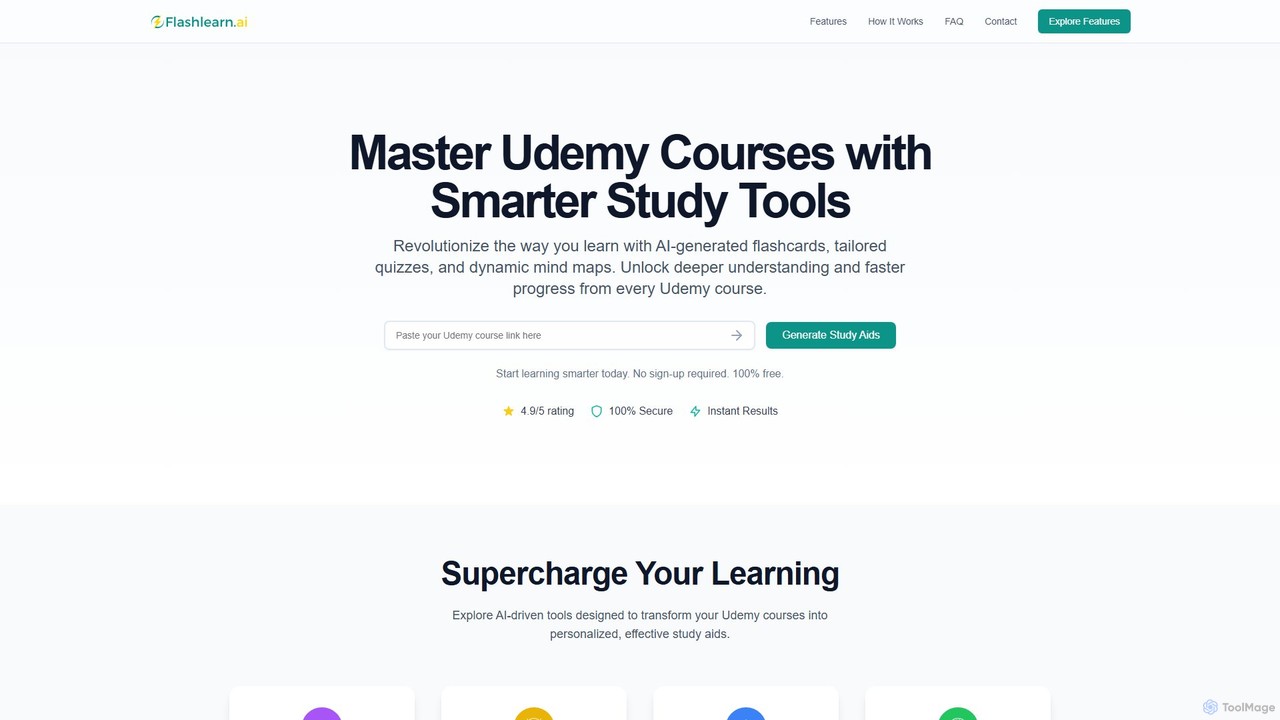
flashlearn is a free AI-powered study tool that transforms Udemy courses into interactive learning materials. Simply provide a course link to instantly generate personalized flashcards, quizzes, and dynamic mind maps, helping you learn faster and retain information more effectively without any sign-up.

Learning Assistant
Visits 4.6KFavorites 86Likes 118

About Quiz Generator

Quiz Generator tools are AI-powered platforms designed to automate the creation of quizzes, tests, and assessments. These tools leverage natural language processing (NLP) and machine learning to analyze provided content, topics, or documents, then generate relevant questions and answer keys. They significantly streamline the assessment creation process for educators, trainers, and content creators, transforming raw information into engaging and effective learning checks.

Core Features

  • Automated Question Generation: Creates diverse question types (multiple-choice, true/false, open-ended) from input text or topics.
  • Instant Answer Key Creation: Automatically provides correct answers and explanations for generated questions.
  • Difficulty Level Adjustment: Allows users to specify the desired complexity of the quiz questions.
  • Content Analysis & Extraction: Intelligently processes documents, articles, or URLs to identify key information for quiz questions.
  • Multiple Export Formats: Supports exporting quizzes to various formats like PDF, Word, or directly to learning management systems (LMS).

Applicable Scenarios

Quiz Generators are invaluable for professionals who regularly need to create assessments. Educators can quickly prepare quizzes for classroom lessons or online courses. Corporate trainers use them to develop knowledge checks for employee onboarding and skill development programs. Content marketers leverage these tools to create interactive quizzes for audience engagement and lead generation on websites or social media.

How to Choose

When selecting a Quiz Generator, consider the types of input it accepts (text, URL, document upload) and the variety of question formats it supports. Evaluate its customization options for difficulty, branding, and question phrasing. Check for integration capabilities with your existing learning management systems or content platforms, and assess the accuracy and relevance of the generated content to ensure high-quality assessments.

Quiz Generator use cases

1

Generate Classroom Quizzes for Students

An educator uploads lecture notes or textbook chapters into an AI quiz generator. The tool analyzes the content and automatically creates multiple-choice and short-answer questions, complete with an answer key. This saves hours of manual question writing, allowing the teacher to focus more on lesson planning and student interaction, ensuring regular knowledge checks without extensive preparation time.

2

Design Employee Training Knowledge Checks

A corporate trainer needs to assess employee understanding of new compliance policies. By feeding the policy documents into a quiz generator, they can quickly produce a series of true/false and multiple-choice questions. This ensures that all key aspects of the policy are covered in the assessment, providing a standardized and efficient way to verify comprehension across the workforce.

3

Add Interactive Quizzes to E-learning Platforms

An online course creator wants to break up long video lectures with interactive elements. They use a quiz generator to create short, engaging quizzes based on each video's transcript. These quizzes are then embedded directly into the e-learning platform, helping students self-assess their understanding and reinforcing key concepts immediately after learning them, improving retention and engagement.

4

Generate Marketing Lead Quizzes

A digital marketer aims to capture leads by offering an interactive quiz on their website. They input content related to their industry or product, and the AI generates a fun, personality-based, or knowledge-based quiz. This attracts visitors, encourages participation, and provides valuable data on user preferences, which can then be used for targeted marketing campaigns.

5

Automate Content Review & Comprehension

A content manager needs to ensure their team understands complex internal documents or new industry reports. They upload these documents to a quiz generator, which then creates a series of questions to test comprehension. This provides a quick and objective way to verify that team members have absorbed critical information, improving internal communication and knowledge sharing efficiency.

6

Tailor Quizzes for Personalized Learning

A tutor or personalized learning platform uses a quiz generator to create adaptive assessments. Based on a student's previous performance or learning style profile, the AI generates quizzes with varying difficulty levels or question types. This allows for highly customized practice and assessment, addressing individual learning gaps and accelerating progress more effectively than generic quizzes.

Quiz Generator FAQ

What are AI Quiz Generators and how do they work?

AI Quiz Generators are tools that use artificial intelligence, specifically natural language processing (NLP) and machine learning, to automatically create quizzes and assessments. Users provide text, topics, or documents, and the AI analyzes the content to formulate relevant questions (e.g., multiple-choice, true/false, open-ended) and their corresponding answers. This process significantly reduces the manual effort involved in designing educational or training assessments.

How do I choose the best AI Quiz Generator for my specific needs?

When selecting an AI Quiz Generator, consider several factors. First, evaluate the types of input it supports (e.g., plain text, PDFs, URLs, videos). Second, check the variety of question formats it can generate and if it provides explanations for answers. Third, assess its customization options, such as difficulty level adjustment and branding. Finally, consider integration capabilities with your existing learning management systems (LMS) or other platforms, and review user feedback on the accuracy and relevance of generated questions.

What types of questions can AI Quiz Generators typically create?

AI Quiz Generators are capable of creating a diverse range of question types to suit various assessment needs. Common formats include multiple-choice questions (MCQs) with several options and one correct answer, true/false statements, and open-ended questions that require a written response. Some advanced generators can also produce fill-in-the-blank questions, matching exercises, or even scenario-based questions, depending on the complexity of the input content and the AI's capabilities.

Can AI Quiz Generators integrate with existing Learning Management Systems (LMS)?

Many AI Quiz Generators offer integration capabilities with popular Learning Management Systems (LMS) like Moodle, Canvas, Blackboard, or Google Classroom. This integration allows users to seamlessly export generated quizzes directly into their courses, assign them to students, and track results within the LMS environment. Some tools provide API access for custom integrations, while others offer standard export formats (e.g., SCORM, QTI, CSV) that can be imported into most LMS platforms, streamlining the assessment workflow.

What's the difference between an AI Quiz Generator and a general AI Content Generator?

While both use AI, an AI Quiz Generator is specialized for creating structured assessments. Its primary function is to analyze content and formulate specific question types with correct answers and explanations, focusing on knowledge retention and evaluation. A general AI Content Generator, on the other hand, is designed for broader content creation tasks like writing articles, marketing copy, or creative text, without the specific goal of generating questions for assessment purposes. The quiz generator's AI is fine-tuned for pedagogical and evaluative outputs.