
Eadlyn
Eadlyn is an advanced AI platform specializing in creating hyper-realistic digital clones. It offers high-fidelity voice cloning to …
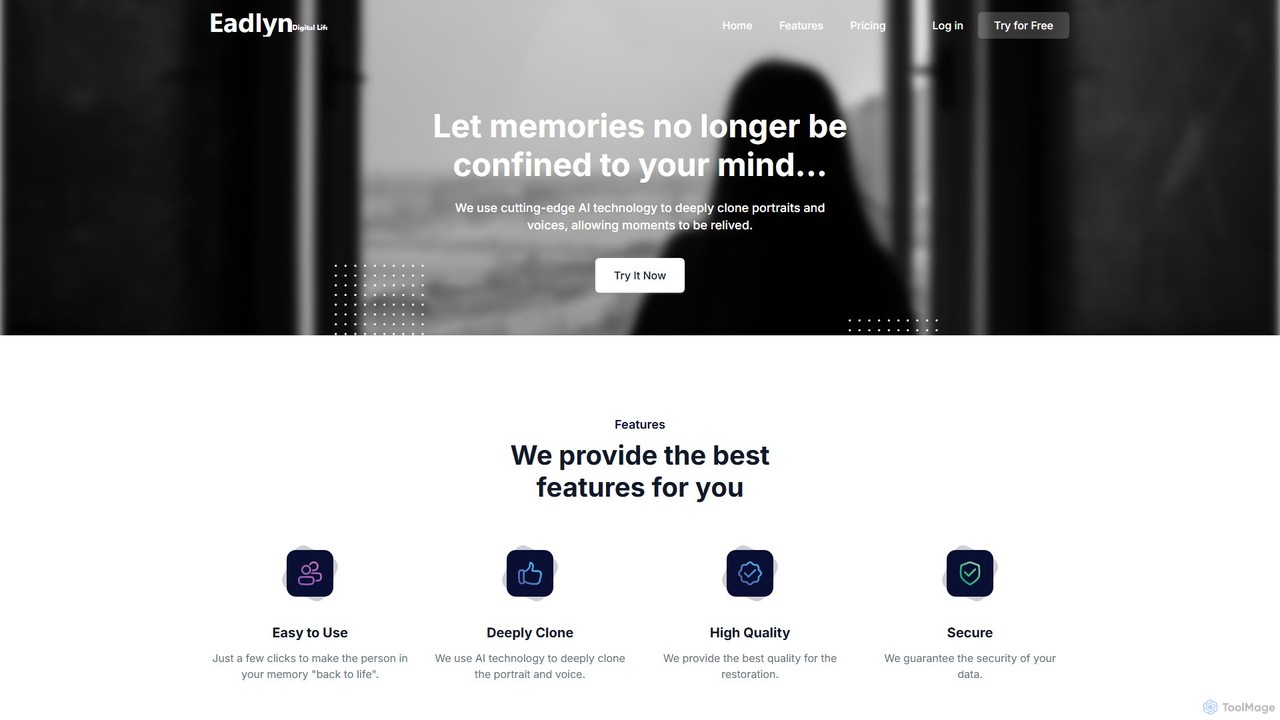
Eadlyn is an advanced AI platform specializing in creating hyper-realistic digital clones. It offers high-fidelity voice cloning to replicate any voice with emotional nuance and deepfake portrait cloning to animate static images into lifelike videos. It's designed for entertainment, content creation, and personal use.
About Deepfake
Deepfake tools are a specialized category of AI video software that use deep learning to create highly realistic, synthetic media. These tools primarily leverage Generative Adversarial Networks (GANs) to analyze facial features and movements, enabling them to convincingly swap a person's face onto another's body in a video. The core value lies in generating fabricated yet photorealistic video content for creative, entertainment, or professional purposes. Beyond simple face swapping, advanced tools also offer capabilities like voice cloning and expression transfer.
Core Features
- Face Swapping: Seamlessly replaces a face in a target video with a source face while preserving expressions and lighting.
- Lip-Sync Dubbing: Automatically adjusts the lip movements of a person in a video to match a new audio track, ideal for dubbing.
- Expression Transfer: Maps the facial expressions from a source video (e.g., smiling, frowning) onto a target face.
- Voice Cloning: Creates a synthetic model of a specific person's voice that can be used to generate new speech.
- Puppeteering: Animates a static photo or a 3D model using a live video feed of a person's face as a driver.
Use Cases
Deepfake technology is primarily used in the entertainment and media industries for post-production tasks like de-aging actors or creating digital doubles. Content creators on social media use it for parody, satire, and creating viral memes. In marketing, it can be applied to create personalized video advertisements. It also has applications in education for creating historical reenactments or in corporate training for realistic simulations.
How to Choose
When selecting a Deepfake tool, first evaluate the quality and realism of the output; check for visual artifacts or unnatural movements. Consider the ease of use—some tools are one-click mobile apps, while others are complex software requiring technical expertise. Assess the processing requirements, as many tools demand powerful GPUs or rely on cloud-based processing. Finally, prioritize platforms with clear ethical guidelines and responsible use policies to prevent misuse.
DeepfakeUse Cases
Film & TV Post-Production Enhancement
A visual effects (VFX) artist working on a major film needs to de-age an actor for flashback scenes. Instead of spending weeks on manual, frame-by-frame digital makeup, the artist uses a professional Deepfake tool. They train an AI model on footage of the actor from their younger years and apply it to the current footage. The tool automatically handles lighting changes, head movements, and expressions, producing a consistently realistic and youthful appearance. This significantly reduces production time and costs compared to traditional VFX methods.
Creating Personalized Video Marketing
A marketing team wants to launch a campaign featuring their CEO. To increase engagement, they use a Deepfake tool with voice cloning and lip-sync capabilities. They record a single video of the CEO giving a generic message. Then, using a customer list, they generate hundreds of personalized variations where the AI-cloned voice of the CEO addresses each customer by name, and the lip movements are perfectly synced. This creates a highly personal connection with potential clients at scale, without requiring the CEO to record each video individually.
Generating Satirical Content for Social Media
A content creator specializing in political satire wants to create a viral video. They use an easy-to-use Deepfake app to swap the faces of two rival politicians onto the bodies of characters in a famous comedy movie scene. The app allows them to quickly upload the source images and the target video, processing the face swap in minutes. The resulting humorous video is shared across social media platforms, gaining significant traction and views by providing a funny, topical commentary on current events.
Seamless Foreign Language Film Dubbing
A film distribution company wants to release an American blockbuster in Japan. To improve the viewing experience over traditional dubbing, they use an AI Deepfake tool specializing in lip-syncing. The tool analyzes the original actors' speech and precisely modifies their lip movements to match the Japanese dialogue spoken by voice actors. The result is a seamless dub where the on-screen characters appear to be genuinely speaking Japanese. This enhances immersion and makes the film more accessible and enjoyable for the local audience.
Creating Realistic Avatars for Virtual Events
An event organizer is hosting a large-scale virtual conference. To make the experience more engaging, they offer attendees the ability to create realistic digital avatars. Using a Deepfake tool, attendees upload a single photo of themselves. The tool then generates a 3D animated avatar that not only looks like them but can also be controlled by their webcam in real-time, mimicking their expressions and head movements. This allows for more personal and expressive interactions within the virtual event space, moving beyond static profile pictures.
Educational Content with Historical Figures
An educational technology company is developing an interactive history module. They use a Deepfake tool to bring a historical figure, like Albert Einstein, to life. Using a well-known photograph as a base, they animate his face and use a cloned voice to have him explain the theory of relativity. The 'puppeteering' feature allows a presenter to drive Einstein's expressions in real-time during a live virtual class. This creates a highly memorable and engaging learning experience for students, making complex topics more accessible and interesting.