SoraCreators
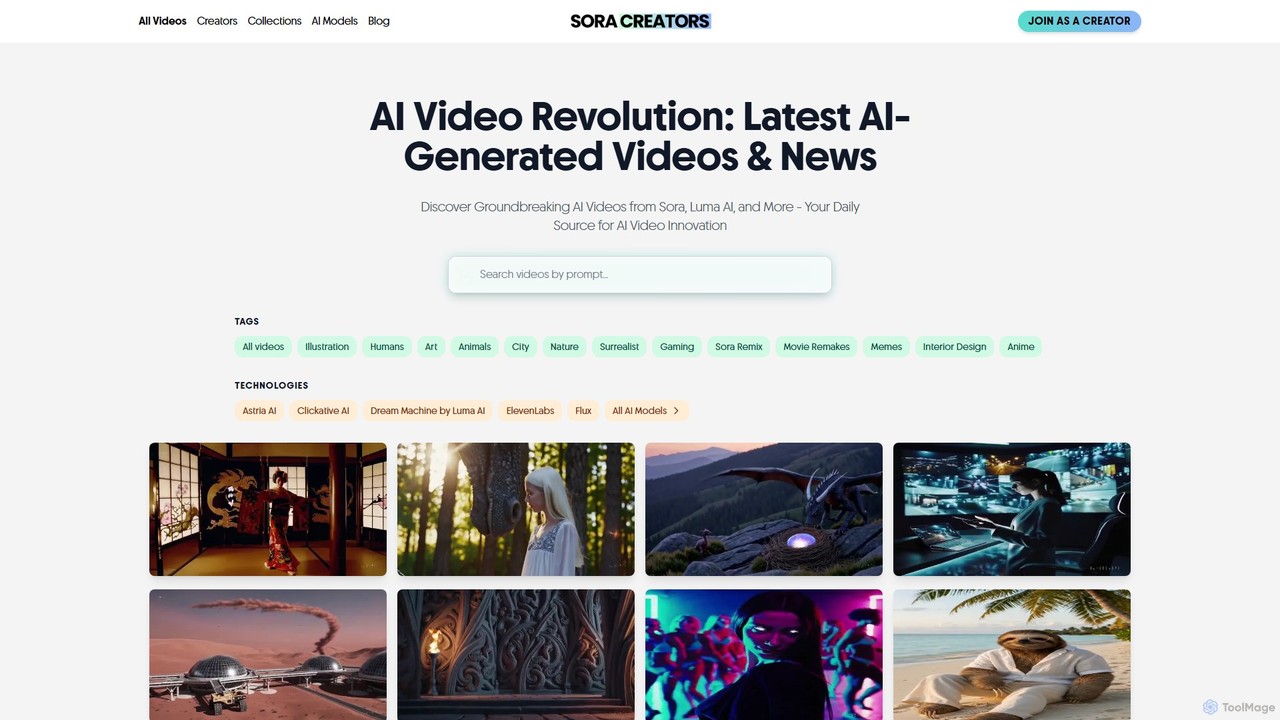
SoraCreators is a central hub for the AI video revolution. It's a community platform and showcase for discovering …
SoraCreators is a central hub for the AI video revolution. It's a community platform and showcase for discovering groundbreaking AI-generated videos, learning from expert tutorials, and staying updated on news about models like Sora, Luma AI, and RunwayML.
About Inspiration
AI Inspiration tools for video are a class of software designed to generate creative ideas and concepts for video production. These tools leverage large language models and generative algorithms to produce script outlines, storyboard concepts, topic suggestions, and visual styles from simple text prompts. Their primary value lies in overcoming creative blocks, accelerating the pre-production workflow, and providing a diverse range of ideas for content creators and marketers. They act as a creative partner, helping to spark the initial concept that a full video project can be built upon.
Core Features
- Script Idea Generation: Creates plot summaries, character concepts, dialogue snippets, and scene outlines based on genre, tone, or keywords.
- Visual & Storyboard Concepts: Generates visual descriptions or simple storyboards to help visualize scenes, camera angles, and aesthetics.
- Topic & Trend Analysis: Suggests relevant and trending video topics based on a specific niche, platform, or target audience.
- Creative Prompt Variations: Takes a single idea and expands it into multiple different angles, tones, and narrative structures.
Use Cases
These tools are particularly useful for social media content creators, marketing teams, independent filmmakers, and corporate communication specialists. For instance, a YouTuber can use them to brainstorm a month's worth of video ideas, while a marketing agency can quickly generate multiple ad concepts for a new product campaign, significantly speeding up the ideation phase.
How to Choose
When selecting an AI Inspiration tool, consider the specificity of its output (e.g., script-focused vs. visual concepts), the level of customization available for prompts, the supported output formats (text, images), and its ability to analyze current trends. Also, evaluate the user interface's simplicity and how well it integrates into your existing creative workflow.

InspirationUse Cases
Generating Viral Short Video Ideas
A social media content creator focusing on platforms like TikTok and YouTube Shorts often faces pressure to produce engaging content daily. Using an AI Inspiration tool, they can input their niche, such as 'DIY home decor,' and a desired tone, like 'humorous and quick.' The tool generates a list of 20 video ideas, including catchy hooks ('3 things you're cleaning wrong'), brief scene-by-scene outlines, and suggestions for trending audio. This process reduces brainstorming time from hours to minutes, ensuring a consistent flow of fresh, platform-relevant content.
Developing Ad Campaign Concepts
A marketing team is tasked with creating a video ad campaign for a new eco-friendly water bottle. Instead of a traditional brainstorming session, they use an AI tool. They input key product features ('BPA-free, self-cleaning, temperature control') and the target audience ('active millennials, tech-savvy'). The AI generates five distinct campaign concepts, each with a unique storyboard, tagline, and script outline. One concept focuses on technology, another on sustainability, and a third on adventure. This allows the team to quickly evaluate diverse creative directions and select the most promising one for production.
Outlining a Short Film Script
An independent filmmaker has a basic premise for a short film—a sci-fi story about a lonely robot—but is stuck on the plot. They use an AI inspiration tool, providing the genre ('sentimental sci-fi'), a character description ('a small, curious cleaning bot'), and a theme ('finding friendship'). The tool generates several potential plot outlines, including key turning points, character arcs, and even dialogue suggestions for pivotal scenes. The filmmaker uses one of these outlines as a structural foundation, helping them break through their writer's block and begin writing the full script with a clear direction.
Structuring an Explainer Video Series
An educational content producer needs to create a five-part video series explaining 'Quantum Computing for Beginners'. The topic is complex and structuring it is challenging. They use an AI tool to generate a series outline. By inputting the main topic and the number of episodes, the AI suggests a logical progression:
- Video 1: What is a Qubit?
- Video 2: Superposition Explained.
- Video 3: The Power of Entanglement.
- Video 4: Quantum Algorithms.
- Video 5: Future Applications. For each video, it provides key talking points and ideas for visual analogies, saving the producer significant planning time.
Ideating Internal Training Videos
A corporate trainer needs to create engaging videos for a new cybersecurity policy. To avoid dry, lecture-style content, they use an AI inspiration tool. They input the topic 'Phishing Awareness' and request 'relatable, scenario-based' ideas. The AI generates several short video scripts based on common workplace situations, such as an employee receiving a suspicious email from 'HR' or a fake login page for a company tool. These practical, story-driven concepts make the training more memorable and effective than a simple presentation of rules.
Planning a Weekly YouTube Content Calendar
A full-time YouTuber in the 'personal finance' niche needs to maintain a consistent upload schedule but is running low on fresh ideas. They use an AI inspiration tool to analyze their channel's past successful videos and current trends in finance. The tool generates a four-week content plan, suggesting video titles like '5 Millennial Money Myths Debunked' for week one, and 'A Beginner's Guide to Index Funds' for week two. It also provides a brief outline with key talking points for each video, allowing the creator to focus their energy on production rather than ideation.