ToolMage
Sign in

Best 2 Motion Capture AI tools for Video

Popular Motion Capture AI tools in Video include radicalmotion and PoseTracker, helping you work more efficiently.

radicalmotion
Freemium

radicalmotion

RADiCAL is a browser-based AI platform for real-time motion capture and 3D content creation. It enables users to generate 3D animations from single 2D videos or live camera feeds without special hardware or suits. It features two core products: RADiCAL Motion for mocap and RADiCAL Canvas for 3D scene design, making 3D creation accessible to everyone.

3D
Visits 69.1KFavorites 142Likes 138
PoseTracker
Freemium

PoseTracker

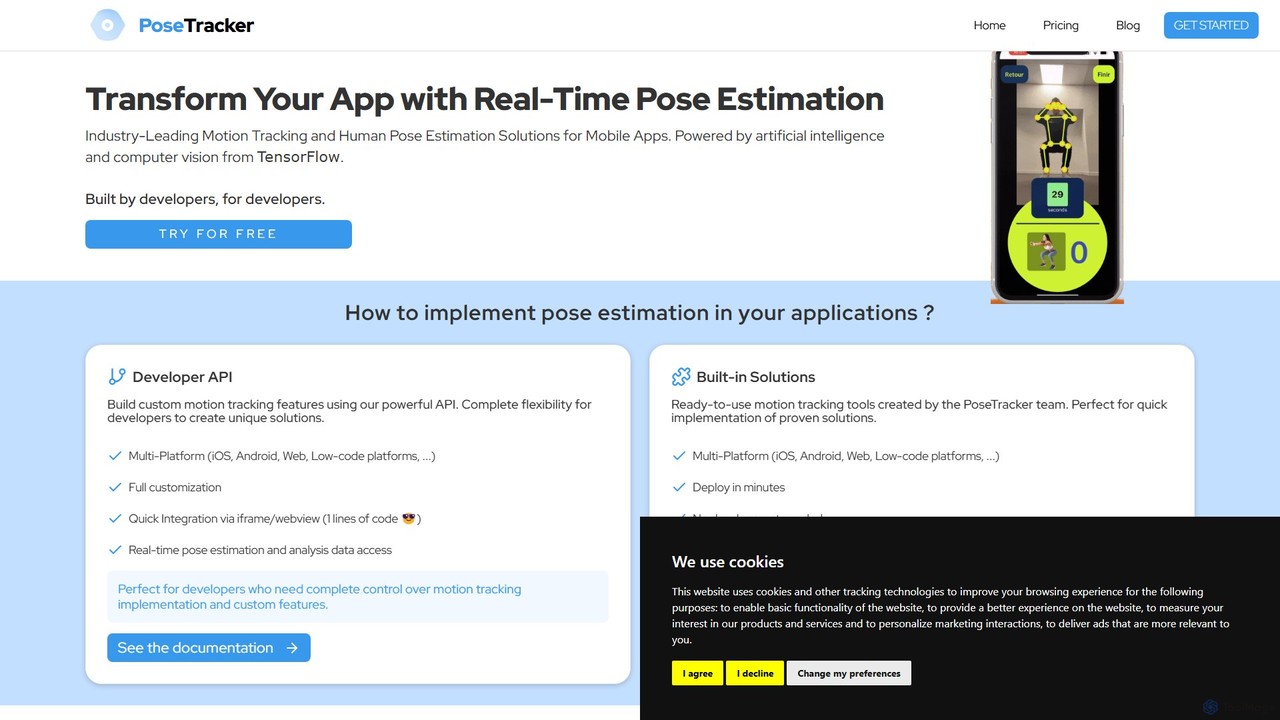
A developer-focused AI platform providing real-time pose estimation and motion tracking APIs. It enables the integration of features like exercise analysis, form correction, and flexibility measurement into fitness, health, and gaming apps across multiple platforms.

Api
Visits 6.1KFavorites 134Likes 126

About Motion Capture

Motion Capture tools are AI-powered solutions that digitally record human or object movement for use in virtual environments. These advanced tools leverage computer vision and machine learning to analyze video footage or sensor data, translating real-world actions into precise 3D animation data. They significantly streamline the animation process, enabling creators to produce realistic and expressive character movements for various digital media applications.

Core Features

  • Real-time Tracking: Captures and processes movement data instantly, allowing for immediate visualization and feedback in virtual scenes.
  • Markerless Capture: Utilizes AI to track body movements from standard video cameras without the need for special suits or markers.
  • Facial & Hand Tracking: Extends capture capabilities to intricate facial expressions and detailed finger movements, enhancing character realism.
  • Data Retargeting: Automatically adapts captured motion data to different character rigs and skeletal structures, simplifying animation transfer.
  • Pose Estimation: AI algorithms accurately estimate 3D joint positions and orientations from 2D images or video streams.

Applicable Scenarios

Motion Capture tools are indispensable in industries requiring high-fidelity animation. Game developers use them to create lifelike character movements and cutscenes, while film and TV studios employ them for visual effects and virtual production. Animators leverage these tools to accelerate character animation workflows, producing complex sequences with greater speed and realism than traditional keyframe animation.

How to Choose

When selecting a Motion Capture tool, consider the required accuracy and fidelity, especially for subtle movements like facial expressions. Evaluate the capture method (markerless vs. marker-based) based on your budget and setup complexity. Assess integration capabilities with your existing 3D software (e.g., Blender, Maya, Unity, Unreal Engine) and the ease of data retargeting. Finally, compare pricing models and the availability of support and tutorials.

Motion Capture use cases

1

Creating Realistic Game Character Animations

Game developers can use AI motion capture to record an actor's movements, such as walking, running, or fighting, and instantly apply them to 3D game characters. This process drastically reduces the time and effort required for manual animation, resulting in more fluid and believable in-game character actions and cutscenes, enhancing player immersion.

2

Accelerating Virtual Production Workflows

Filmmakers and virtual production teams utilize real-time motion capture to animate virtual characters or objects directly on set. This allows directors to visualize performances within digital environments in real-time, making immediate adjustments to staging and camera angles, thereby streamlining pre-visualization and final shot creation for VFX-heavy productions.

3

Enhancing Architectural Visualization Walkthroughs

Architects and designers can employ motion capture to animate human figures walking through proposed building designs in virtual walkthroughs. By capturing natural human movement, these tools create more engaging and realistic presentations for clients, helping them better understand the scale and flow of a space before construction begins.

4

Developing Immersive VR/AR Experiences

Creators of virtual and augmented reality content leverage motion capture to bring avatars and interactive elements to life with natural movements. Whether it's a virtual assistant in an AR app or a player's avatar in a VR game, accurate motion data ensures a more intuitive and immersive user experience, bridging the gap between physical and digital interactions.

5

Generating Expressive Digital Doubles for Film

Visual effects artists in film production use advanced motion capture, including facial and hand tracking, to create highly expressive digital doubles of actors. This enables seamless integration of CGI characters into live-action footage, allowing for complex stunts or fantastical performances that would be impossible or unsafe for human actors, maintaining emotional nuance.

6

Streamlining Sports Performance Analysis

Sports scientists and coaches can apply motion capture to analyze an athlete's biomechanics during training. By digitally recording and quantifying movements like a golf swing or a running stride, these tools provide precise data for identifying inefficiencies, preventing injuries, and optimizing performance, offering actionable insights for improvement.

Motion Capture FAQ

What is AI Motion Capture?

AI Motion Capture is a technology that uses artificial intelligence, particularly computer vision and machine learning, to record and interpret human or object movement. Unlike traditional methods, AI-powered systems can often perform markerless capture from standard video, automatically extracting 3D motion data to animate digital characters or objects with high fidelity and efficiency.

How does AI Motion Capture differ from traditional Motion Capture?

AI Motion Capture primarily differs from traditional methods by its reliance on advanced algorithms for markerless tracking and data processing. Traditional motion capture often requires specialized suits with physical markers and dedicated camera setups. AI systems can analyze standard video footage, offering greater flexibility, reduced setup time, and often lower costs, while still achieving impressive accuracy, especially for subtle movements.

What are the key benefits of using Motion Capture tools?

The primary benefits of Motion Capture tools include significantly increased animation speed and efficiency, allowing for rapid iteration and production. They enable the creation of highly realistic and natural-looking character movements, enhancing immersion in games, films, and VR/AR. Furthermore, these tools reduce the need for extensive manual keyframe animation, saving time and resources for animators and studios.

What software integrations are common with Motion Capture tools?

Motion Capture tools commonly integrate with leading 3D animation and game development software. This includes professional applications like Autodesk Maya, Blender, Cinema 4D, and 3ds Max for animation and modeling. For game engines, strong integration with Unity and Unreal Engine is crucial for directly applying captured motion data to game characters and environments.

Can Motion Capture be used for facial expressions and hand gestures?

Yes, advanced Motion Capture tools are increasingly capable of capturing intricate facial expressions and detailed hand gestures. Utilizing specialized cameras, depth sensors, or AI-driven facial landmark tracking from video, these systems can record subtle nuances of human emotion and complex finger movements, bringing a higher level of realism and expressiveness to digital characters.