Codebuff
Code Generation
AI TOOL COMPARISON
What is the difference, and which fits your workflow? Compare features, usage, pricing models and traffic side by side.
Code Generation
Large Language Model
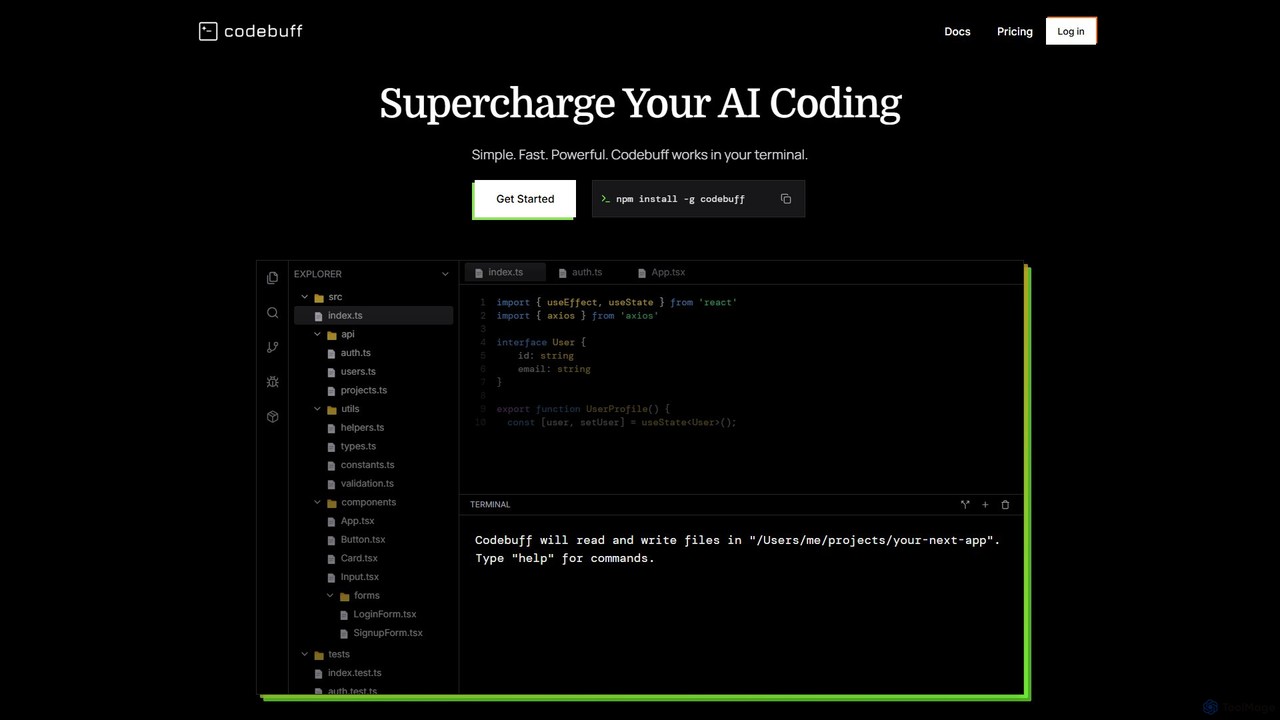
Codebuff is a powerful AI coding assistant that operates directly in your terminal. It deeply understands your entire codebase, enabling it to perform complex tasks like surgical code edits, feature implementation, and large-scale refactoring with unparalleled speed and accuracy. It learns from your project context and integrates seamlessly into any tech stack.
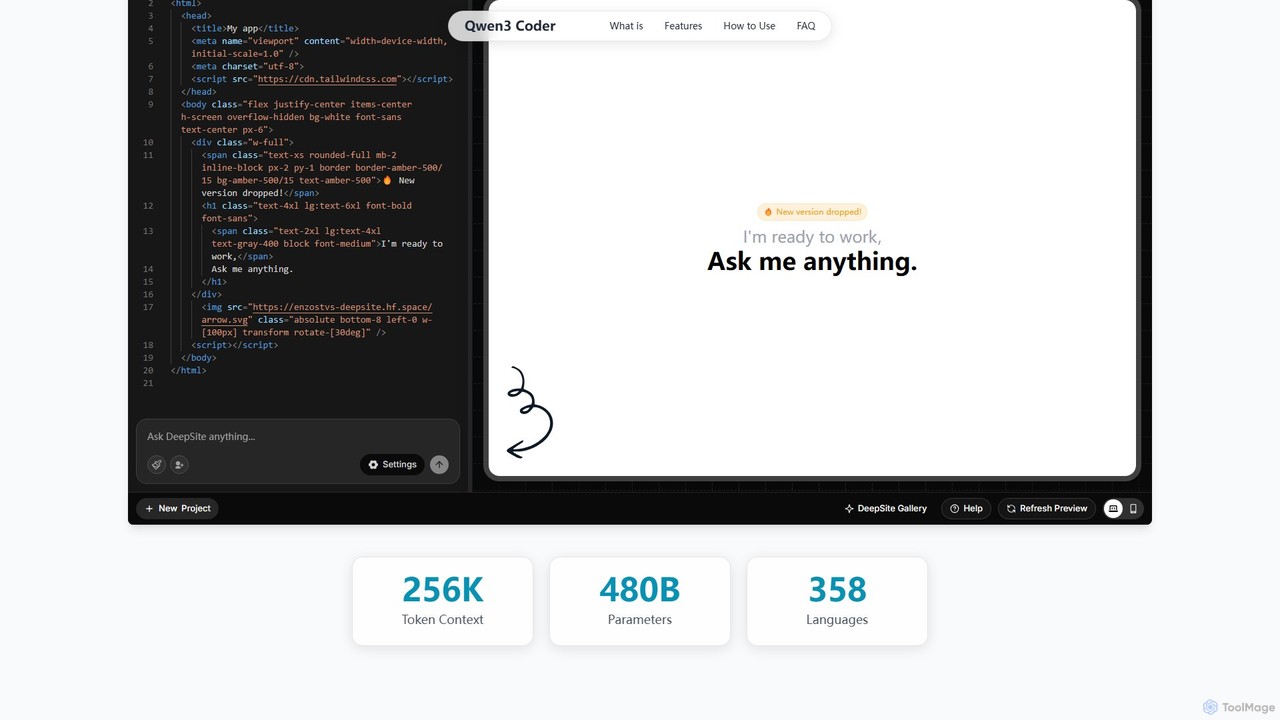
Qwen3 Coder is a state-of-the-art, open-source large language model by Alibaba Cloud, engineered for advanced code generation, comprehension, and agentic tasks. Featuring a 480B Mixture-of-Experts architecture and trained on 7.5 trillion tokens, it achieves GPT-4 level performance across 358 programming languages. It supports a massive 256K context window and is designed for complex, multi-step software development workflows.
Compare product focus, pricing models and audiences. Highlighted rows indicate different listed information; unknown pricing does not mean free.
| Quick facts | Codebuff | Qwen3 Coder |
|---|---|---|
| Pricing model | Freemium | Freemium |
| Product type | App | Web |
| Primary focus | Code Generation | Large Language Model |
| Audience and roles | No data available | No data available |
| Categories | Code Generation · Code Assistant · Developer Tools | Large Language Model · Code Assistant · Developer Tools |
| Added | Aug 4, 2025 | Aug 17, 2025 |
| Updated | Nov 19, 2026 | Nov 19, 2026 |
Explore the listed product descriptions, features and workflows. Taxonomy labels alone are not feature evaluations.
Codebuff is a next-generation AI coding agent designed to supercharge your development workflow directly from the terminal. Unlike other AI tools that operate in a separate window or have limited context, Codebuff indexes and deeply understands your entire codebase in seconds. This total codebase awareness allows it to generate highly accurate and context-aware code, perform precise edits, and execute complex refactoring tasks that other tools struggle with. It's built for professional developers who demand speed, precision, and seamless integration into their existing environment.
By building a complete map of your project, including hidden dependencies and structural patterns, Codebuff delivers solutions that respect your project's architecture and coding style. It continuously learns from your interactions, storing project-specific knowledge in human-readable Markdown files (`knowledge.md`). This persistent memory means you don't have to repeat yourself, and the assistant becomes more effective and tailored to your needs over time.
Getting started with Codebuff is straightforward and designed for a hassle-free setup. It works with any tech stack and doesn't require special environments.
npm install -g codebuff. You'll need Node.js version 18 or higher.codebuff. The tool will automatically index your codebase..codebuffignore file to exclude specific files/folders from its context, similar to .gitignore. You can also create a codebuff.json file to configure startup processes, file change hooks, and agent behavior, turning Codebuff into a central hub for your development environment.knowledge.md files, allowing it to learn and improve with every session..codebuffignore) and managing development processes (codebuff.json).--lite for cost savings, --max for complex problems, and --experimental for cutting-edge features.Codebuff is versatile and can be used for a wide range of development tasks:
Codebuff stands out from competitors like GitHub Copilot and Cursor by offering a fundamentally different and more powerful approach:
Codebuff uses a simple, usage-based pricing model that is flexible and transparent.
Qwen3 Coder is a revolutionary open-source AI model developed by Alibaba Cloud, specifically designed to redefine the boundaries of AI-powered software development. It represents the pinnacle of coding AI, leveraging a sophisticated Mixture-of-Experts (MoE) architecture with a massive 480 billion total parameters. During inference, it efficiently uses only 35 billion active parameters, delivering exceptional performance without prohibitive computational costs. Trained on an enormous 7.5 trillion token corpus, with 70% dedicated to source code from 358 different programming languages, Qwen3 Coder demonstrates performance on par with leading proprietary models like GPT-4.
What sets Qwen3 Coder apart is its evolution from a simple code generator to an active, agentic software development partner. It doesn't just write code; it understands requirements, plans solutions, utilizes tools, executes code, analyzes results, and iteratively debugs its own work. This is made possible by its innovative training methodology, including large-scale reinforcement learning with code execution feedback (Execution-Driven Learning) and long-horizon RL training in 20,000 parallel environments. This allows the model to learn complex, multi-step workflows, making it a true AI software agent.
Qwen3 Coder is accessible to developers through multiple channels, catering to various needs and technical setups:
Here is a quick start example using the Hugging Face Transformers library:
from transformers import AutoTokenizer, AutoModelForCausalLM

device = "cuda" # Adjust based on your hardware
tokenizer = AutoTokenizer.from_pretrained("Qwen/Qwen3-Coder-480B-A35B-Instruct")
model = AutoModelForCausalLM.from_pretrained("Qwen/Qwen3-Coder-480B-A35B-Instruct", device_map="auto").eval()

input_text = "# Write a quick sort algorithm in Python"
model_inputs = tokenizer([input_text], return_tensors="pt").to(device)
generated_ids = model.generate(model_inputs.input_ids, max_new_tokens=512, do_sample=False)[0]
output = tokenizer.decode(generated_ids[len(model_inputs.input_ids[0]):], skip_special_tokens=True)

print(output)Qwen3 Coder is a versatile tool for a wide range of software development tasks:
Qwen3 Coder offers significant advantages over other coding models:
Qwen3 Coder is available under a dual-access model:
Their taxonomy shows where the products overlap and where each one has a more distinct focus. Unknown fields are shown explicitly and are never filled with assumptions.
Traffic is shown on the same scale so differences in market visibility are not visually understated.
Both charts share the same months and vertical scale. Each tool identifies its latest reporting month; missing months are left blank, not counted as zero. Regional and source visit counts are estimates calculated from the reported shares.
| Country/region | Percentage | Estimated visits |
|---|---|---|
| 🇮🇳India | 43.22% | 24.4K |
| 🇻🇳Vietnam | 23.15% | 13.1K |
| 🇨🇳China | 13.41% | 7.6K |
| 🇺🇸United States | 10.8% | 6.1K |
| 🇧🇷Brazil | 9.42% | 5.3K |
| Source type | Percentage | Estimated visits |
|---|---|---|
| Direct | 89.04% | 50.3K |
| Referral | 10.96% | 6.2K |
No data available
Ratings, comments, favorites, and likes are community signals—not a substitute for product fit.
This page is assembled from ToolMage product listings, taxonomy, traffic statistics and on-site user feedback. It is not a hands-on test or an independent review.