Codespell
Code Assistant
AI TOOL COMPARISON
What is the difference, and which fits your workflow? Compare features, usage, pricing models and traffic side by side.
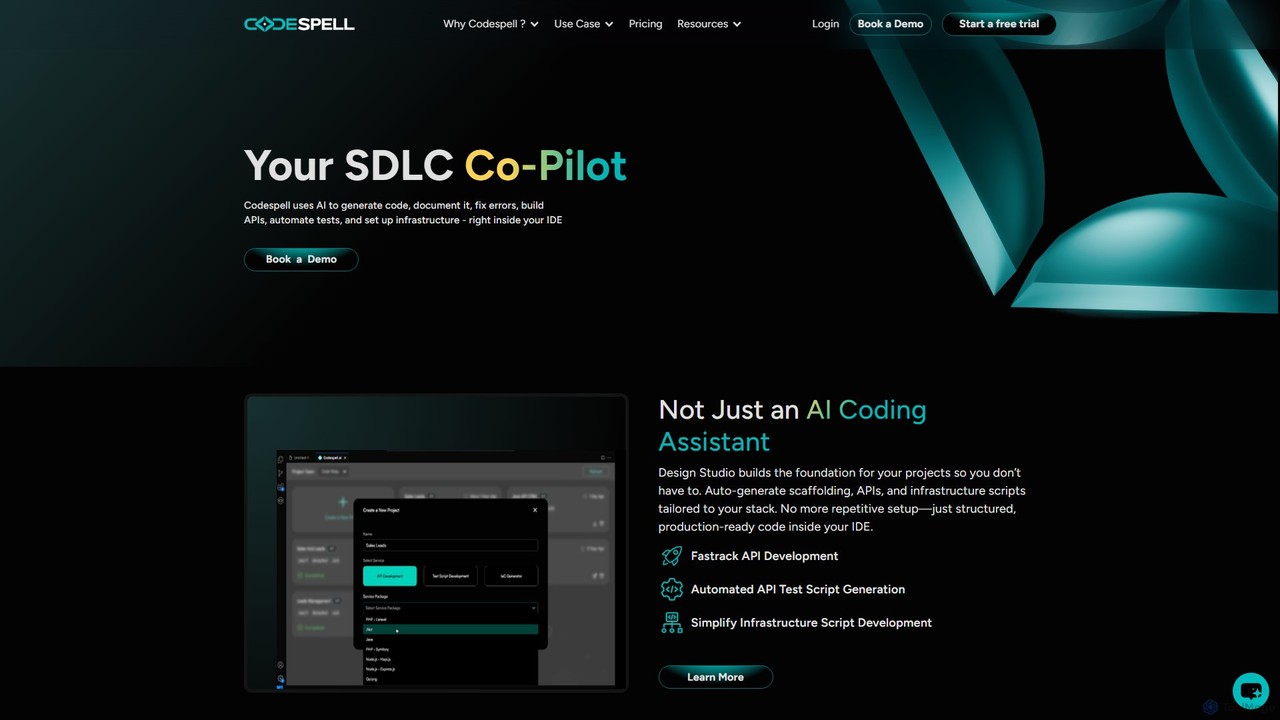
Codespell is an AI-powered SDLC co-pilot that integrates into your IDE to accelerate software development. It goes beyond code completion, helping generate code, create APIs, automate tests, document logic, and fix errors, streamlining the entire development lifecycle.
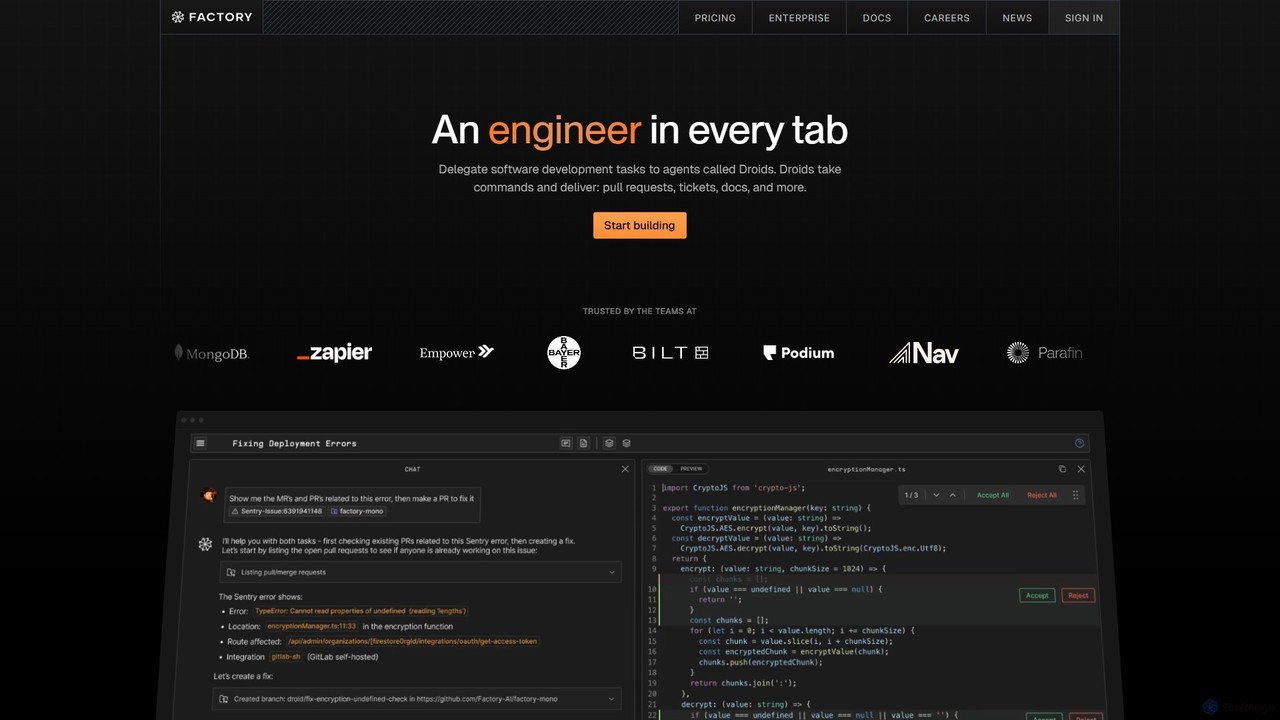
Factory is an AI-powered software development platform that uses autonomous agents called 'Droids' to automate the entire Software Development Lifecycle (SDLC). From planning and coding to incident response and documentation, Droids handle complex tasks, delivering merge-ready pull requests, detailed reports, and rapid fixes. It's designed to work alongside engineering teams, boosting productivity, accelerating development cycles, and clearing backlogs within a secure, enterprise-grade environment.
Compare product focus, pricing models and audiences. Highlighted rows indicate different listed information; unknown pricing does not mean free.
| Quick facts | Codespell | Factory |
|---|---|---|
| Pricing model | Freemium | Paid |
| Product type | Extensions | Web |
| Primary focus | Code Assistant | Code Assistant |
| Audience and roles | No data available | No data available |
| Categories | Code Assistant · Low Code No Code · Testing · Automation | Code Assistant · Devops · Automation |
| Added | Aug 16, 2025 | Aug 9, 2025 |
| Updated | Nov 19, 2026 | Nov 19, 2026 |
Explore the listed product descriptions, features and workflows. Taxonomy labels alone are not feature evaluations.
Codespell presents itself as a comprehensive AI Co-Pilot for the Software Development Life Cycle (SDLC), designed to significantly accelerate the journey from concept to deployment. Unlike standard AI coding assistants that focus solely on code completion, Codespell offers a holistic suite of tools that integrate directly into your development environment. It aims to reduce manual coding effort by 30-50% by automating repetitive and complex tasks across the development spectrum.
The platform is built on two core pillars: the Design Studio and the AI Coding Sidekick. The Design Studio acts as a foundational tool, automatically generating project scaffolding, APIs, and infrastructure scripts tailored to your specific technology stack. This eliminates the tedious setup phase, allowing developers to start with structured, production-ready code. The AI Coding Sidekick assists with day-to-day coding tasks through simple commands called "spells." These spells enable developers to instantly generate documentation, explain complex logic, refactor code for optimization, create unit tests, and clean up errors, all without leaving the IDE.
Using Codespell is designed to be a seamless part of a developer's existing workflow. First, you install the Codespell extension into your preferred IDE, such as VS Code, JetBrains, or Eclipse. Once integrated, you can interact with the AI in several ways:
/doc will generate comprehensive documentation for it. Using /unit will create corresponding unit tests, and /optimize will suggest structural improvements./explain, /doc, /unit, /optimize, and /clear to perform complex tasks.Codespell is valuable for individual developers, small teams, and large enterprises looking to boost productivity. Key use cases include:
/explain and /doc spells to understand and document old codebases before refactoring./optimize for code structure and /unit for test coverage.The primary advantage of Codespell is its focus on the entire SDLC, not just coding. By automating setup, documentation, and testing, it frees up developers to focus on building core features. Its deep integration into the IDE means less context-switching, leading to higher efficiency. The collaborative features make it a powerful tool for teams, ensuring consistency and shared standards. Finally, the promise of reducing manual coding effort by up to 50% presents a significant return on investment by accelerating delivery times and reducing development costs.
Codespell offers a freemium model with a 1-month free trial to get started.
Usage counts for features like Task Completions and Design Studios are pooled and shared across the entire team for multi-license purchases.
Factory is a revolutionary AI platform designed to serve as a command center for software development, effectively placing an engineer in every browser tab. It leverages advanced AI agents, known as 'Droids', to assist and automate tasks across the entire Software Development Lifecycle (SDLC). These Droids are not just code autocompleters; they are autonomous agents capable of understanding complex requirements, planning solutions, and delivering complete, merge-ready work. The platform is built to collaborate with human engineers, augmenting their capabilities and freeing them to focus on high-level architecture and innovation rather than repetitive tasks.
Using Factory is an intuitive process designed to integrate seamlessly into existing developer workflows. Users delegate tasks to Droids through natural language commands or by providing context like issue tickets or alert details. For example, a developer can assign a backlog item to a Droid. The Droid will then analyze the requirements, plan the implementation steps, write the necessary code, generate tests, and submit a merge-ready pull request for human review. In an incident scenario, an engineer can feed the Droid exception details from an alert. The Droid will trace the root cause, post a Root Cause Analysis (RCA), and open a pull request with a proposed fix, often before the on-call pager has cooled down.
Accelerating Feature Development: Teams can clear their backlogs faster by delegating feature tickets and bug fixes to Droids. This turns the queue into shipped code, allowing human engineers to focus on more strategic initiatives.
Streamlining Incident Management: When a production alert fires, Factory can be used to immediately investigate. As demonstrated by Empower, it can reduce incident response times by up to 40% by quickly identifying the problematic change and generating a fix.
Onboarding and System Understanding: New engineers can get up to speed quickly by asking a Droid to generate a detailed architectural overview of a complex service. This is also invaluable for planning large-scale refactoring projects.
Automating Repetitive Chores: Droids can handle tedious tasks like dependency updates, code refactoring, or writing boilerplate code, freeing up valuable engineering time.
Factory provides a significant competitive edge by directly tackling engineering productivity bottlenecks. It leads to a faster development cycle, a substantial reduction in code churn, and an estimated saving of thousands of dollars per engineer annually. By automating the full task, it goes beyond simple code suggestions to deliver tangible outcomes. Its focus on security, with self-hosting and compliance certifications, makes it a trusted partner for enterprises. The ability to run Droids in parallel and integrate with over 100 frameworks and tools ensures it scales with your organization's needs.
Factory offers tailored plans for different team sizes:
Their taxonomy shows where the products overlap and where each one has a more distinct focus. Unknown fields are shown explicitly and are never filled with assumptions.
Traffic is shown on the same scale so differences in market visibility are not visually understated.
Both charts share the same months and vertical scale. Each tool identifies its latest reporting month; missing months are left blank, not counted as zero. Regional and source visit counts are estimates calculated from the reported shares.
No data available
| Country/region | Percentage | Estimated visits |
|---|---|---|
| 🇺🇸United States | 52.83% | 187.5K |
| 🇨🇳China | 18.42% | 65.4K |
| 🇮🇳India | 10.63% | 37.7K |
| 🇬🇧United Kingdom | 9.44% | 33.5K |
| 🇻🇳Vietnam | 8.68% | 30.8K |
| Source type | Percentage | Estimated visits |
|---|---|---|
| Direct | 85.52% | 303.5K |
| Referral | 12.4% | 44K |
| 2.08% | 7.4K |
Ratings, comments, favorites, and likes are community signals—not a substitute for product fit.
This page is assembled from ToolMage product listings, taxonomy, traffic statistics and on-site user feedback. It is not a hands-on test or an independent review.