Flower
Frameworks
AI TOOL COMPARISON
What is the difference, and which fits your workflow? Compare features, usage, pricing models and traffic side by side.
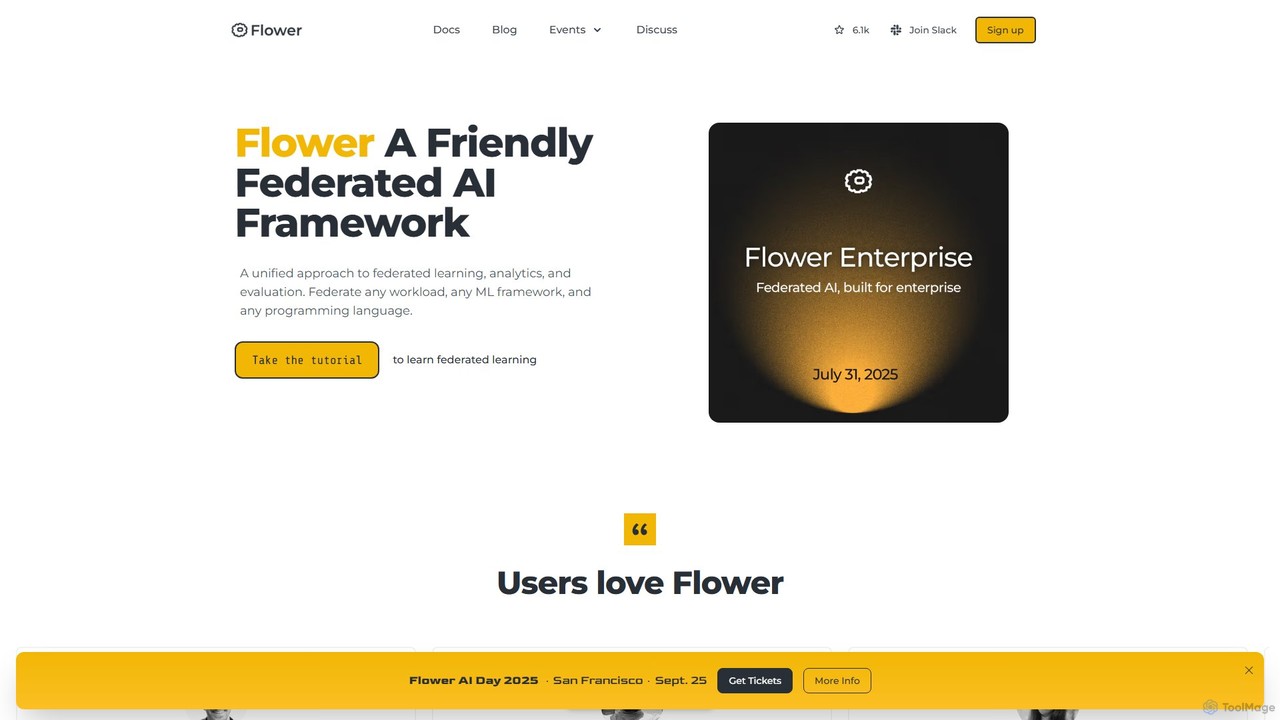
Flower is a friendly, open-source framework for federated learning, analytics, and evaluation. It enables training AI models on decentralized data across various devices and platforms without compromising privacy, supporting numerous ML frameworks like PyTorch, TensorFlow, and Hugging Face.
PyBrain is a modular and flexible open-source Machine Learning Library for Python. It provides powerful, easy-to-use algorithms for machine learning tasks, with a particular focus on neural networks, reinforcement learning, and unsupervised learning. It is designed to be accessible for beginners while remaining powerful enough for research purposes.
Compare product focus, pricing models and audiences. Highlighted rows indicate different listed information; unknown pricing does not mean free.
| Quick facts | Flower | PyBrain |
|---|---|---|
| Pricing model | Free | Free |
| Product type | Web | Web |
| Primary focus | Frameworks | Libraries & Frameworks |
| Audience and roles | No data available | No data available |
| Categories | Frameworks · Machine Learning · Decentralized Ai | Libraries & Frameworks · Machine Learning · Research |
| Added | Aug 2, 2025 | Aug 14, 2025 |
| Updated | Nov 19, 2026 | Nov 19, 2026 |
Explore the listed product descriptions, features and workflows. Taxonomy labels alone are not feature evaluations.
Flower is a comprehensive, open-source framework designed to unify federated learning, federated analytics, and federated evaluation. It addresses the growing challenges of privacy, data regulation (like GDPR and CCPA), and data volume in modern machine learning. Instead of the traditional approach of centralizing data for training, Flower champions a decentralized method: it moves the computation (model training) to where the data resides. This privacy-by-design approach allows organizations and developers to build powerful AI models by collaborating on sensitive, distributed datasets without ever exposing the raw data.
Built for scalability and ease of use, Flower is designed to be accessible to both researchers and production engineers. It allows for a smooth transition from a research prototype to a large-scale production system with minimal engineering overhead. The framework is trusted and used by leading organizations like Mozilla, and praised by researchers for its efficiency and simplicity.
Getting started with Flower is straightforward, especially for developers familiar with Python and popular machine learning libraries. The process can be broken down into a few simple steps:
pip install flwr[simulation].flwr new and follow the interactive prompts to select your preferred ML framework (e.g., TensorFlow, PyTorch).flwr run ..Flower offers extensive documentation, including quickstart guides and tutorials for a wide array of frameworks such as PyTorch, TensorFlow, Hugging Face, JAX, scikit-learn, and XGBoost, making it easy to federate existing projects.
Flower's privacy-preserving nature unlocks AI applications in numerous sensitive domains:
The primary advantage of Flower is its ability to enable machine learning in scenarios where it was previously impossible due to privacy, legal, or logistical constraints. It democratizes access to collaborative AI by providing an open, flexible, and powerful tool. Its framework-agnostic design ensures developers can leverage their existing skills and codebases. The strong community on Slack and GitHub provides excellent support, and the comprehensive documentation and examples lower the barrier to entry for federated learning.
Flower is an open-source project licensed under the Apache 2.0 License. It is completely free to use for both academic and commercial purposes. The development is supported by a vibrant community of contributors and commercial partners.
PyBrain (Python-Based Reinforcement Learning, Artificial Intelligence, and Neural Network Library) is a versatile and powerful open-source library for machine learning in Python. Although it is an older library compared to modern frameworks like TensorFlow or PyTorch, it remains a valuable tool for educational purposes and for researchers who need a simple, transparent, and flexible environment for prototyping algorithms, especially in the realms of neural networks and reinforcement learning.
The core philosophy of PyBrain is modularity. It allows users to build complex neural network architectures and training scenarios by connecting simple, reusable components. This makes it an excellent tool for learning the fundamental concepts of machine learning, as users can see how different parts (datasets, networks, trainers) interact. It supports a wide range of network types, including feed-forward networks, recurrent networks, and even Long Short-Term Memory (LSTM) networks, which were a significant feature at the time of its development.
Using PyBrain is straightforward for anyone familiar with Python. The typical workflow involves these steps:
pip install pybrain.buildNetwork for creating networks, SupervisedDataSet for data, and BackpropTrainer for training.buildNetwork shortcut for standard feed-forward networks or manually construct more complex, custom architectures, including recurrent connections.SupervisedDataSet, which holds input and target pairs.train() or trainUntilConvergence() method to start the learning process. The trainer will iteratively adjust the network's weights to minimize the error on the dataset.activate() method to make predictions on new, unseen data.PyBrain is well-suited for a range of applications, particularly in academic and prototyping contexts:
Despite the emergence of newer frameworks, PyBrain holds several key advantages:
PyBrain is an open-source project distributed under the BSD license. It is completely free for academic, personal, and commercial use. There are no pricing plans, subscriptions, or hidden costs. Development and maintenance are driven by community contributions.
Their taxonomy shows where the products overlap and where each one has a more distinct focus. Unknown fields are shown explicitly and are never filled with assumptions.
Traffic is shown on the same scale so differences in market visibility are not visually understated.
Both charts share the same months and vertical scale. Each tool identifies its latest reporting month; missing months are left blank, not counted as zero. Regional and source visit counts are estimates calculated from the reported shares.
| Country/region | Percentage | Estimated visits |
|---|---|---|
| 🇧🇷Brazil | 37.03% | 29.2K |
| 🇺🇸United States | 20.99% | 16.6K |
| 🇮🇳India | 17.3% | 13.7K |
| 🇩🇪Germany | 13.13% | 10.4K |
| 🇵🇱Poland | 11.55% | 9.1K |
| Source type | Percentage | Estimated visits |
|---|---|---|
| Direct | 79.68% | 62.9K |
| Referral | 18.58% | 14.7K |
| 1.74% | 1.4K |
No data available
Ratings, comments, favorites, and likes are community signals—not a substitute for product fit.
This page is assembled from ToolMage product listings, taxonomy, traffic statistics and on-site user feedback. It is not a hands-on test or an independent review.