ToolMage
Sign in

AI TOOL COMPARISON

PyBrain vs PyTorch

What is the difference, and which fits your workflow? Compare features, usage, pricing models and traffic side by side.

Jump to key differences

Product overview

PyBrain Product overview

PyBrain is a modular and flexible open-source Machine Learning Library for Python. It provides powerful, easy-to-use algorithms for machine learning tasks, with a particular focus on neural networks, reinforcement learning, and unsupervised learning. It is designed to be accessible for beginners while remaining powerful enough for research purposes.

Preview

PyTorch Product overview

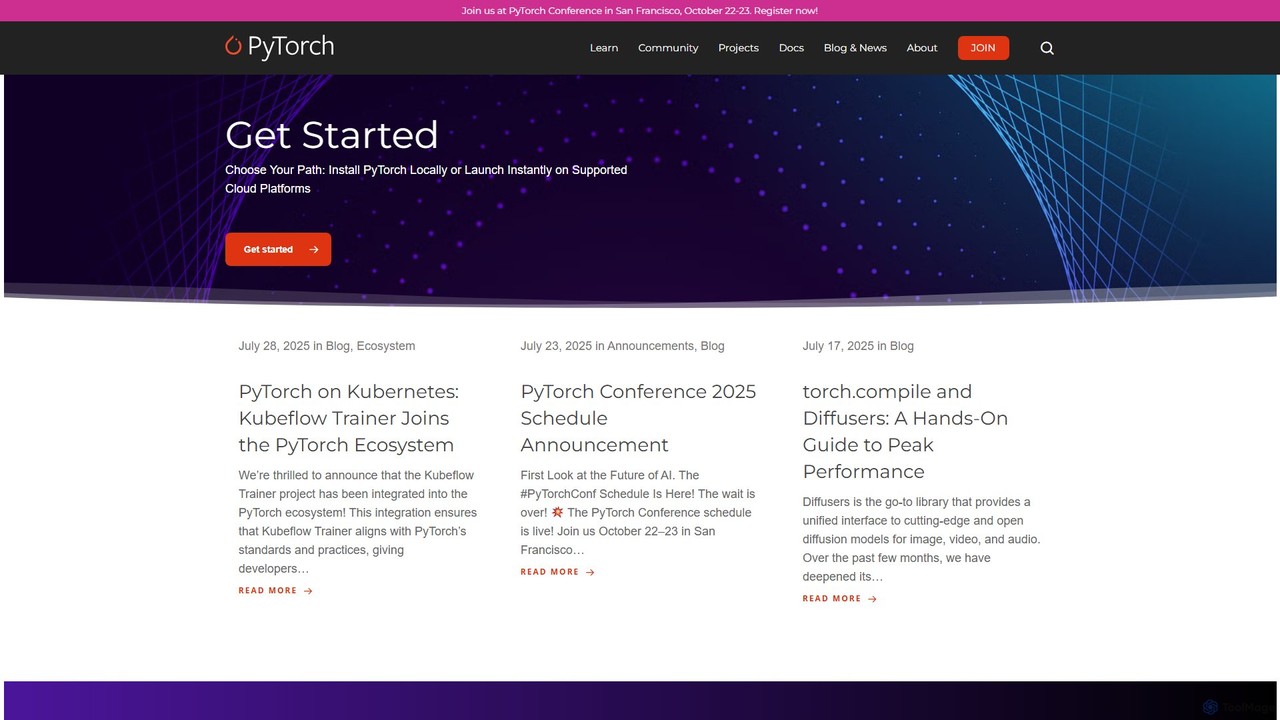
PyTorch is an open-source machine learning framework based on the Torch library, used for applications such as computer vision and natural language processing. It offers a flexible, Python-first environment that accelerates the path from research prototyping to production deployment.

Preview

Quick facts

Compare product focus, pricing models and audiences. Highlighted rows indicate different listed information; unknown pricing does not mean free.

PyBrain VS PyTorch — Quick facts
Quick factsPyBrainPyTorch
Pricing modelFreeFree
Product typeWebWeb
Primary focusLibraries & FrameworksDeep Learning
Audience and rolesNo data availableNo data available
CategoriesLibraries & Frameworks · Machine Learning · ResearchDeep Learning · Framework · Machine Learning
AddedAug 14, 2025Aug 17, 2025
UpdatedNov 19, 2026Nov 19, 2026

Features, usage and use cases

Explore the listed product descriptions, features and workflows. Taxonomy labels alone are not feature evaluations.

PyBrain

PyBrain (Python-Based Reinforcement Learning, Artificial Intelligence, and Neural Network Library) is a versatile and powerful open-source library for machine learning in Python. Although it is an older library compared to modern frameworks like TensorFlow or PyTorch, it remains a valuable tool for educational purposes and for researchers who need a simple, transparent, and flexible environment for prototyping algorithms, especially in the realms of neural networks and reinforcement learning.

The core philosophy of PyBrain is modularity. It allows users to build complex neural network architectures and training scenarios by connecting simple, reusable components. This makes it an excellent tool for learning the fundamental concepts of machine learning, as users can see how different parts (datasets, networks, trainers) interact. It supports a wide range of network types, including feed-forward networks, recurrent networks, and even Long Short-Term Memory (LSTM) networks, which were a significant feature at the time of its development.

How to use PyBrain

Using PyBrain is straightforward for anyone familiar with Python. The typical workflow involves these steps:

  1. Installation: PyBrain can be easily installed using pip: pip install pybrain.
  2. Import Modules: Import the necessary components from the library, such as buildNetwork for creating networks, SupervisedDataSet for data, and BackpropTrainer for training.
  3. Define Network Architecture: Create a neural network. You can use the buildNetwork shortcut for standard feed-forward networks or manually construct more complex, custom architectures, including recurrent connections.
  4. Create a Dataset: Structure your data into a PyBrain-compatible format. For supervised learning, this is typically the SupervisedDataSet, which holds input and target pairs.
  5. Initialize a Trainer: Choose a training algorithm, such as backpropagation, and create a trainer instance. The trainer connects the network, the dataset, and the learning algorithm.
  6. Train the Model: Call the trainer's train() or trainUntilConvergence() method to start the learning process. The trainer will iteratively adjust the network's weights to minimize the error on the dataset.
  7. Activate and Test: Once trained, use the network's activate() method to make predictions on new, unseen data.

Core Features of PyBrain

  • Neural Networks: Comprehensive support for various network types, including Feed-Forward Networks (FFN), Recurrent Neural Networks (RNN), and Long Short-Term Memory (LSTM).
  • Learning Algorithms: Implements a variety of learning paradigms, including supervised, unsupervised, and reinforcement learning. This includes algorithms like backpropagation, Q-learning, and SARSA.
  • Modularity and Flexibility: Networks, datasets, trainers, and experiments are all distinct objects, allowing for high flexibility in designing and testing custom models and learning scenarios.
  • Python-Native: Written purely in Python, making it easy to read, understand, and extend without needing to compile external code.
  • Educational Focus: Its clear and explicit structure makes it an excellent tool for teaching and learning the underlying principles of neural networks and machine learning.

Use Cases for PyBrain

PyBrain is well-suited for a range of applications, particularly in academic and prototyping contexts:

  • Academic Research: Researchers can quickly implement and test novel network architectures or variations of learning algorithms.
  • Educational Tool: It is widely used in university courses and by individuals to learn the fundamentals of neural networks, backpropagation, and reinforcement learning.
  • Prototyping Simple Models: Developers can use it to build and validate simple models for tasks like time-series prediction, classification, and regression before moving to more complex, production-level frameworks.
  • Reinforcement Learning Experiments: Its built-in support for agents, environments, and RL algorithms makes it ideal for experimenting with tasks like pole-balancing, simple mazes, or other classic control problems.

Advantages of PyBrain

Despite the emergence of newer frameworks, PyBrain holds several key advantages:

  • Simplicity and Intuitiveness: The API is straightforward and easy to grasp, lowering the barrier to entry for beginners in machine learning.
  • Transparency: As a pure Python library, the source code is highly readable, allowing users to delve into the implementation details of algorithms.
  • Open Source: It is completely free to use, modify, and distribute, fostering a collaborative and open environment for learning and research.
  • Lightweight: It has minimal dependencies and is less resource-intensive than larger frameworks, making it suitable for smaller-scale projects and learning environments.

Pricing and Plans

PyBrain is an open-source project distributed under the BSD license. It is completely free for academic, personal, and commercial use. There are no pricing plans, subscriptions, or hidden costs. Development and maintenance are driven by community contributions.

PyTorch

PyTorch is a premier open-source machine learning library developed to provide a seamless path from research and prototyping to production deployment. Maintained by the PyTorch Foundation, a part of the Linux Foundation, it has become a cornerstone for AI researchers and developers worldwide. PyTorch is renowned for its Python-first integration, flexibility, and extensive ecosystem, making it a go-to choice for a wide range of deep learning applications, including computer vision, natural language processing (NLP), and generative AI.

The framework is built around the concept of tensors, which are multi-dimensional arrays similar to NumPy arrays but with the added capability of running on GPUs for accelerated computing. Its imperative programming style and dynamic computation graphs (eager execution) allow for intuitive model building and debugging, making the development process highly interactive and efficient.

How to use PyTorch

Getting started with PyTorch is straightforward for developers of all levels. You can choose between a local installation or using a pre-configured cloud environment.

  1. Local Installation: Visit the official PyTorch website and use the interactive installation matrix. You can select your operating system (Linux, Mac, Windows), package manager (Pip, Conda), programming language (Python, C++/Java), and compute platform (CPU, CUDA for NVIDIA GPUs, ROCm for AMD GPUs). The website will generate the precise command for a stable or nightly build installation. For example, a common command is pip3 install torch torchvision torchaudio.
  2. Cloud Platforms: PyTorch is extensively supported on major cloud services like Amazon Web Services (AWS), Google Cloud Platform (GCP), and Microsoft Azure. You can launch instances with PyTorch pre-installed via services like Amazon SageMaker, Google Cloud Deep Learning VMs, and Azure Machine Learning, eliminating setup friction and enabling easy scaling.
  3. Learning Resources: PyTorch offers comprehensive documentation, in-depth tutorials for beginners and advanced users, and practical recipes. These resources cover everything from the basics of tensors to advanced topics like distributed training and model optimization.

Core Features of PyTorch

  • Dynamic Computation Graph: PyTorch's eager execution mode builds the computation graph on-the-fly, offering unparalleled flexibility and making debugging simpler.
  • Production Ready with TorchScript & TorchServe: Seamlessly transition models from research (eager mode) to production (graph mode) using TorchScript for optimization. TorchServe provides a performant and scalable tool for serving PyTorch models.
  • Distributed Training: The `torch.distributed` package enables scalable distributed training and performance optimization, allowing you to train large models on multiple GPUs or machines efficiently.
  • Robust Ecosystem: A rich ecosystem of tools and libraries extends PyTorch's capabilities. Key projects include torchvision for computer vision, torchtext for NLP, torchaudio for audio processing, Captum for model interpretability, and PyTorch Geometric for deep learning on graphs.
  • Hardware Acceleration: Excellent support for NVIDIA (CUDA) and AMD (ROCm) GPUs, as well as other accelerators, ensuring high-performance computation for demanding deep learning tasks.
  • C++ Frontend (LibTorch): A pure C++ interface for PyTorch that allows for high-performance, low-latency deployment in environments where Python is not suitable.

Use Cases for PyTorch

PyTorch is versatile and powers a vast array of state-of-the-art AI applications:

  • Computer Vision: Image classification, object detection, semantic segmentation, and image generation using libraries like `torchvision` and pre-trained models.
  • Natural Language Processing: Building complex models for machine translation, text summarization, sentiment analysis, and question answering. It is the foundation for many Transformer-based architectures.
  • Generative AI: Developing and training cutting-edge diffusion models for generating high-quality images, video, and audio, as highlighted by its integration with libraries like Diffusers.
  • Academic Research: Its flexibility and ease of use make it the preferred framework for researchers prototyping and experimenting with new algorithmic approaches.
  • Reinforcement Learning: Creating and training agents for tasks in gaming, robotics, and optimization.

Advantages of PyTorch

PyTorch stands out due to its developer-centric design and powerful features:

  • Pythonic and Intuitive: Its API is designed to feel natural to Python developers, reducing the learning curve and improving productivity.
  • Flexibility for Research: The dynamic graph system is ideal for complex architectures and research that requires a high degree of flexibility.
  • Strong Community and Support: Backed by the Linux Foundation and a massive global community of developers and researchers, ensuring continuous development, a wealth of tutorials, and quick support.
  • Seamless Path to Production: Tools like TorchScript and TorchServe bridge the gap between research and deployment, a historical challenge in machine learning.

Pricing and Plans

PyTorch is a completely free and open-source project licensed under a modified BSD license. It is available for anyone to use, modify, and distribute without any cost. The development is supported by the PyTorch Foundation and its members, including major technology companies, ensuring its long-term sustainability and accessibility to the community.

Positioning

Their taxonomy shows where the products overlap and where each one has a more distinct focus. Unknown fields are shown explicitly and are never filled with assumptions.

Categories

Shared
Machine Learning
Only PyBrain
Libraries & FrameworksResearch
Only PyTorch
Deep LearningFramework

Tags

Shared
deep learningmachine learningopen sourcepython
Only PyBrain
data scienceeducationlibraryneural networkreinforcement learning
Only PyTorch
computer visionframeworkGPUneural networksNLPtensor

Audience and roles

Shared
No listed items
Only PyBrain
No listed items
Only PyTorch
No listed items

Traffic comparison

Traffic is shown on the same scale so differences in market visibility are not visually understated.

How to interpret the traffic data

Both charts share the same months and vertical scale. Each tool identifies its latest reporting month; missing months are left blank, not counted as zero. Regional and source visit counts are estimates calculated from the reported shares.

PyBrain

No data available

PyTorch monthly traffic:

Latest traffic · 2026-05

Monthly visits
1.5M
Avg. visit duration
2:20
Pages per visit
2.64
Bounce rate
43.95%
Data updated 2026-06-15

Monthly traffic trend

  • 2025-09: 2.1M
  • 2026-01: 1.9M
  • 2026-02: 1.7M
  • 2026-03: 1.9M
  • 2026-04: 1.8M
  • 2026-05: 1.5M

Top regions

Top 5 countries/regions
Country/regionPercentageEstimated visits
🇺🇸United States48.01%703.7K
🇨🇳China18.96%277.9K
🇮🇳India15.53%227.6K
🇬🇧United Kingdom9.81%143.8K
🇷🇺Russia7.69%112.7K

Traffic sources

Source typePercentageEstimated visits
Direct73.42%1.1M
Referral24.55%359.8K
Email2.03%29.8K

Search keywords

py torchpytorchpytorch installtorchtorch install

Community signals

Ratings, comments, favorites, and likes are community signals—not a substitute for product fit.

PyBrain

Rating
No data available
Comments
0
Favorites
164
Likes
163

PyTorch

Rating
No data available
Comments
0
Favorites
223
Likes
236

PyBrain vs PyTorch · Comparison FAQ

What do PyBrain and PyTorch have in common?
Both tools are listed under Machine Learning. These categories indicate overlapping use cases; compare their detailed descriptions for workflows, capabilities and limitations.
Are PyBrain and PyTorch free?
Listed pricing models: PyBrain — Free; PyTorch — Free. Missing pricing is not proof of a free plan, and freemium does not mean every feature is free. Check official sites for current plans, limits and trials.
How should I choose between PyBrain and PyTorch?
The primary listed category is Libraries & Frameworks for PyBrain, and Deep Learning for PyTorch. Compare features, steps and use cases, then verify pricing, data permissions and deployment needs. This page does not include hands-on testing and does not declare a winner from traffic or tags.

Sources and comparison methodology

This page is assembled from ToolMage product listings, taxonomy, traffic statistics and on-site user feedback. It is not a hands-on test or an independent review.

  • Feature and plan descriptions reflect information in the listings, not real-time guarantees. Verify pricing, quotas, availability and privacy terms on the official sites.
  • Traffic uses the reporting months shown. Missing statistics do not mean zero visits, and different periods do not establish growth or superiority. Regional and source visit counts are estimates based on shares.
  • Different tags indicate differences in the listings, not proof that the other product lacks a capability. Ratings, favorites and visits are not used to declare a winner.

Related comparisons