ToolMage
Sign in

Best 1 World Generation AI tools for 3D & Design

Popular World Generation AI tools in 3D & Design include Marble, helping you work more efficiently.

Marble

Marble

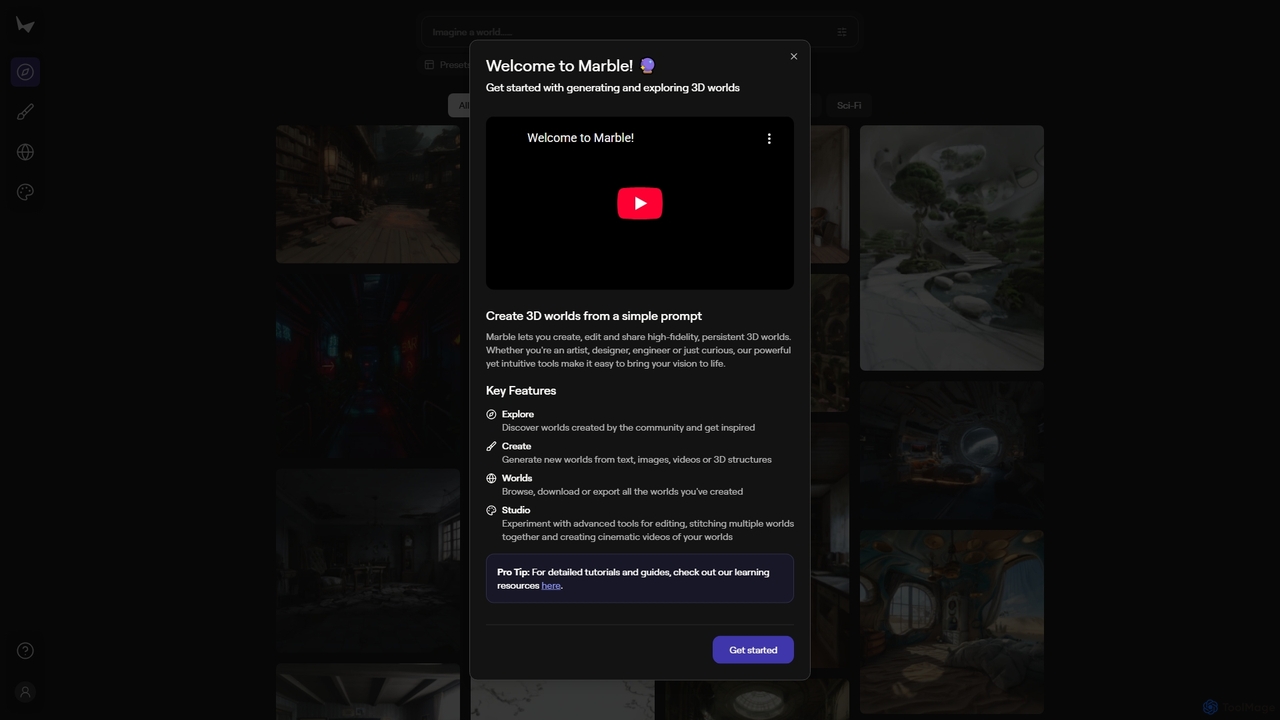
Marble is an innovative AI tool that empowers artists, designers, and enthusiasts to create, edit, and share high-fidelity, persistent 3D worlds from simple prompts. It transforms text, images, videos, or 3D structures into immersive virtual environments, fostering creativity and exploration within a vibrant community.

World Generation
Visits 155.2KFavorites 142Likes 149

About World Generation

World Generation tools are AI-powered solutions designed to automatically create virtual environments, landscapes, and entire digital worlds. Leveraging advanced algorithms, procedural generation, and machine learning, these tools automate the complex and time-consuming process of crafting immersive digital spaces. They offer unparalleled speed and detail in generating diverse terrains, biomes, and object placements, significantly accelerating workflows in various creative industries.

Core Features

  • Procedural Terrain Generation: Automatically creates diverse and realistic landscapes, including mountains, valleys, rivers, and coastlines.
  • Biome & Ecosystem Simulation: Designs and populates worlds with varied biomes like forests, deserts, and oceans, complete with natural elements.
  • Asset Placement & Distribution: Intelligently places objects such as trees, rocks, buildings, and props within the generated environment.
  • Stylized & Realistic Outputs: Generates worlds in a wide range of artistic styles, from photorealistic to fantastical and abstract.
  • Interactive Editing & Refinement: Provides intuitive tools for users to fine-tune, modify, and customize the generated worlds to their specific vision.

Use Cases

These tools are indispensable for game developers creating expansive open-world maps, filmmakers designing elaborate digital sets for visual effects, and architects visualizing large-scale urban or natural environments. They streamline the creation of complex digital landscapes, enabling rapid iteration and exploration of design concepts.

How to Choose

When selecting a world generation tool, consider its generation scope and detail to match your project's scale and complexity. Evaluate the level of customization and artistic control it offers, along with its integration capabilities with your existing 3D software or game engines. Finally, assess the richness of its built-in asset library and ease of importing custom assets.

World Generation use cases

1

Game Development for Open Worlds

Game designers and developers utilize world generation tools to rapidly create expansive, detailed open-world maps. By defining parameters for terrain, biomes, and points of interest, they can generate diverse landscapes, cities, and dungeons, significantly reducing manual design time and allowing for more iterative gameplay testing and exploration.

2

Film & VFX Production for Digital Sets

VFX artists and filmmakers leverage world generation tools to create realistic or fantastical digital environments for movie scenes, commercials, and animations. This allows them to quickly prototype and render vast landscapes, alien planets, or historical settings, saving significant time and resources compared to traditional 3D modeling and set construction.

3

Architectural & Urban Planning Visualization

Architects, urban planners, and landscape designers use these tools to generate large-scale cityscapes, natural environments, or complex architectural sites. This facilitates the visualization of projects within their broader environmental context, aiding in design review, stakeholder presentations, and impact assessments with highly detailed and customizable digital models.

4

Virtual Reality (VR) Environment Creation

VR developers and content creators employ world generation tools to build immersive and interactive virtual worlds for training simulations, educational experiences, or entertainment. The ability to quickly generate diverse and detailed environments is crucial for prototyping and delivering rich, engaging VR experiences without extensive manual asset creation.

5

Concept Art & Pre-visualization

Concept artists and illustrators utilize world generation tools to quickly generate multiple world variations and landscapes. This allows them to explore diverse ideas, establish visual direction, and create compelling backdrops for their projects in the early stages of development, accelerating the creative process and client feedback loops.

6

Tabletop RPG Map Generation

Dungeon Masters and game masters for tabletop role-playing games (TTRPGs) use world generation tools to create unique and detailed maps for their campaigns. This includes generating dungeons, towns, wilderness areas, and entire continents, providing rich visual aids and inspiring new narrative possibilities for their players, saving countless hours of manual map drawing.

World Generation FAQ

What is AI World Generation?

AI World Generation refers to using artificial intelligence and procedural algorithms to automatically create virtual environments, landscapes, and entire digital worlds. These tools leverage machine learning to understand design principles and generate complex, detailed, and often unique terrains, biomes, and object placements. They significantly accelerate the creation of immersive digital spaces for various applications like games, films, and architectural visualization.

How does AI World Generation differ from traditional 3D modeling?

Traditional 3D modeling involves manually sculpting, texturing, and placing every element in a scene, offering precise control but being time-consuming. AI World Generation, conversely, automates much of this process. Users define parameters or provide high-level concepts, and the AI generates vast, detailed worlds procedurally. While less granular control initially, it allows for rapid iteration and the creation of much larger, more complex environments with unprecedented speed, often requiring less manual effort.

What are the key features to look for in a World Generation tool?

When choosing a world generation tool, consider its procedural generation capabilities for diverse terrains and biomes, asset integration for populating the world, and customization options to fine-tune generated results. Also, evaluate its export formats for compatibility with your target game engine or 3D software, and the scale of worlds it can efficiently handle. User-friendliness and community support are also important.

Who benefits most from using World Generation tools?

World Generation tools are highly beneficial for game developers needing vast open worlds, film and VFX artists creating digital sets, and architects/urban planners visualizing large-scale environments. Virtual reality content creators also leverage them for immersive experiences. Essentially, anyone requiring the rapid creation of complex, detailed, and often unique virtual landscapes and environments can significantly benefit from these AI-powered solutions.

Can AI World Generation create both realistic and stylized worlds?

Yes, modern AI World Generation tools are highly versatile and can create both realistic and stylized worlds. By adjusting parameters, inputting specific artistic styles, or using different algorithms, users can guide the AI to generate environments that mimic real-world geography and ecosystems, or produce fantastical, abstract, or cartoon-like landscapes. Many tools offer presets and extensive controls to achieve a wide range of visual aesthetics, catering to diverse project needs.