Ai Assistant Best in category 1 results Prompt Engineering AI Tool

Popular AI tools in the Prompt Engineering field of Ai Assistant include Readit, etc., helping you quickly improve efficiency.

Readit

Readit

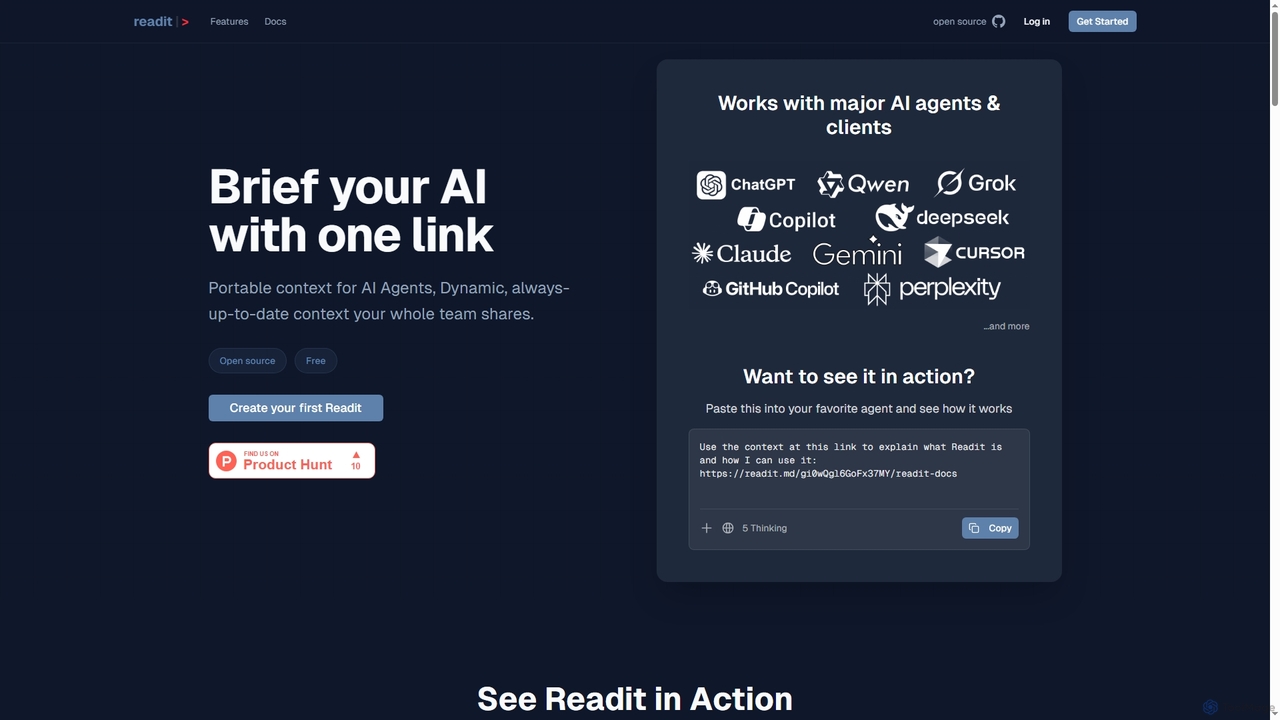
Readit is an open-core platform providing portable, dynamic, and always-up-to-date context for AI agents and teams. It centralizes …

6.4K

About Prompt Engineering

Prompt Engineering tools are a specialized class of AI assistants designed for creating, testing, optimizing, and managing prompts for large language models (LLMs). These platforms move beyond simple trial-and-error by providing a structured environment to systematically improve AI-generated outputs. They enable users to achieve greater consistency, accuracy, and control over model behavior, which is crucial for building reliable AI applications. By treating prompts as manageable software assets, these tools form a critical layer in the professional AI development workflow.

Core Features

  • Prompt Management & Versioning: Centralize, organize, and track changes to prompts like code, allowing for rollbacks and historical analysis.
  • A/B Testing & Evaluation: Systematically compare the performance of different prompt variations against defined metrics to find the most effective version.
  • Prompt Templating: Create reusable prompt structures with dynamic variables for easy adaptation across different scenarios and applications.
  • Collaboration Workspace: Enable teams to work together on creating, reviewing, and deploying prompts in a shared environment.
  • Performance Analytics: Monitor key metrics such as token usage, latency, and cost associated with different prompts to optimize efficiency.

Use Cases

These tools are essential for developers building AI-powered features, content teams aiming for a consistent brand voice in AI-generated materials, and customer support operations creating reliable automated responses. They are also widely used by AI engineers and data scientists to fine-tune model interactions for specific tasks like data extraction or complex reasoning, ensuring predictable and high-quality results at scale.

How to Choose

When selecting a Prompt Engineering tool, consider its compatibility with the LLMs you use (e.g., GPT, Claude, Llama). Evaluate its integration capabilities, including API access and SDKs for embedding into your applications. Assess the sophistication of its testing and evaluation features, and ensure its collaboration tools match your team's size and workflow. Finally, analyze the pricing model based on usage, features, and team size.

Prompt EngineeringUse Cases

1

Standardizing Marketing Copy Generation

A marketing team uses a prompt engineering platform to create a centralized library of prompts for generating social media posts, ad copy, and email newsletters. By using prompt templates with variables for product names, target audiences, and key messages, they ensure all AI-generated content maintains a consistent brand voice and style. The A/B testing feature allows them to refine prompts to maximize engagement rates, leading to more effective campaigns without manual oversight for every piece of content.

2

Developing Reliable AI Customer Support Agents

A customer support team aims to build an AI agent that can handle complex queries accurately. They use a prompt engineering tool to design and test conversational flows. The evaluation feature allows them to run batch tests with hundreds of real-world user questions, automatically scoring the AI's responses for accuracy, tone, and helpfulness. This systematic approach helps them identify and fix weaknesses in their prompts before deploying the agent, significantly improving first-contact resolution rates and customer satisfaction.

3

Optimizing API Costs for an AI-Powered Application

A developer is building a SaaS product with an AI feature that summarizes articles. They use a prompt engineering tool to experiment with different prompt structures and model parameters. The platform's analytics dashboard shows detailed token usage and latency for each prompt version. By comparing a complex, single-shot prompt with a simpler, chain-of-thought prompt, they discover the latter produces slightly better summaries while using 30% fewer tokens. This data-driven optimization allows them to reduce their LLM API costs significantly while improving performance.

4

Collaborative Prompt Development for a Content Agency

A content agency with multiple writers uses a prompt engineering tool as a central hub for prompt management. Each client has a dedicated folder with prompts tailored to their specific tone of voice and content pillars. New writers can quickly get up to speed by using these pre-approved prompts. The version control feature allows the head of content to track changes, review suggestions from the team, and roll back to a previous version if a new prompt underperforms, ensuring consistent quality across all client work.

5

Refining Prompts for Structured Data Extraction

A data analyst needs to extract key information (company name, revenue, date) from thousands of unstructured news articles. Using a prompt engineering tool, they craft a prompt that instructs the LLM to return the data in a specific JSON format. They create a test suite with 50 sample articles and expected JSON outputs. The tool automatically runs the prompt against the test suite and flags any discrepancies. This allows the analyst to iteratively refine the prompt's instructions until it achieves over 99% accuracy, automating a previously manual and time-consuming task.

6

Managing Prompt Versions for Regulatory Compliance

A fintech company uses an AI model to generate financial advice summaries. Due to strict regulations, they must be able to audit why the AI produced a specific output at any given time. They use a prompt engineering tool with version control. Every change to a prompt is logged with a timestamp and the author's name. When a new LLM version is released, they can re-run their evaluation suite on all critical prompts to ensure performance hasn't degraded. This creates a fully auditable trail, ensuring compliance and maintaining trust in their AI system.

Prompt EngineeringFrequently Asked Questions