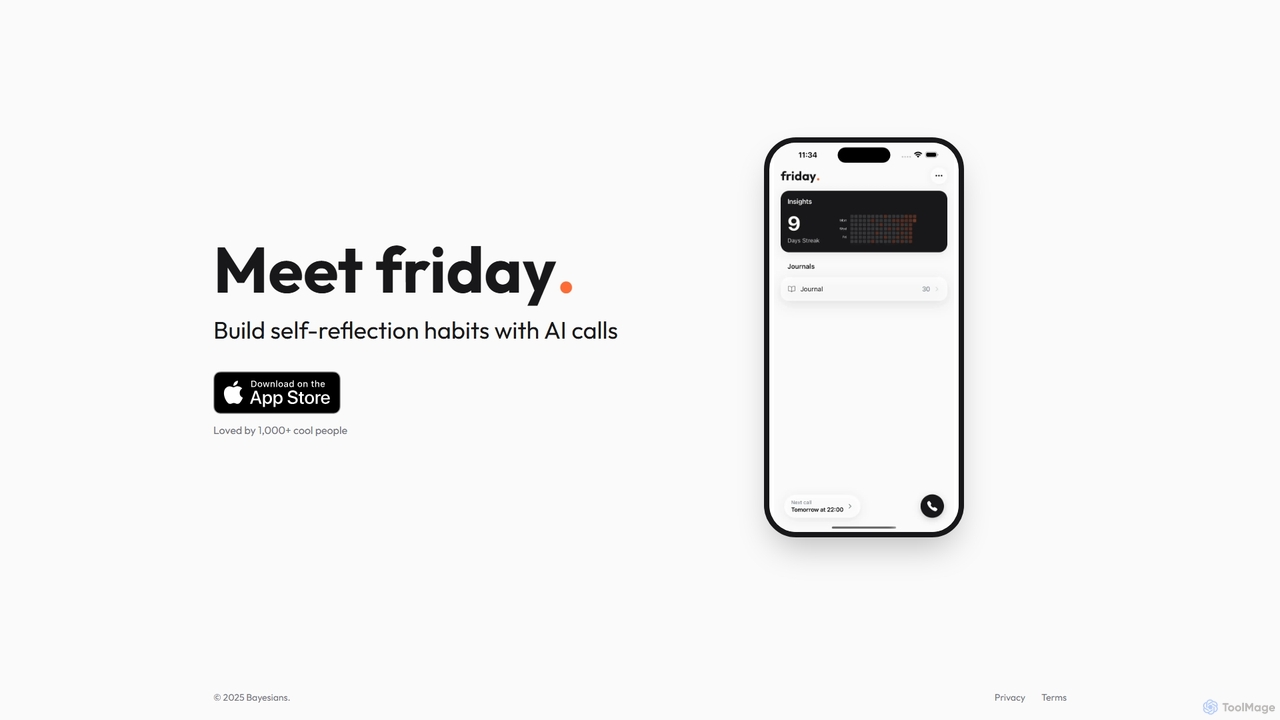
Friday
Friday is an innovative AI tool designed to help users cultivate consistent self-reflection habits through engaging AI-powered calls. …
Friday is an innovative AI tool designed to help users cultivate consistent self-reflection habits through engaging AI-powered calls. It provides a unique, interactive way to process thoughts and foster personal growth daily, trusted by over 1,000 individuals.
About Reflection
AI Reflection tools are a specialized type of AI assistant designed to help users analyze their thoughts, emotions, and activities to gain self-awareness and personal insights. These tools leverage Natural Language Processing (NLP) and pattern recognition to process journal entries, mood logs, or productivity data. By identifying recurring themes, emotional trends, and behavioral patterns, they provide structured feedback and guided prompts for deeper introspection. This process facilitates personal growth, improves mental well-being, and supports more informed decision-making.
Core Features
- Pattern Recognition: Identifies recurring themes, emotions, and cognitive biases in text entries or data.
- Guided Journaling Prompts: Offers intelligent, context-aware questions to encourage deeper self-exploration.
- Data Synthesis: Aggregates and visualizes data from various sources like calendars or notes for a holistic review.
- Sentiment Analysis: Tracks emotional tone over time to provide insights into mood fluctuations and triggers.
- Goal & Habit Analysis: Connects daily actions to long-term goals, highlighting progress and potential obstacles.
Use Cases
These tools are valuable for individuals focused on mental health and personal development, professionals seeking to optimize their productivity, and teams conducting project retrospectives. For example, a therapist might recommend an AI reflection tool to a client for daily thought logging, while a manager could use one to analyze their own decision-making patterns over a quarter.
How to Choose
When selecting an AI Reflection tool, prioritize data privacy and security policies, as you'll be sharing sensitive information. Evaluate the quality of its analytical insights and the relevance of its guided prompts. Also, check for integration capabilities with other apps you use, such as calendars or note-taking software, and ensure the user interface is conducive to thoughtful engagement.

ReflectionUse Cases
Enhance Personal Growth with Guided Journaling
A user seeking self-improvement uses an AI reflection tool for daily journaling. They write about their experiences, challenges, and feelings. The AI analyzes the text, identifies recurring negative thought patterns (like catastrophizing), and provides gentle prompts based on Cognitive Behavioral Therapy (CBT) principles. For instance, it might ask, 'I noticed you used the word 'failure' several times this week. What's another way to look at this situation?' This guided process helps the user reframe their perspective, build resilience, and track their emotional progress over months, leading to greater self-awareness.
Optimize Weekly Work Productivity
A remote worker connects their digital calendar and to-do list app to an AI reflection assistant. At the end of each week, the tool generates a personalized productivity report. It visualizes how time was allocated between deep work, meetings, and administrative tasks. The AI might highlight that 80% of meetings occurred on Tuesdays, suggesting a 'no-meeting Wednesday' to improve focus. It can also identify which types of tasks are most frequently postponed, helping the user recognize and address procrastination triggers or workflow bottlenecks.
Improve Mental Wellness Through Mood Tracking
An individual managing stress uses an AI reflection tool as a daily mental wellness companion. They log their mood throughout the day and briefly note the context. The AI applies sentiment analysis to these entries and correlates them with activities from a connected calendar. Over time, it reveals patterns, such as a consistent dip in mood after certain types of meetings or an improvement after exercise. The tool provides visualizations and summaries, empowering the user and their therapist with objective data to develop effective coping strategies.
Facilitate Team Project Retrospectives
A project manager uses an AI reflection tool to streamline sprint retrospectives. Team members anonymously submit feedback on what went well, what didn't, and ideas for improvement. The AI processes this qualitative data, groups similar comments into key themes (e.g., 'Communication Gaps,' 'Tooling Issues'), and performs sentiment analysis on each theme. This provides an objective, data-driven summary that depersonalizes feedback and helps the team focus discussions on the most impactful areas, making retrospectives more efficient and constructive.
Accelerate Learning and Knowledge Consolidation
A student uses an AI reflection tool to consolidate knowledge from courses. After each study session, they write a summary and list questions they still have. The AI analyzes these reflections to identify conceptual gaps or recurring points of confusion. It can then generate targeted quiz questions or suggest related topics to review. By actively reflecting on their learning process, the user moves beyond passive consumption of information, strengthening memory retention and achieving a deeper understanding of the subject matter.
Refine Decision-Making Skills
A business leader maintains a decision journal within an AI reflection tool. For each significant decision, they document the context, options, rationale, and expected outcome. Later, they record the actual result. The AI analyzes the entire journal to identify potential biases in their decision-making process, such as a tendency towards optimism bias or risk aversion. It can highlight patterns where certain types of information were consistently over or undervalued, providing critical insights for improving future strategic choices.