
Freemium
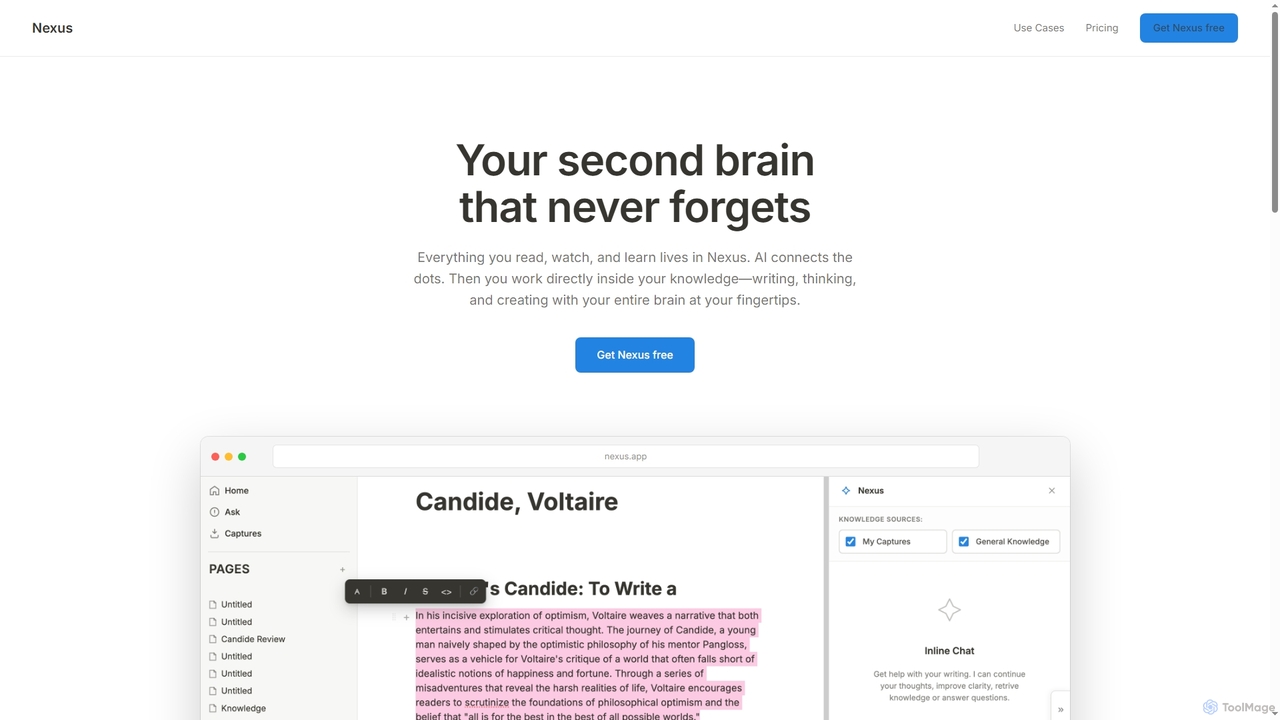
Popular Research AI tools in Ai Assistant include Nexus, helping you work more efficiently.
Research AI tools are specialized AI assistants designed to automate and enhance the process of information gathering, analysis, and synthesis. Leveraging natural language processing (NLP) and machine learning, these tools efficiently sift through vast datasets, academic papers, reports, and web content. They empower users to quickly extract key insights, identify trends, and summarize complex information, significantly accelerating discovery and decision-making across various fields.
Academics and students utilize these tools for literature reviews, thesis writing, and staying updated on new publications. Market researchers employ them to analyze consumer trends and competitive landscapes. Business analysts leverage them for industry reports and strategic planning, while content creators use them to gather factual information and background for articles and scripts.
When selecting a Research AI tool, consider its data source coverage (e.g., academic, web, proprietary), the accuracy of its summarization and extraction capabilities, and its integration with existing workflows. Evaluate the user interface for ease of use, the depth of its analytical features, and the pricing model relative to your research volume and team size.
Academic researchers and PhD students can use Research AI tools to rapidly scan thousands of scholarly articles, journals, and conference papers. By inputting research questions or keywords, the AI identifies relevant studies, extracts methodologies, findings, and gaps, and even generates initial summaries, drastically reducing the time spent on manual review and helping to build a robust foundation for their own research.
Market analysts and business strategists leverage these AI tools to monitor industry news, competitor reports, and consumer sentiment across various online platforms. The AI can identify emerging market trends, analyze competitive positioning, and synthesize data into actionable insights, enabling companies to make informed decisions on product development, marketing campaigns, and strategic investments.
Content creators, journalists, and technical writers utilize Research AI tools to quickly gather factual information, statistics, and background details for articles, blog posts, and scripts. The AI can extract key facts from multiple sources, verify information, and even help structure arguments, ensuring accuracy and depth while significantly speeding up the content development process.
Investment analysts and venture capitalists employ Research AI tools to perform rapid due diligence on potential investments. The AI can quickly process company reports, financial statements, news archives, and regulatory filings to identify risks, opportunities, and key performance indicators, providing a comprehensive overview that supports faster and more confident investment decisions.
Legal professionals can use Research AI tools to sift through vast libraries of case law, statutes, and legal documents. The AI helps identify precedents, relevant clauses, and arguments, summarizing complex legal texts and highlighting critical information pertinent to a specific case. This significantly reduces the manual effort in legal research, allowing lawyers to focus more on strategy and client advice.
Lifelong learners and professionals seeking to acquire new skills or deepen their understanding of a subject can use Research AI tools. By feeding the AI specific topics or learning objectives, it can curate relevant articles, tutorials, and summaries from diverse sources, creating a personalized learning path and accelerating knowledge acquisition without sifting through irrelevant information.
AI Research Tools are advanced software applications that use artificial intelligence, primarily natural language processing (NLP) and machine learning, to automate and enhance various stages of the research process. They are designed to help users efficiently discover, collect, analyze, summarize, and synthesize information from vast amounts of data, making complex research tasks faster and more accessible.
While traditional search engines index and retrieve documents based on keywords, AI Research Tools go further by understanding the semantic meaning and context of queries and content. They can extract specific facts, summarize entire documents, identify relationships between concepts, and analyze trends across multiple sources, offering deeper insights beyond simple information retrieval.
The primary benefits include significant time savings in data collection and analysis, improved accuracy in identifying relevant information, enhanced ability to synthesize complex data, and the capacity to uncover insights that might be missed by manual review. They empower users to conduct more comprehensive and efficient research, leading to better-informed decisions and higher-quality outputs.
A wide range of professionals and students can benefit, including academics, scientists, market researchers, business analysts, journalists, content creators, legal professionals, and anyone who regularly needs to process and understand large volumes of information. These tools are particularly valuable for tasks requiring extensive literature reviews, trend analysis, or rapid information synthesis.
When selecting an AI Research Tool, evaluate its specific functionalities (e.g., summarization, data extraction, trend analysis), the breadth and quality of its data sources, and its integration capabilities with your existing workflows. Also, consider the user-friendliness of its interface, the accuracy of its AI models, and its pricing structure to ensure it aligns with your research needs and budget.