ToolMage
Sign in

Best 2 Study Aid AI tools for Ai Assistant

Popular Study Aid AI tools in Ai Assistant include MathGPT and Assignmate, helping you work more efficiently.

MathGPT
Freemium

MathGPT

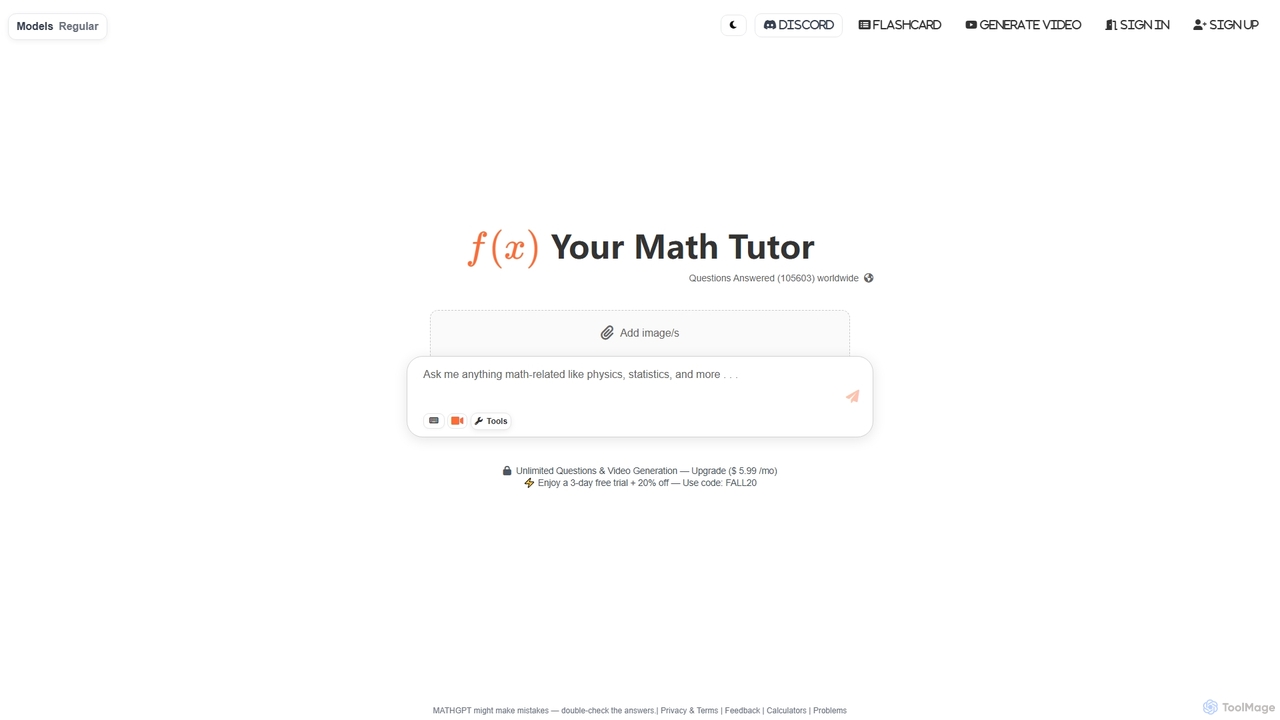
MathGPT is an advanced AI-powered math tutor and homework helper designed to provide step-by-step solutions and explanations for a vast range of mathematical and scientific problems. It features a comprehensive suite of calculators, a flashcard generator for active learning, and AI-driven video explanations, making complex concepts accessible for students and learners worldwide.

Study Aid
Visits 4.2KFavorites 108Likes 101
Assignmate
Freemium

Assignmate

Assignmate is an intelligent AI-powered platform designed for high school and college students to organize, track, and excel in their academic journey. It offers smart assignment tracking, AI study assistance, progress analytics, and collaborative tools to help students manage deadlines, understand complex concepts, and improve grades.

Study Aid
Visits 4.1KFavorites 97Likes 93

About Study Aid

AI Study Aid tools are specialized AI assistants designed to support and enhance the learning process. They leverage natural language processing (NLP) and machine learning models to interact with academic content, providing personalized assistance for students and researchers. These tools can summarize complex texts, explain difficult concepts, generate study materials, and offer step-by-step guidance on problems. Their primary value lies in making learning more efficient, accessible, and tailored to individual needs.

Core Features

  • Concept Explanation: Breaks down complex topics, theories, and jargon into simple, understandable language.
  • Automated Summarization: Condenses long articles, research papers, or book chapters into concise summaries and key points.
  • Interactive Q&A: Allows users to ask specific questions about their study materials and receive detailed answers.
  • Quiz & Flashcard Generation: Automatically creates practice questions and flashcards from notes or documents to aid revision.
  • Problem-Solving Guidance: Offers step-by-step solutions and explanations for mathematical, scientific, or coding problems.

Applicable Scenarios

These tools are widely used in academia by high school and university students for exam preparation, essay writing, and homework assistance. Researchers use them to quickly digest dense literature and identify key findings. Self-learners and professionals also utilize them for mastering new subjects or skills efficiently.

Selection Criteria

When choosing an AI Study Aid, consider the subject coverage (e.g., STEM, humanities, languages), the accuracy and reliability of the information provided, and its ability to cite sources. Also evaluate its integration with other platforms like note-taking apps, the user interface, and the privacy policy regarding your data.

Featured tool rankings

Study Aid use cases

1

Preparing for Final Exams with AI-Generated Quizzes

A university student studying biology is overwhelmed by the volume of information for their final exam. They upload their lecture notes, textbook chapters, and past papers into an AI Study Aid tool. The tool processes the content and automatically generates a series of multiple-choice quizzes and flashcards focusing on key concepts like cellular respiration and genetics. The student uses these interactive materials for daily revision, helping them identify knowledge gaps and reinforce memory, ultimately leading to better exam performance.

2

Summarizing Dense Academic Papers for Research

A postgraduate researcher needs to conduct a literature review on quantum computing but faces dozens of dense, technical papers. Instead of spending days reading each one, they use an AI Study Aid to generate concise summaries. For each paper, the tool extracts the abstract, methodology, key findings, and conclusions into a structured overview. This allows the researcher to quickly assess the relevance of each paper, saving significant time and enabling them to focus on analyzing the most critical sources for their review.

3

Getting Step-by-Step Guidance for Math Homework

A high school student is struggling with their calculus homework, specifically with integration problems. They use an AI Study Aid by taking a photo of a difficult problem. The tool doesn't just give the final answer; it provides a detailed, step-by-step solution, explaining each part of the process, from identifying the correct integration technique to performing the final calculation. This guided approach helps the student understand the underlying logic, enabling them to solve similar problems independently in the future.

4

Drafting and Outlining an Essay on a Historical Topic

A student needs to write a 2,000-word essay on the causes of World War I. They start by providing the AI Study Aid with their thesis statement and a list of primary sources. The AI then generates a structured essay outline, suggesting key arguments for each section and how the sources can be used as evidence. It also helps draft introductory and concluding paragraphs. This process provides a strong foundation, helping the student organize their thoughts and overcome writer's block, while ensuring they remain in control of the final content and analysis.

5

Practicing a New Language with a Conversation Partner

Someone learning Japanese wants to practice their conversational skills but doesn't have a native speaker to talk to. They use an AI Study Aid's language tutoring feature. They can engage in spoken or text-based conversations on various topics, from ordering food to discussing hobbies. The AI acts as a patient conversation partner, correcting their grammar, suggesting more natural phrasing, and explaining cultural nuances related to the conversation. This provides immersive, on-demand practice that helps build fluency and confidence.

6

Explaining and Debugging Code for a Programming Assignment

A computer science student is stuck on a Python assignment involving recursion. Their code isn't working, and they can't spot the error. They paste the code snippet into an AI Study Aid specialized in programming. The tool not only identifies the logical error (e.g., a missing base case) but also provides a corrected version of the code. More importantly, it generates a plain-language explanation of why the original code failed and how the corrected code works, deepening the student's understanding of the core programming concept.

Study Aid FAQ

What are AI Study Aid tools?

AI Study Aid tools are a specialized category of AI assistants designed specifically for academic and learning tasks. Unlike general-purpose assistants, they are fine-tuned to understand and process educational content. Their core functions include summarizing texts, explaining complex concepts in simple terms, generating quizzes from notes, and providing step-by-step solutions to problems in subjects like math and science. They act as a personalized tutor to make studying more efficient and effective.

How do AI Study Aids differ from general AI Assistants?

The main difference lies in their specialization and features. While a general AI assistant (the parent category) can answer a wide range of questions, AI Study Aids are specifically designed for learning. Key differences include:

  • Specialized Features: They offer built-in tools like flashcard generators, citation finders, and math problem solvers, which general assistants lack.
  • Data Focus: Many are trained or fine-tuned on academic databases, textbooks, and research papers, leading to more accurate and contextually relevant answers for academic queries.
  • Workflow Integration: They often integrate with learning management systems (LMS) or note-taking apps, fitting directly into a student's workflow.
In essence, they are not just information retrievers but active learning partners.

How to choose the right AI Study Aid tool?

Choosing the right tool depends on your specific needs. Consider these factors:

  • Subject Matter: Does the tool excel in your area of study? Some are better for STEM subjects with complex formulas, while others are stronger in humanities and text analysis.
  • Accuracy and Citations: Check if the tool provides sources for its information. For academic work, verifying accuracy is crucial.
  • Features: Do you need a tool primarily for summarizing, for interactive Q&A, or for generating flashcards? Match the features to your study habits.
  • User Interface and Cost: The tool should be easy to use and fit within your budget. Many offer free trials, which are a good way to test their suitability.

Are the answers from AI Study Aids always accurate?

While AI Study Aids are powerful, their answers are not always 100% accurate. They can sometimes misunderstand context, make errors in complex calculations, or generate information based on flawed data (a phenomenon known as 'hallucination'). It is essential to use these tools as a supplementary resource, not a primary source of truth. Always cross-reference critical information with reliable academic sources, textbooks, or instructor guidance. Think of them as a knowledgeable study partner who can sometimes make mistakes.

Can AI Study Aids help with writing essays and reports?

Yes, they can be very helpful, but must be used responsibly. AI Study Aids can assist with several stages of the writing process, such as:

  • Brainstorming: Generating ideas and different angles on a topic.
  • Outlining: Creating a logical structure for your arguments.
  • Grammar and Style: Checking for errors and suggesting improvements for clarity.
  • Finding Sources: Some tools can help locate relevant research papers or articles.
However, it is crucial to avoid plagiarism. Never copy and paste AI-generated text directly into your work. Use the AI's output as a guide or starting point, and always write the final piece in your own words, incorporating your own critical analysis.