Ghibli Art Generator
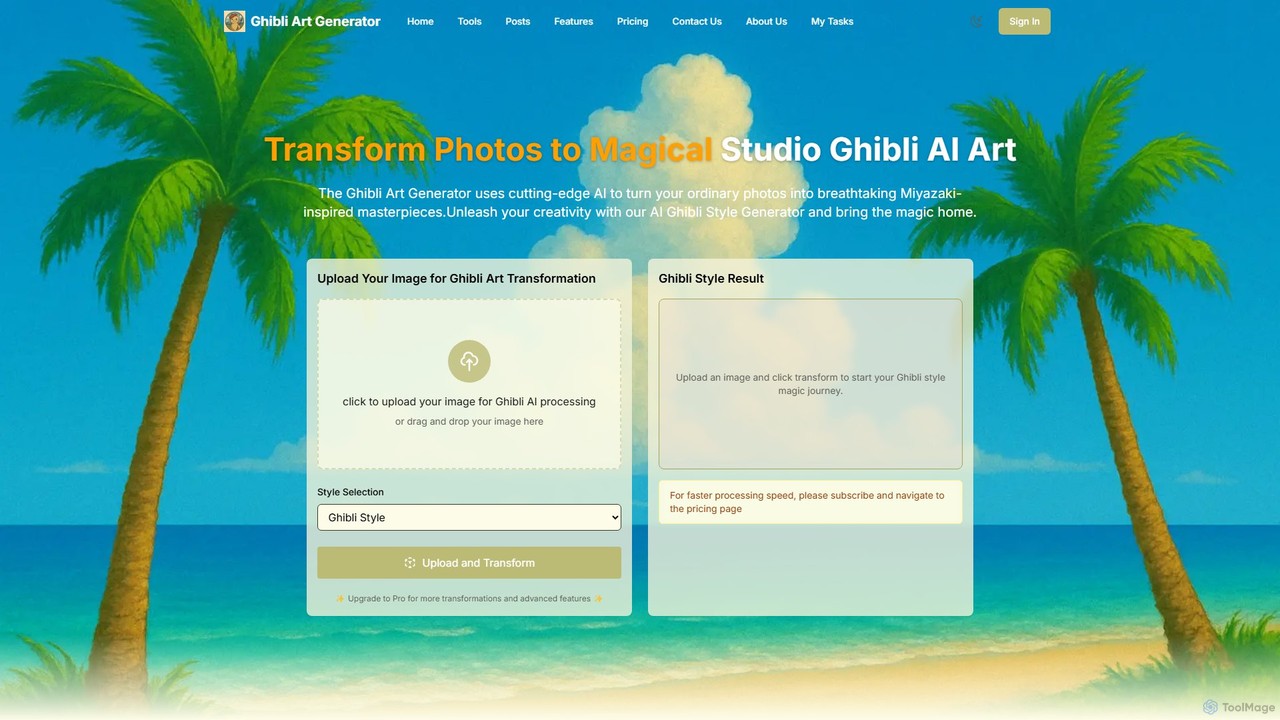
An AI-powered tool that transforms your photos into the enchanting and magical art style of Studio Ghibli. It …
An AI-powered tool that transforms your photos into the enchanting and magical art style of Studio Ghibli. It also supports various other styles like Pixar, Disney, and Anime, allowing you to reimagine your images as breathtaking masterpieces with just a few clicks.
About Art Generators
Art Generators are AI-powered tools that create original visual art from textual descriptions, images, or other inputs. They utilize advanced generative models, such as diffusion or GANs, to interpret prompts and synthesize unique, high-quality images. This technology empowers artists, designers, and creators to rapidly visualize concepts, explore diverse creative styles, and produce artwork without requiring traditional manual skills. Their primary value lies in transforming abstract ideas into concrete visual representations in a matter of seconds.
Core Features
- Text-to-Image Generation: Converts written prompts and descriptions into detailed, original images.
- Style Control & Customization: Allows users to specify artistic styles like photorealism, anime, oil painting, or cyberpunk.
- Image-to-Image Transformation (img2img): Modifies an existing image based on a new text prompt, altering its style or content.
- Parameter Adjustment: Provides control over aspect ratio, resolution, seed numbers, and generation steps for fine-tuning results.
- Negative Prompts: Enables users to specify elements or characteristics to exclude from the final image.
Use Cases
Art Generators are widely used by graphic designers for creating marketing assets, game developers for concept art, and content creators for unique blog or social media visuals. They also serve as a powerful brainstorming tool for artists and illustrators to explore new ideas and compositions quickly, significantly accelerating the creative workflow.
How to Choose
When selecting an Art Generator, consider the quality and coherence of the generated images, the range of available art styles, and the level of control over parameters. Also, evaluate the user interface's ease of use, the platform's pricing model (e.g., subscription vs. credit-based), and any restrictions on the commercial use of the generated images.

Art GeneratorsUse Cases
Creating Concept Art for Game Development
A game artist needs to visualize a new character described as a 'cyberpunk samurai in a neon-lit rainy city.' Instead of spending days sketching, they use an Art Generator. They input the detailed prompt, specifying a 'cinematic, photorealistic' style. The AI generates dozens of variations in minutes, exploring different poses, armor designs, and backgrounds. The artist then selects the most promising concepts to refine, accelerating the pre-production phase significantly and providing a rich visual foundation for the 3D modeling team.
Generating Unique Marketing and Ad Creatives
A marketing team for a new beverage brand needs diverse ad visuals for a social media campaign. They use an Art Generator to create a series of images featuring their product in surreal, eye-catching settings, like 'a soda can floating in a galaxy of fruit.' This allows them to A/B test multiple creative concepts quickly and cost-effectively without expensive photoshoots. The tool can generate visuals in various aspect ratios suitable for different platforms like Instagram Stories or Facebook posts.
Designing Album Covers and Music Visuals
An independent musician wants a unique album cover that reflects their music's mood. They input lyrics and thematic keywords like 'ethereal dreamscape, melancholic tones, glowing flora' into an Art Generator. The tool produces abstract and evocative imagery that captures the essence of the music. This provides a professional-looking cover at a fraction of the cost of hiring a designer, allowing the artist to maintain creative control and generate visuals for promotional materials and music videos.
Visualizing Architectural and Interior Designs
An interior designer wants to show a client different style options for a living room. They upload a photo of the empty room and use the image-to-image feature with prompts like 'minimalist Scandinavian design with oak furniture and natural light.' The tool re-renders the space in various styles, providing realistic visualizations that help the client make decisions faster. This process is much quicker than traditional 3D rendering and allows for more creative exploration in the early stages of a project.
Creating Illustrations for Blog Posts and Articles
A content writer needs a custom header image for an article about 'The Future of Renewable Energy.' Stock photos feel generic. They use an Art Generator with the prompt 'futuristic cityscape with solar panel skyscrapers and wind turbines, optimistic and bright style.' The result is a unique, on-topic illustration that enhances the article's visual appeal and professionalism. This avoids copyright issues with stock imagery and ensures the visual content perfectly matches the article's tone.
Prototyping Fashion and Textile Designs
A fashion designer explores new pattern ideas for their next collection. They use an Art Generator to create seamless patterns by inputting prompts like 'art deco floral pattern with gold and emerald green.' The tool generates countless unique textile designs, which can be quickly evaluated and used for digital mockups on clothing models. This streamlines the creative process, allowing for rapid iteration and exploration of visual themes before committing to physical samples, saving time and material costs.