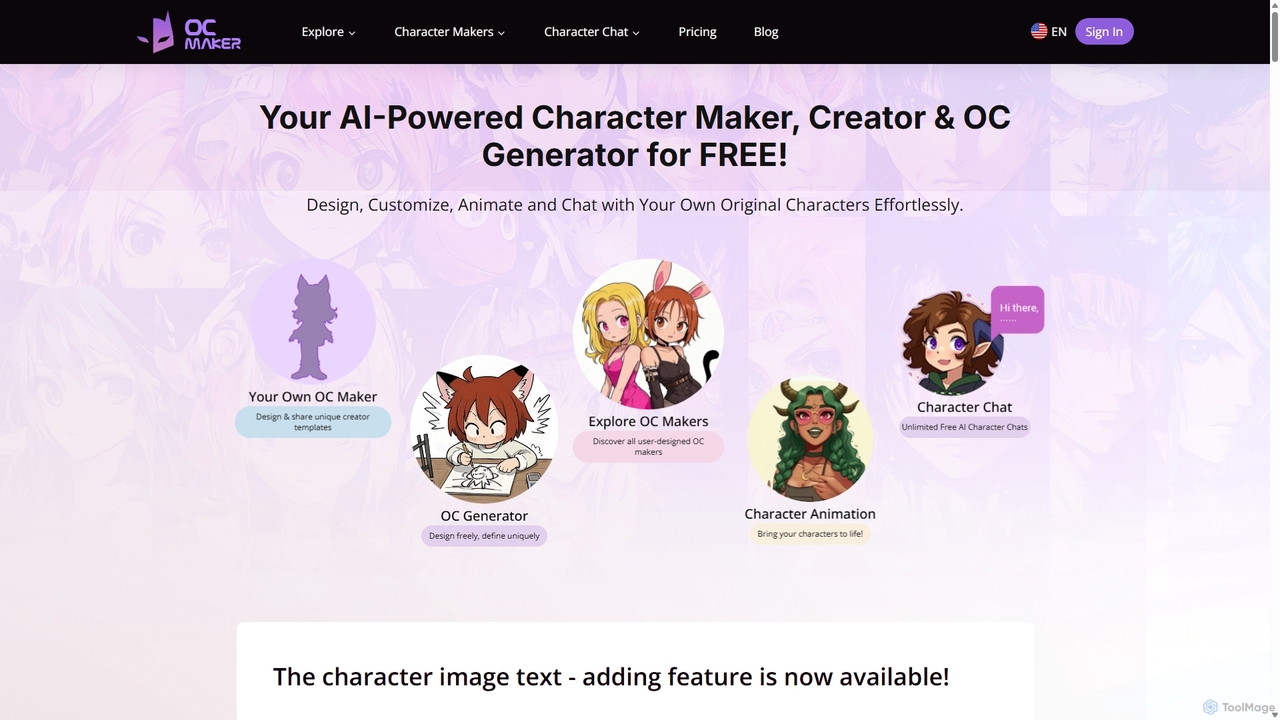
AI Character Generators are specialized tools that create unique and detailed character visuals, often accompanied by backstories or traits, from user inputs. They utilize advanced generative models to translate text descriptions, style selections, or parameter adjustments into high-quality character art. These generators empower creators to rapidly visualize concepts, produce consistent character designs for projects, and overcome creative blocks. Many tools offer deep customization, allowing control over everything from facial features and clothing to poses and expressions, making them a vital asset in game development, storytelling, and digital art.
Core Features
- Style Customization: Allows users to select or define specific art styles, such as anime, photorealistic, fantasy, or cartoon, ensuring visual consistency.
- Trait-Based Generation: Generates characters based on specific attributes like age, ethnicity, clothing, and personality traits for targeted designs.
- Pose and Expression Control: Provides options to specify a character's pose, posture, and facial expression to convey mood and action.
- Iterative Design & Consistency: Enables the creation of multiple variations of the same character, maintaining core features for use in different scenes or contexts.
- Asset Export Options: Supports exporting characters in various formats, including high-resolution images, transparent PNGs, sprite sheets, or even 3D models for direct use in projects.
Applicable Scenarios
These tools are widely used by game developers for creating player characters and NPCs, authors for visualizing their literary creations, and tabletop RPG players for designing custom avatars. They are also valuable for animators and comic artists during the concept design phase, as well as for marketers creating brand mascots or virtual influencers.
Selection Criteria
When choosing a Character Generator, consider the variety and quality of available art styles, the depth of customization options, and the required export formats (e.g., 2D sprites vs. 3D models). Also, evaluate the tool's ability to maintain character consistency across multiple generations and its pricing model, whether it's subscription-based, credit-based, or a one-time purchase.