promptrr.io
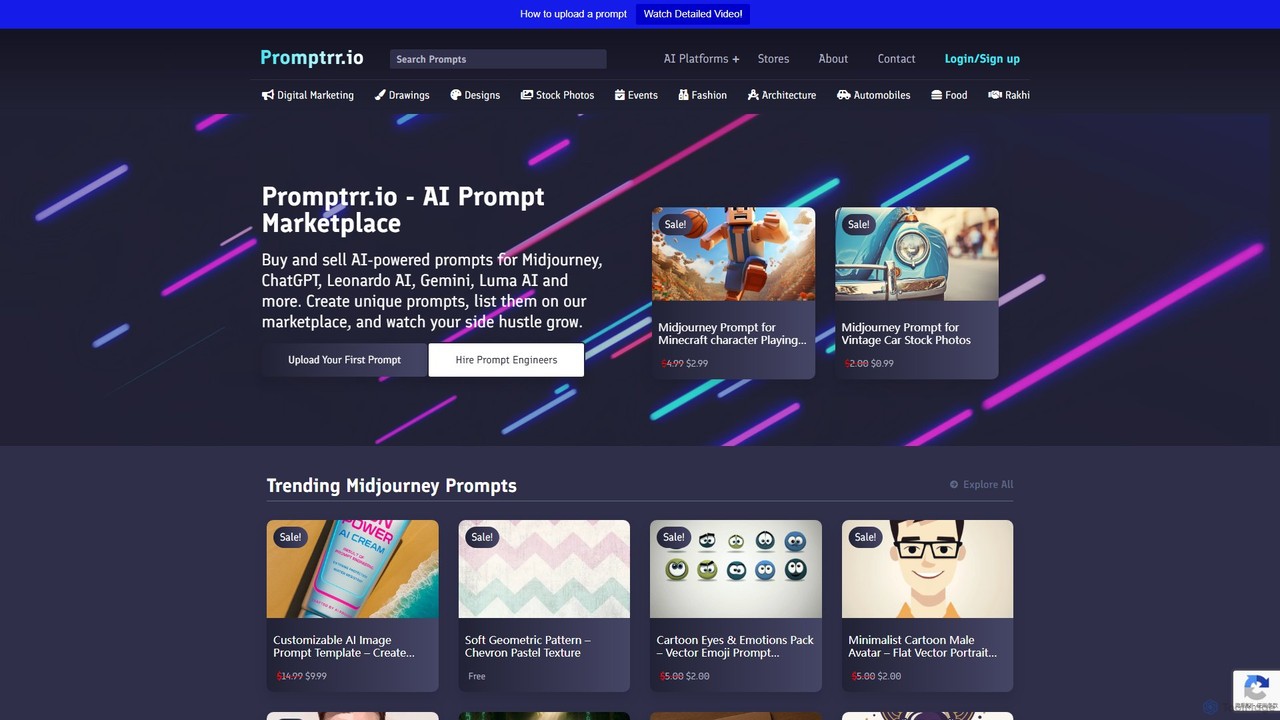
A comprehensive marketplace for buying and selling high-quality AI prompts. Promptrr.io connects prompt engineers with users of tools …
A comprehensive marketplace for buying and selling high-quality AI prompts. Promptrr.io connects prompt engineers with users of tools like ChatGPT, Midjourney, Leonardo AI, and Gemini, offering a vast library of prompts for art, marketing, productivity, and more. Creators can monetize their skills, while users can find the perfect prompt to enhance their AI-generated results.
About Image Prompts
Image Prompts tools are specialized utilities designed to help users create, refine, and discover effective text descriptions for AI image generators. These tools act as a creative co-pilot, translating simple ideas into detailed, structured prompts that AI models can interpret more accurately. By providing structured vocabularies, style suggestions, and optimization features, they significantly improve the quality and consistency of generated images. This process empowers both beginners and experts to unlock the full potential of generative art AI, reducing trial-and-error and accelerating the creative workflow.
Core Features
- Prompt Generation & Expansion: Automatically creates detailed, complex prompts from a few simple keywords or a basic idea.
- Prompt Library & Marketplace: Offers a searchable database of successful prompts submitted by the community, often with resulting images for reference.
- Visual Prompt Builder: Provides a user-friendly interface with menus and options to construct prompts by selecting styles, artists, camera angles, and other parameters.
- Prompt Analysis & Optimization: Evaluates existing prompts and suggests improvements, such as adding negative prompts or refining descriptive terms for better results.
- Image-to-Prompt (Reverse Engineering): Analyzes an existing image to generate a text prompt that could produce a similar visual outcome.
Use Cases
These tools are invaluable for digital artists, graphic designers, and content creators seeking to overcome creative blocks and explore new visual styles. Marketers and brand managers use them to craft consistent visual assets for campaigns. Game developers and concept artists leverage them to rapidly prototype characters, environments, and assets. They also serve as an excellent learning resource for beginners in AI art, helping them understand the principles of effective prompt engineering.
How to Choose
When selecting an Image Prompts tool, consider the scope of its prompt library and the quality of its suggestions. Evaluate the user interface—a visual builder may be better for beginners, while advanced users might prefer powerful text-based optimizers. Check for compatibility with the AI image generators you use (e.g., Midjourney, Stable Diffusion). Finally, consider the community features; an active community can be a great source of inspiration and learning.

Image PromptsUse Cases
Discovering New Artistic Styles
A digital artist feels stuck in a creative rut, repeatedly using the same visual styles. By using an Image Prompt tool, they input a simple concept like 'a lone castle in a forest'. The tool's generator expands this into multiple detailed prompts, suggesting various artistic movements ('in the style of surrealism'), lighting conditions ('dramatic twilight lighting'), and camera angles ('low-angle shot'). This allows the artist to generate dozens of unique visual interpretations in their AI image generator, quickly discovering new aesthetics and breaking their creative block without hours of manual experimentation.
Creating Consistent Brand Marketing Visuals
A marketing manager needs to produce a series of social media images for a new product, all with a consistent, high-end aesthetic. Instead of manually writing prompts for each image, they use a visual prompt builder. They select a base style ('minimalist, clean, studio lighting'), a color palette ('brand colors: navy blue, gold'), and specific negative prompts ('no shadows, no clutter'). They save this as a template. For each new post, they simply load the template and add the specific product description, ensuring every generated image adheres to the brand's visual identity, saving hours and ensuring consistency across the campaign.
Rapid Prototyping for Game Assets
A concept artist for an indie game studio needs to generate a wide variety of 'magical potion' icons. Using an Image Prompt tool's library, they search for 'fantasy potion bottle'. They find a highly-rated prompt that produces excellent results. They then use this prompt as a base, systematically modifying keywords with the tool's help—changing 'glowing blue liquid' to 'swirling purple smoke' or 'bubbling green goo'. This allows them to generate over 50 distinct potion variations in under an hour, a task that would have taken days to sketch manually, dramatically speeding up the asset conceptualization phase.
Learning Prompt Engineering Principles
A beginner in AI art is frustrated because their simple prompts like 'a dog' yield generic and uninteresting images. They use an Image-to-Prompt tool to upload a professional-looking AI-generated image of a dog they admire. The tool reverse-engineers the image and provides a detailed prompt: 'photorealistic portrait of a golden retriever, happy expression, sitting in a sunlit park, shallow depth of field, detailed fur texture, 8K resolution'. By studying this and other reverse-engineered prompts, the user quickly learns how to structure their own prompts with specifics about subject, style, lighting, and technical details, dramatically improving their image generation skills.
Generating Themed Content for Social Media
A content creator manages an Instagram account focused on 'cottagecore' aesthetics. To maintain a consistent feed, they need a steady stream of unique images. Using an Image Prompt tool, they create a master prompt that includes core keywords like 'cottagecore, rustic, warm sunlight, vintage film photography, soft focus'. Each day, they use the tool's expansion feature to add a new element, such as 'a girl reading a book', 'a basket of fresh bread', or 'a wildflower garden'. This method allows them to generate hundreds of on-brand images efficiently, ensuring their content calendar is always full with high-quality, thematically consistent visuals.
Optimizing Prompts for Photorealistic Product Images
An e-commerce manager wants to create lifestyle images for a new wristwatch. Their initial prompt, 'wristwatch on a table', produces flat and unappealing results. They use a prompt optimization tool, which analyzes their prompt and suggests adding crucial details. The optimized prompt becomes: 'luxury chronograph wristwatch, stainless steel, on a rustic wooden table next to a leather-bound journal, soft morning window light, macro shot, high detail, photorealistic'. This refined prompt results in a professional, high-quality image that looks like a real photograph, significantly increasing the product's perceived value and appeal for online listings.