Business Best in category 4 results Agriculture AI Tool

Popular AI tools in the Agriculture field of Business include eos、Precip、UrbanKisaan、Netagrow, etc., helping you quickly improve efficiency.

UrbanKisaan

UrbanKisaan

UrbanKisaan is a comprehensive agricultural intelligence platform that leverages AI to create climate-resilient farming solutions. It offers a …

7.6K
Precip

Precip

Precip provides hyper-local, highly accurate rainfall totals and historical weather data through a web dashboard and a powerful …

422.5K
Netagrow

Netagrow

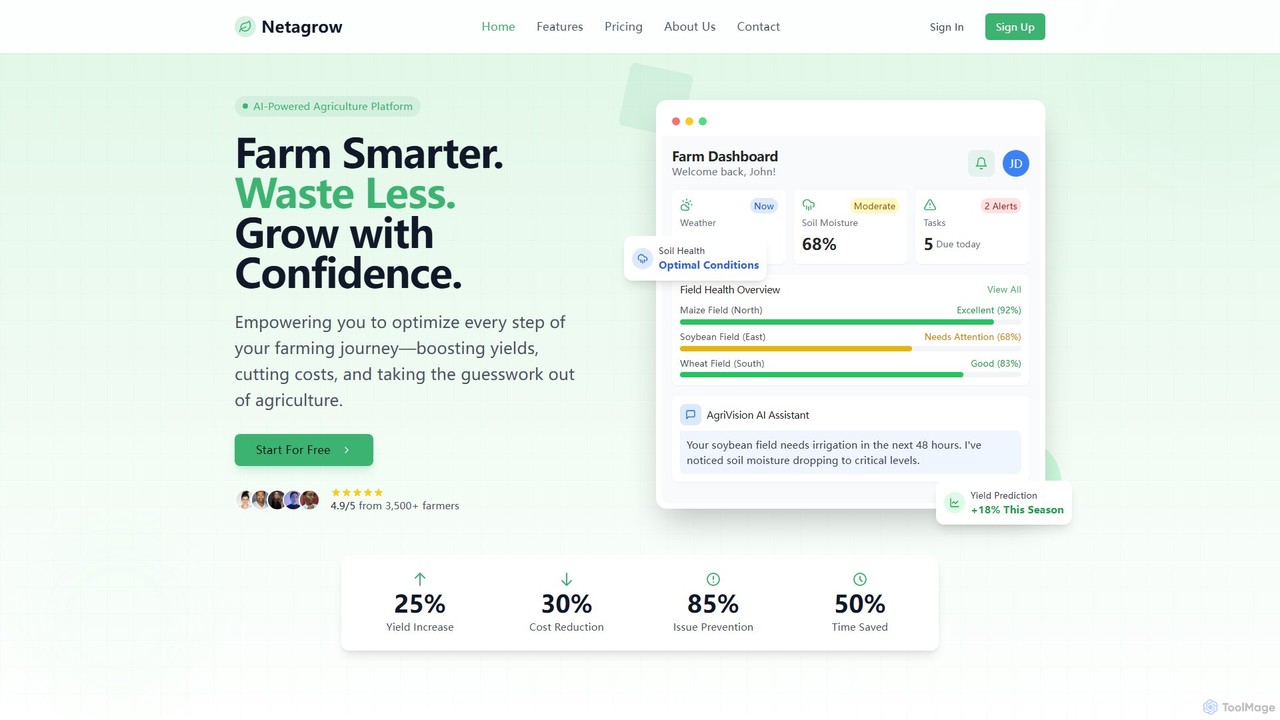
Netagrow is an AI-powered agriculture platform designed to simplify farm management. It empowers farmers to increase yields, reduce …

5.6K
eos

eos

EOS Data Analytics (eos) is an AI-powered platform providing satellite imagery analysis for various industries. It leverages machine …

1.0M

About Agriculture

AI Agriculture tools are specialized platforms that leverage artificial intelligence to optimize farming operations and increase productivity. They analyze vast datasets from sources like drones, sensors, and satellites to provide actionable insights for crop and livestock management. These tools help farmers make data-driven decisions, reduce resource waste, and implement sustainable agricultural practices. By integrating machine learning and computer vision, they automate tasks ranging from pest detection to yield forecasting, forming a critical part of modern business agriculture.

Core Features

  • Crop and Soil Monitoring: Analyze imagery and sensor data to assess plant health, nutrient levels, and soil conditions in real-time.
  • Predictive Analytics: Forecast crop yields, weather patterns, and disease outbreaks to inform strategic planning and resource allocation.
  • Precision Farming Automation: Control autonomous tractors, drones, and irrigation systems for targeted application of water, fertilizers, and pesticides.
  • Livestock Management: Use computer vision and wearable sensors to monitor animal health, behavior, feeding patterns, and overall welfare.

Use Cases

These tools are utilized by large-scale agribusinesses, family farms, agronomists, and agricultural researchers. They are applied in field crop production, horticulture, dairy farming, and aquaculture to enhance operational efficiency, improve decision-making, and promote sustainability.

How to Choose

When selecting an AI Agriculture tool, consider its specific application (e.g., crop vs. livestock), its ability to integrate with existing farm equipment and software, the user-friendliness of its interface for non-technical staff, and the scalability of its pricing model based on farm size or acreage.


AgricultureUse Cases

1

Precision Crop Spraying with Drones

A farm manager overseeing a large cornfield uses an AI-powered drone system to manage weeds efficiently. The drone flies over the fields, capturing high-resolution images. An AI model analyzes these images in real-time to differentiate between crops and various types of weeds. The system then generates a precise map indicating weed-infested areas. This map is fed to an agricultural sprayer drone, which targets and sprays herbicide only on the identified weed patches, avoiding the healthy crops. This process reduces herbicide usage by up to 90%, lowers operational costs, and minimizes environmental impact compared to traditional broadcast spraying.

2

Monitoring Dairy Cow Health and Behavior

A dairy farmer uses an AI-powered livestock management system to monitor the health of their herd. Each cow is fitted with a smart collar that tracks activity levels, rumination time, and body temperature. The AI platform collects this data continuously and establishes a baseline behavior pattern for each animal. If a cow's activity drops significantly or rumination patterns change, the system flags it as a potential health issue, such as lameness or indigestion, and sends an alert to the farmer's smartphone. This early detection allows for prompt intervention, often before clinical signs are visible, improving animal welfare and preventing costly drops in milk production.

3

Forecasting Crop Yield for Agribusiness

An agronomist at a large agricultural cooperative uses a predictive analytics platform to forecast soybean yield across hundreds of member farms. The AI tool integrates diverse data sources, including historical yield data, current satellite imagery (NDVI), long-range weather forecasts, and soil type information. By analyzing these variables, the machine learning model generates accurate yield predictions for each field, updated weekly. This forecast allows the cooperative to optimize logistics for harvesting and storage, negotiate better prices in futures markets, and provide data-backed advice to farmers on nutrient management to maximize their output.

4

Optimizing Irrigation with Smart Sensors

A vineyard owner uses an AI-driven smart irrigation system to conserve water and improve grape quality. Soil moisture sensors are placed throughout the vineyard, collecting real-time data on water levels at different depths. The AI platform combines this sensor data with weather forecasts and the specific water needs of the grapevines at their current growth stage. It then calculates the precise amount of water needed for each zone and automatically controls the drip irrigation system to deliver it. This prevents both under-watering, which stresses the vines, and over-watering, which can lead to disease and wasted resources, ensuring optimal conditions for high-quality wine production.

5

Automated Sorting and Grading of Produce

A large apple packing facility employs an AI-powered sorting machine to grade produce automatically. As apples move along a conveyor belt, high-speed cameras capture images of each one from multiple angles. A computer vision algorithm analyzes these images instantly, assessing size, color, shape, and identifying any blemishes or defects like bruises or cuts. Based on this analysis, the system directs each apple to the appropriate bin for different quality grades (e.g., premium, grade 1, or for juice). This automated process is significantly faster and more consistent than manual sorting, increasing throughput and ensuring a uniform quality standard for customers.

6

Optimizing Harvest Timing for Specialty Crops

A coffee plantation manager uses an AI tool to determine the optimal time to harvest coffee cherries. The system analyzes images taken by workers' smartphones or fixed cameras in the field. The AI model is trained to assess the ripeness of cherries based on their color, size, and texture, providing a ripeness score for different sections of the plantation. This data helps the manager deploy harvesting crews to the ripest areas first, ensuring that cherries are picked at their peak flavor profile. This data-driven approach improves the overall quality of the coffee beans, increases the yield of high-grade specialty coffee, and maximizes the plantation's profitability.

AgricultureFrequently Asked Questions