MongoDB
MongoDB is a developer data platform built on a leading NoSQL document database. Its cloud offering, MongoDB Atlas, …
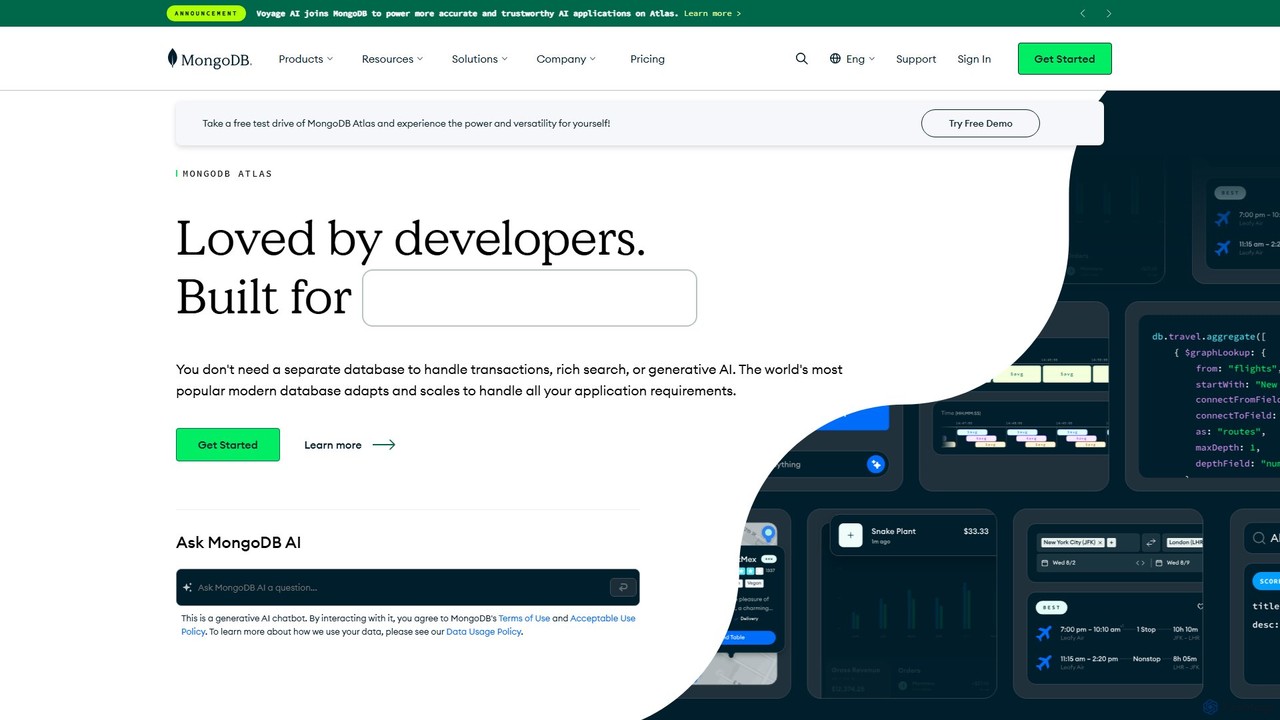
MongoDB is a developer data platform built on a leading NoSQL document database. Its cloud offering, MongoDB Atlas, provides an integrated suite of services, including powerful Vector Search for generative AI, full-text search, and real-time analytics. It's designed for modern applications, offering flexibility, scalability, and a unified experience for developers to build faster and more efficiently across multiple clouds.
About Backend
AI Backend tools are platforms and services that provide server-side logic, data management, and APIs for applications, enhanced with artificial intelligence capabilities. They handle complex background tasks such as user authentication, database operations, and serverless computing, allowing developers to focus on the user-facing front end. By integrating AI, these tools can offer advanced features like predictive analytics, automated data processing, and intelligent API management. This accelerates development cycles and enables the creation of smarter, more scalable business applications without deep infrastructure expertise.
Core Features
- Managed Databases: Provides scalable and secure databases (SQL or NoSQL) with automated backups and management.
- Serverless Functions: Allows running backend code in response to events without provisioning or managing servers.
- User Authentication: Offers secure, pre-built systems for user sign-up, login, and access control.
- AI-Powered APIs: Delivers pre-trained models for tasks like natural language processing, image recognition, or data analysis via simple API calls.
- Real-time Data Sync: Enables seamless data synchronization between the client-side application and the backend database.
Use Cases
These tools are primarily used by software developers, startups, and enterprise IT teams to build and scale web and mobile applications. They are ideal for projects requiring rapid development, such as creating a Minimum Viable Product (MVP) for a SaaS platform, building the backend for a mobile app with push notifications, or developing internal business tools that need to process and analyze company data.
How to Choose
When selecting an AI Backend tool, consider its scalability and performance limits to ensure it can handle future growth. Evaluate the supported programming languages and frameworks for compatibility with your existing tech stack. Analyze the pricing model—whether it's pay-as-you-go, tiered subscription, or resource-based—to align with your budget. Finally, review the security features and compliance certifications (like GDPR or HIPAA) if you handle sensitive user data.

BackendUse Cases
Rapid Prototyping for a SaaS MVP
A startup's development team needs to launch a Minimum Viable Product (MVP) quickly to test a business idea. Instead of spending months building a backend from scratch, they use an AI Backend platform. This provides them with pre-built user authentication, a managed database for customer data, and serverless functions to run their core business logic. They can launch their product in weeks instead of months, allowing them to gather user feedback and iterate much faster while keeping initial infrastructure costs low.
Automating Business Intelligence Reporting
A business analyst needs to create real-time dashboards that display sales trends and customer behavior. They use an AI Backend service that offers data processing APIs. By connecting their company's data sources to the backend, they can use pre-built AI functions to automatically clean the data, identify significant patterns, and calculate key performance indicators (KPIs). The results are then exposed through a secure API that their dashboarding tool consumes, providing up-to-date insights to decision-makers without manual data wrangling.
Building a Scalable Mobile App Backend
A mobile app developer is creating a social networking app that could experience sudden spikes in user activity. To handle unpredictable traffic, they build their backend on a serverless platform. They write individual functions for actions like posting a message, uploading a photo, or adding a friend. The platform automatically scales the resources for each function based on demand, ensuring the app remains responsive during peak times. This approach also means they only pay for the compute time they actually use, making it cost-effective for an app with fluctuating usage patterns.
Implementing Secure User Authentication
A fintech company is developing a new financial planning app that requires robust security. Instead of building a complex and time-consuming authentication system in-house, they integrate a managed AI Backend service. This service provides secure user sign-up and login flows, multi-factor authentication (MFA), and social logins (e.g., Google, Apple) out of the box. The backend service handles password hashing, token management, and protection against common threats, allowing the company to meet security compliance standards and protect user data without dedicating extensive engineering resources.
Integrating an AI-Powered Content Moderation API
A social media platform needs to moderate user-generated content to maintain a safe community. Manually reviewing every post is impossible at scale. They integrate an AI Backend API specialized in content moderation. When a user uploads an image or text, the platform's application sends the content to this API. The AI model analyzes it for inappropriate material (e.g., hate speech, violence) and returns a score. Based on this score, the platform can automatically flag, hide, or remove the content, significantly reducing the workload on human moderators and enabling faster response times.
Real-time Data Sync for Collaborative Tools
A company developing a collaborative project management tool needs to ensure that when one user updates a task, it is instantly visible to all other team members. They use a backend service with a real-time database. The application front-end subscribes to changes in the database. Whenever data is modified (e.g., a task is marked as complete), the backend service immediately pushes the update to all connected clients. This eliminates the need for users to manually refresh the page and provides a seamless, collaborative experience, which is crucial for productivity tools.