Vital
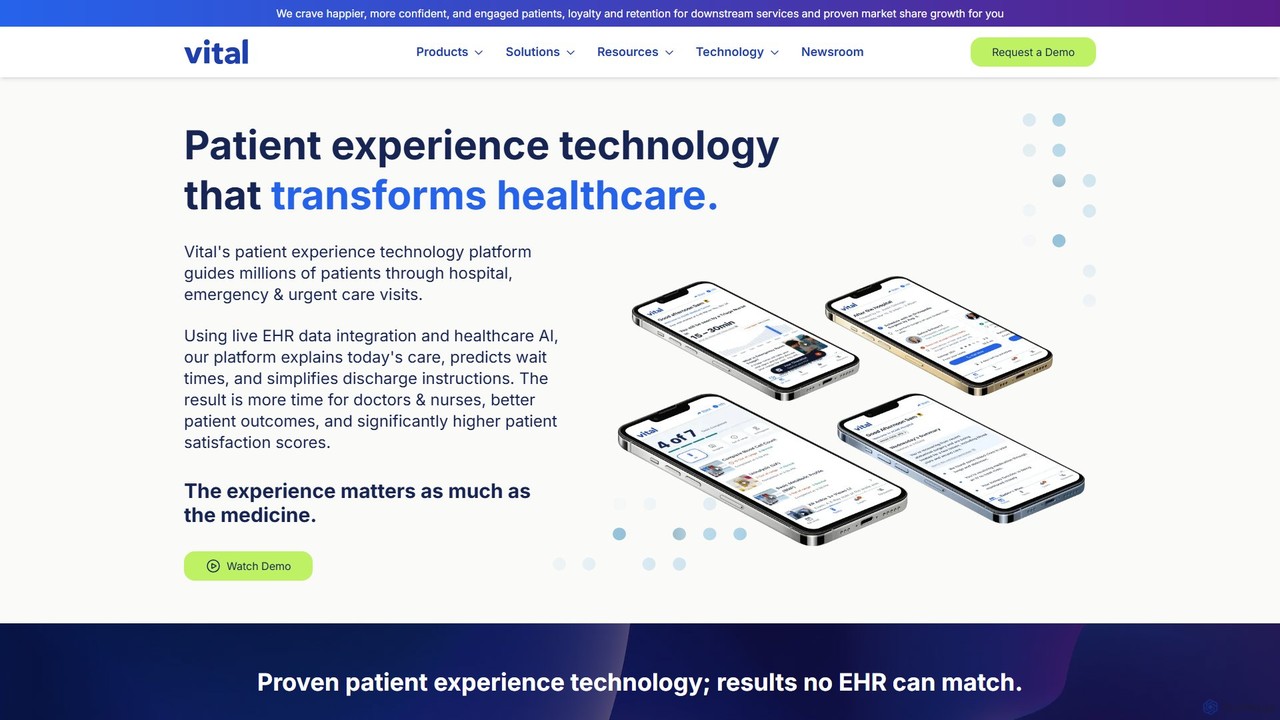
Vital is an AI-powered patient experience platform designed for hospitals and health systems. It enhances communication, provides real-time …
Vital is an AI-powered patient experience platform designed for hospitals and health systems. It enhances communication, provides real-time updates, and simplifies medical information for patients, improving satisfaction and operational efficiency for healthcare providers.
About Healthcare Management
Healthcare Management AI tools are specialized solutions that leverage artificial intelligence to optimize administrative, operational, and patient care processes within healthcare organizations. These tools utilize machine learning, natural language processing, and predictive analytics to streamline workflows, enhance decision-making, and improve resource allocation. They are designed to address the complex challenges of modern healthcare, from patient scheduling to financial management, ultimately aiming to increase efficiency and service quality.
Core Features
- Automated Scheduling & Resource Planning: Optimizes appointment booking, staff rostering, and bed allocation based on demand forecasts.
- Medical Billing & Claims Processing: Automates coding, submission, and management of insurance claims, reducing errors and denials.
- Operational Analytics & Predictive Insights: Provides data-driven insights into patient flow, equipment utilization, and supply chain needs to inform strategic decisions.
- Patient Engagement & Communication: Facilitates personalized communication, appointment reminders, and basic query handling through AI-powered chatbots.
- Clinical Workflow Optimization: Assists with documentation, task prioritization, and inventory management within clinical settings.
Applicable Scenarios
Healthcare Management AI tools are invaluable for hospitals, clinics, long-term care facilities, and private practices. They are used by administrators to manage daily operations, by financial departments to streamline billing, and by clinical staff to improve patient flow and reduce administrative burden. These tools help organizations adapt to fluctuating patient volumes, manage complex regulatory requirements, and deliver more efficient care.
How to Choose
When selecting Healthcare Management AI tools, consider the specific operational challenges you aim to solve, such as patient wait times or billing inefficiencies. Evaluate the tool's integration capabilities with existing Electronic Health Records (EHR) systems and other hospital information systems. Assess the vendor's commitment to data security and compliance with regulations like HIPAA. Finally, consider the scalability of the solution to grow with your organization's needs and the level of support provided.

Healthcare ManagementUse Cases
Optimizing Patient Scheduling and Resource Allocation
Hospital administrators and clinic managers can leverage AI tools to predict patient demand, optimize appointment slots, and efficiently allocate medical staff and bed resources. By analyzing historical data, seasonal trends, and real-time patient flow, AI can minimize patient wait times, reduce staff burnout, and ensure critical resources like operating rooms are utilized effectively. This leads to smoother operations and improved patient satisfaction, potentially reducing administrative overhead by up to 20%.
Automating Medical Billing and Claims Processing
Medical billing specialists and financial departments in healthcare facilities can use AI to automate the complex process of medical coding, claims submission, and denial management. AI algorithms can quickly analyze patient records and services rendered to assign accurate codes, identify potential errors before submission, and even predict the likelihood of claim denials. This significantly reduces manual effort, accelerates revenue cycles, and minimizes financial losses due to rejected claims, improving billing accuracy by over 30%.
Enhancing Clinical Workflow Efficiency
Clinical staff, including nurses and doctors, can utilize AI tools to streamline daily tasks and improve workflow efficiency. AI can automate the generation of clinical documentation, prioritize patient tasks based on urgency, and manage medical supply inventory. For example, AI-powered systems can transcribe doctor-patient conversations into structured notes, freeing up clinicians to focus more on patient care rather than administrative duties, potentially saving 1-2 hours per shift for documentation.
Predictive Analytics for Hospital Operations
Hospital operations managers can utilize AI-powered predictive analytics to forecast patient admissions, emergency room visits, and equipment maintenance needs. By analyzing vast datasets, AI can identify patterns and predict future demands, allowing hospitals to proactively adjust staffing levels, manage bed capacity, and schedule preventive maintenance for critical medical devices. This proactive approach minimizes operational disruptions, optimizes resource utilization, and can reduce equipment downtime by up to 15%.
Personalized Patient Engagement and Communication
Healthcare providers and patient relations teams can deploy AI-powered chatbots and virtual assistants to enhance patient engagement and streamline communication. These tools can send automated appointment reminders, provide answers to frequently asked questions about services or billing, and offer personalized health information. By handling routine inquiries, AI frees up human staff to focus on more complex patient needs, improving patient satisfaction scores and reducing call center volumes by up to 25%.
Streamlining Healthcare Supply Chain Management
Supply chain managers in large hospital systems can utilize AI to optimize inventory levels, predict demand for medical supplies, and manage procurement processes. AI algorithms analyze consumption patterns, supplier performance, and market trends to ensure critical supplies are always available while minimizing waste and storage costs. This proactive management reduces stockouts of essential items, improves negotiation power with suppliers, and can lead to cost savings of 10-20% in supply chain operations.