
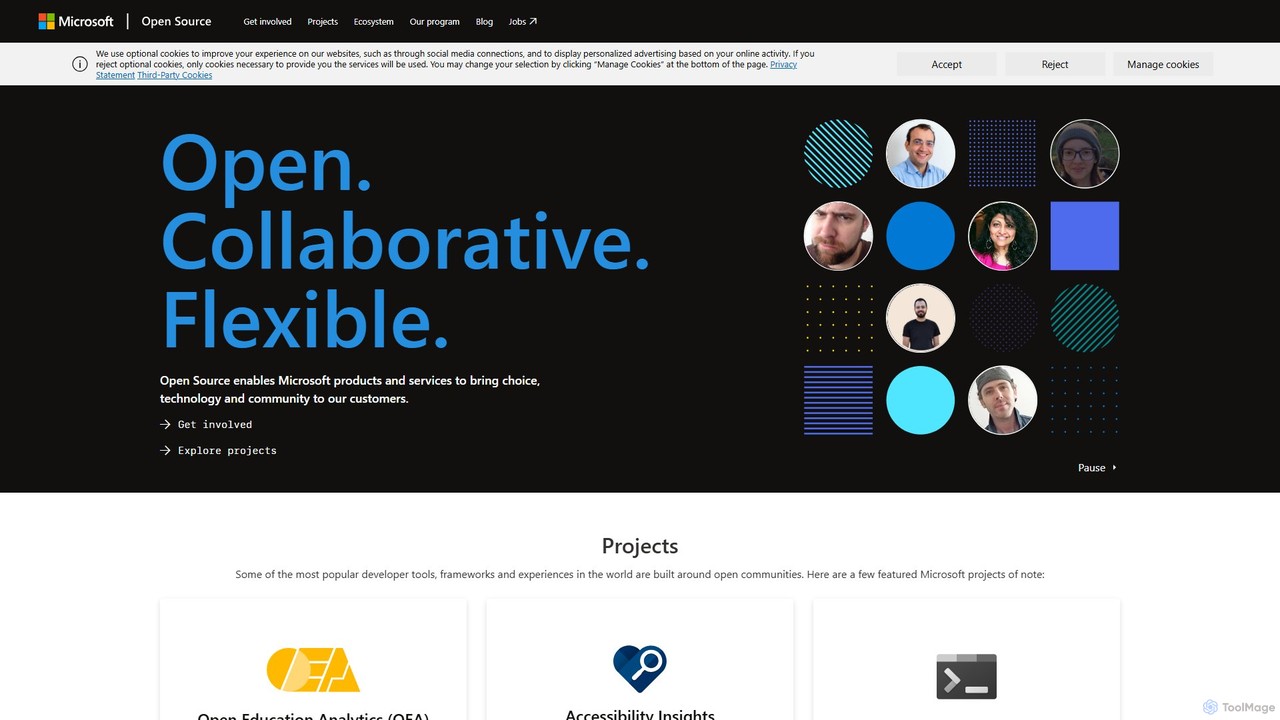
Microsoft Open Source
Microsoft's central hub for discovering, using, and contributing to a vast portfolio of open-source projects. It offers developers …
Microsoft's central hub for discovering, using, and contributing to a vast portfolio of open-source projects. It offers developers access to powerful tools, frameworks, and AI/ML libraries, fostering collaboration and innovation within a global community.
About Platform
AI Platforms are integrated cloud-based environments designed to manage the entire lifecycle of artificial intelligence models. These platforms provide a unified toolchain, from data preparation and model training to deployment and monitoring. They streamline the development process by abstracting complex infrastructure, allowing teams to focus on building and scaling AI applications. This approach accelerates innovation and reduces the technical overhead associated with MLOps.
Core Features
- MLOps Toolchain: Offers integrated tools for experiment tracking, model versioning, CI/CD pipelines, and automated deployment.
- Managed Infrastructure: Provides scalable, on-demand compute resources (GPUs, TPUs) optimized for training and inference.
- Pre-built Models & APIs: Includes access to foundational models and pre-trained algorithms that can be fine-tuned or used directly.
- Data Management Tools: Features capabilities for data ingestion, preprocessing, labeling, and storage management.
Use Cases
AI Platforms are primarily used by data science teams, machine learning engineers, and enterprises looking to build custom AI solutions. They are ideal for developing applications like predictive analytics engines, natural language processing systems for internal documents, or computer vision models for quality control in manufacturing.
How to Choose
When selecting an AI Platform, consider the scope of its MLOps capabilities, compatibility with your existing tech stack, and the availability of pre-trained models relevant to your industry. Also, evaluate the pricing model (e.g., pay-per-use vs. subscription) and the level of technical support and documentation provided.
PlatformUse Cases
Develop a Custom Fraud Detection Model
A financial services company uses an AI Platform to build a real-time fraud detection system. Their data science team ingests transaction data, uses the platform's data labeling tools to mark suspicious activities, and then trains several machine learning models using managed GPU resources. The platform's experiment tracking feature allows them to compare model performance and select the most accurate one. Finally, they deploy the model as a secure API endpoint, which their core banking system calls to score transactions in real-time, significantly reducing fraudulent losses.
Fine-tune an LLM for Specialized Customer Support
A SaaS company wants to create a chatbot that understands its product's technical jargon. Using an AI Platform, their developers select a powerful base Large Language Model (LLM) from the platform's model garden. They upload their product documentation and support tickets as a training dataset. The platform provides a managed environment to fine-tune the LLM on this specific data, creating a specialized model. This new model is then deployed via an API and integrated into their helpdesk, providing customers with accurate, context-aware answers and reducing the workload on human support agents.
Automate Quality Control with Computer Vision
A manufacturing company aims to automate defect detection on its production line. Using an AI Platform, engineers upload thousands of images of their products, labeling them as 'good' or 'defective'. They use the platform's AutoML Vision capabilities to train a custom image classification model without writing extensive code. The platform handles the model selection and hyperparameter tuning automatically. The resulting model is deployed to an edge device on the assembly line, which analyzes products in real-time and flags defective items, improving quality and efficiency.
Build a Predictive Maintenance System for Machinery
An industrial company uses an AI Platform to predict equipment failures before they happen. They stream sensor data (temperature, vibration, pressure) from their machinery into the platform's data lake. Data scientists then use the platform's notebooks and analytics tools to explore the data and engineer features. They build a time-series forecasting model that predicts the likelihood of failure. The model is deployed and monitored through the platform's MLOps dashboard, sending alerts to maintenance teams to schedule repairs proactively, minimizing downtime and saving costs.
Create a Personalized Product Recommendation Engine
An e-commerce business leverages an AI Platform to enhance user experience. They collect user behavior data, such as clicks, purchases, and browsing history. Using the platform's collaborative filtering algorithms and managed training services, their ML team builds a recommendation model. This model generates personalized product suggestions for each user. It's deployed as a scalable microservice that integrates with their website, resulting in increased user engagement, higher conversion rates, and improved customer loyalty by showing shoppers items they are more likely to buy.
Analyze Customer Sentiment from Support Tickets
A large enterprise wants to understand customer satisfaction trends. They use an AI Platform to analyze text from thousands of support tickets and customer reviews. Developers use a pre-trained natural language processing (NLP) model from the platform and fine-tune it with their own data for better accuracy. The platform's pipeline tools automate the process of ingesting new tickets, running sentiment analysis, and visualizing the results on a dashboard. This allows product managers to quickly identify areas of customer frustration and prioritize improvements.