ToolMage
Sign in

Best 1 Call Center AI tools for Communication

Popular Call Center AI tools in Communication include Virtual Scale, helping you work more efficiently.

Virtual Scale
Freemium

Virtual Scale

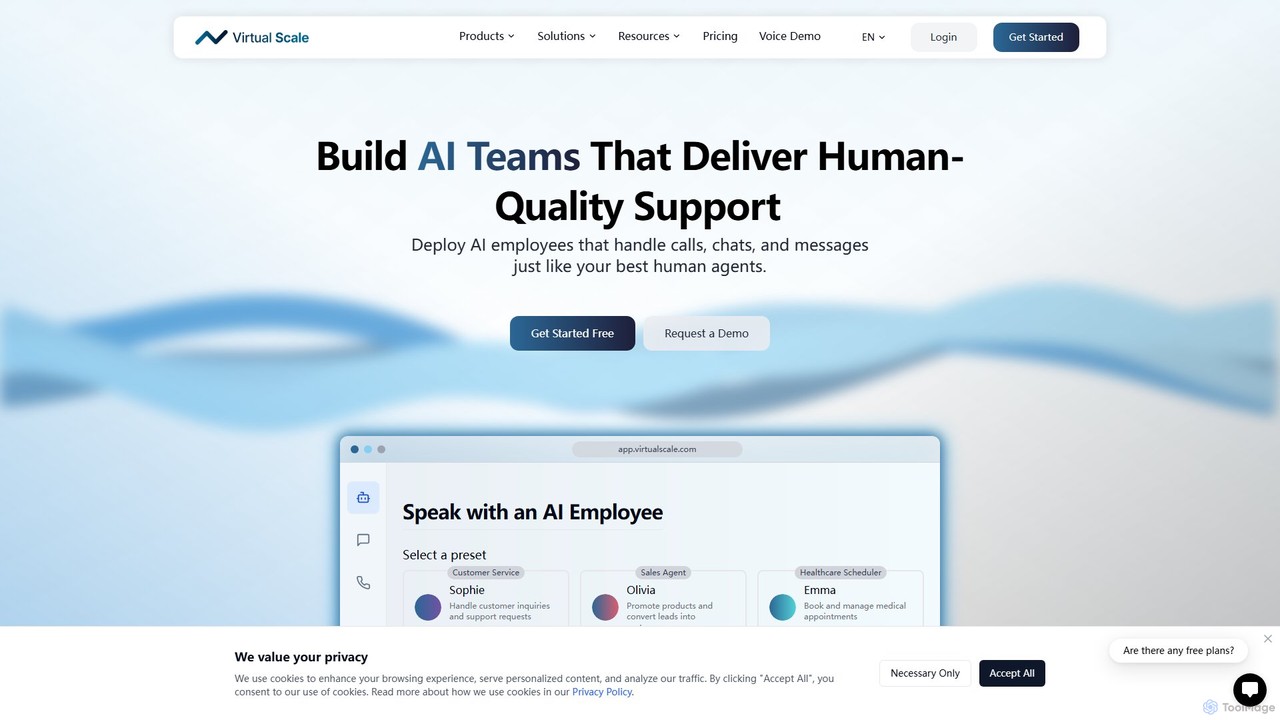
Virtual Scale is an AI platform that enables businesses to build and deploy a custom AI workforce. It provides AI-powered support on calls, chat, WhatsApp, and more, helping companies automate customer interactions, scale operations 24/7, and enhance engagement without the overhead of a large human team.

Call Center
Visits 5.5KFavorites 130Likes 149

About Call Center

AI Call Center tools are specialized platforms that use artificial intelligence to automate, analyze, and enhance customer and agent interactions within a contact center environment. Leveraging technologies like Natural Language Processing (NLP) and speech recognition, these systems understand spoken language, automate responses, and provide real-time support. Their primary value lies in improving operational efficiency, reducing agent workload, and extracting actionable insights from every conversation to elevate the customer experience. These tools represent a significant evolution from traditional call center software by introducing intelligent automation and data-driven decision-making.

Core Features

  • AI Voice Agents & Conversational IVR: Automates responses to common queries and intelligently routes calls without human intervention.
  • Real-time Agent Assist: Provides live guidance, script suggestions, and knowledge base access to agents during calls.
  • Speech-to-Text & Sentiment Analysis: Transcribes all calls and analyzes the content for customer sentiment, keywords, and compliance.
  • Automated Call Summarization: Generates concise summaries of conversations, drastically reducing agent after-call work (ACW).
  • Predictive Dialing & Analytics: Optimizes outbound campaigns by predicting the best times to call and analyzing performance data.

Use Cases

These tools are widely adopted in industries with high call volumes, such as e-commerce, financial services, telecommunications, and healthcare. They are essential for customer support teams aiming to reduce wait times, sales teams looking to improve lead conversion, and quality assurance departments needing to monitor 100% of interactions for compliance and training purposes.

How to Choose

When selecting an AI Call Center tool, evaluate its integration capabilities with your existing CRM and helpdesk systems. Assess the accuracy of its speech recognition and NLP models, especially for your industry's specific terminology. Consider the platform's scalability to handle peak call volumes and the level of customization available for training the AI on your unique business processes. Finally, examine the depth of its analytics and reporting features.

Call Center use cases

1

Automate Customer Support Triage

An e-commerce company's support team uses an AI Voice Agent to handle initial customer inquiries 24/7. When a customer calls about order status, the AI authenticates them, accesses the CRM, and provides a real-time update. For complex issues like a damaged product, the AI gathers initial information and seamlessly transfers the call, along with a summary, to the appropriate live agent. This reduces customer wait times and allows human agents to focus on high-value, complex problem-solving.

2

Provide Real-time Sales Agent Coaching

A B2B software company uses an AI Call Center tool to assist new sales representatives. During live calls with prospects, the Real-time Agent Assist feature listens to the conversation. If a prospect mentions a competitor, the AI instantly displays a battle card on the agent's screen with key differentiators. When a prospect raises a pricing objection, the AI suggests proven rebuttal scripts. This on-the-fly coaching helps new hires ramp up faster, improves confidence, and increases lead conversion rates without constant manager supervision.

3

Monitor Quality Assurance and Compliance at Scale

A financial services firm is required to adhere to strict regulatory scripts during customer calls. Instead of manually reviewing a small sample of calls, they use an AI Call Center tool to transcribe and analyze 100% of interactions. The system automatically flags calls where agents deviated from required disclosures or used non-compliant language. This allows the quality assurance team to identify training needs proactively, ensure enterprise-wide compliance, and reduce regulatory risk, all while saving hundreds of hours of manual review time.

4

Optimize Outbound Telemarketing Campaigns

A marketing agency running a telemarketing campaign uses an AI-powered predictive dialer. The system analyzes historical data to predict the best times to call specific leads to maximize connection rates. It automatically dials numbers from a list and only connects an agent when a live person answers, eliminating time wasted on unanswered calls or voicemails. Post-campaign, the analytics dashboard provides insights into call outcomes, agent performance, and lead quality, helping the agency refine its strategy for future campaigns.

5

Reduce Agent After-Call Work (ACW)

In a high-volume technical support center, agents previously spent several minutes after each call manually logging notes, categorizing the issue, and scheduling follow-ups. By implementing an AI Call Center tool with automated summarization, this process is streamlined. The AI transcribes the call, identifies the key issue and resolution, and generates a concise summary that automatically populates the CRM ticket. This reduces After-Call Work (ACW) by over 70%, allowing agents to handle more calls per day and reducing burnout from repetitive administrative tasks.

6

Expand Multilingual Support Capabilities

A global SaaS company wants to offer 24/7 basic support in multiple languages without hiring a large, distributed team. They deploy AI voice agents that can converse fluently in Spanish, French, and German. These agents handle common account and billing questions from international customers outside of primary business hours. If an issue requires human intervention, the AI agent creates a detailed ticket in English for the core support team to address the next business day. This provides a cost-effective way to improve the global customer experience and offer round-the-clock service.

Call Center FAQ

What are AI Call Center tools?

AI Call Center tools are software solutions that use artificial intelligence to enhance and automate the operations of a contact center. Unlike traditional systems, they leverage technologies like Natural Language Processing (NLP) and machine learning to understand customer intent, automate conversations, analyze call data, and assist human agents in real-time. Key functions include intelligent call routing, AI-powered voice agents (voicebots), real-time transcription, sentiment analysis, and automated call summarization. Their goal is to increase efficiency, improve customer satisfaction, and provide deep insights into contact center performance.

How to choose the right AI Call Center software?

Choosing the right software involves evaluating several key factors:

  • Integration: Ensure it seamlessly integrates with your existing CRM, helpdesk, and other business tools to create a unified workflow.
  • AI Capabilities: Assess the accuracy of its speech recognition, NLP, and sentiment analysis. Request a demo with scenarios relevant to your business.
  • Scalability: The platform should be able to handle your current call volume and scale up or down based on demand without performance issues.
  • Customization and Training: Check how easily you can train the AI on your specific products, industry jargon, and company policies.
  • Analytics and Reporting: Look for a tool with a robust analytics dashboard that provides actionable insights into agent performance, customer satisfaction, and operational metrics.
What's the difference between an AI Call Center and a traditional IVR system?

The primary difference lies in intelligence and flexibility. A traditional Interactive Voice Response (IVR) system is rule-based, guiding users through a rigid phone menu (e.g., 'Press 1 for sales, Press 2 for support'). It relies on specific keywords or keypad inputs. An AI Call Center, particularly one with a Conversational IVR, uses Natural Language Processing (NLP) to understand the user's intent from their natural speech. A user can simply say, 'I need to check the status of my recent order,' and the AI understands and responds dynamically, creating a more human-like and efficient interaction, rather than forcing users through a frustrating menu tree.

What key features should I look for in an AI Call Center solution?

When evaluating AI Call Center solutions, prioritize these features:

  • Conversational IVR/Voicebots: The ability to understand natural language and automate Tier-1 support queries effectively.
  • Real-time Agent Assist: Provides live, on-screen guidance to agents, such as script suggestions and knowledge base articles, to improve performance.
  • Omnichannel Analytics: A unified dashboard that analyzes interactions across all channels (voice, chat, email) to give a complete view of the customer journey.
  • Automated Quality Management: Tools that can automatically score 100% of agent interactions based on custom criteria, identifying coaching opportunities.
  • Robust CRM Integration: Deep, bi-directional integration with your CRM to pull customer data and push interaction summaries automatically.
Who can benefit from using AI Call Center tools?

A wide range of organizations can benefit. Customer support teams use them to reduce wait times, provide 24/7 service, and free up agents for complex issues. Sales teams leverage them for lead qualification, predictive dialing, and real-time coaching to increase conversion rates. Quality assurance and compliance departments use them to monitor 100% of calls for script adherence and training purposes. Essentially, any business with a significant volume of voice-based customer interactions, whether inbound or outbound, can improve efficiency, customer experience, and data-driven insights by implementing these tools.