feedscope
feedscope was an experimental daily quiz platform designed to test knowledge through competitive challenges. Users engaged in daily …
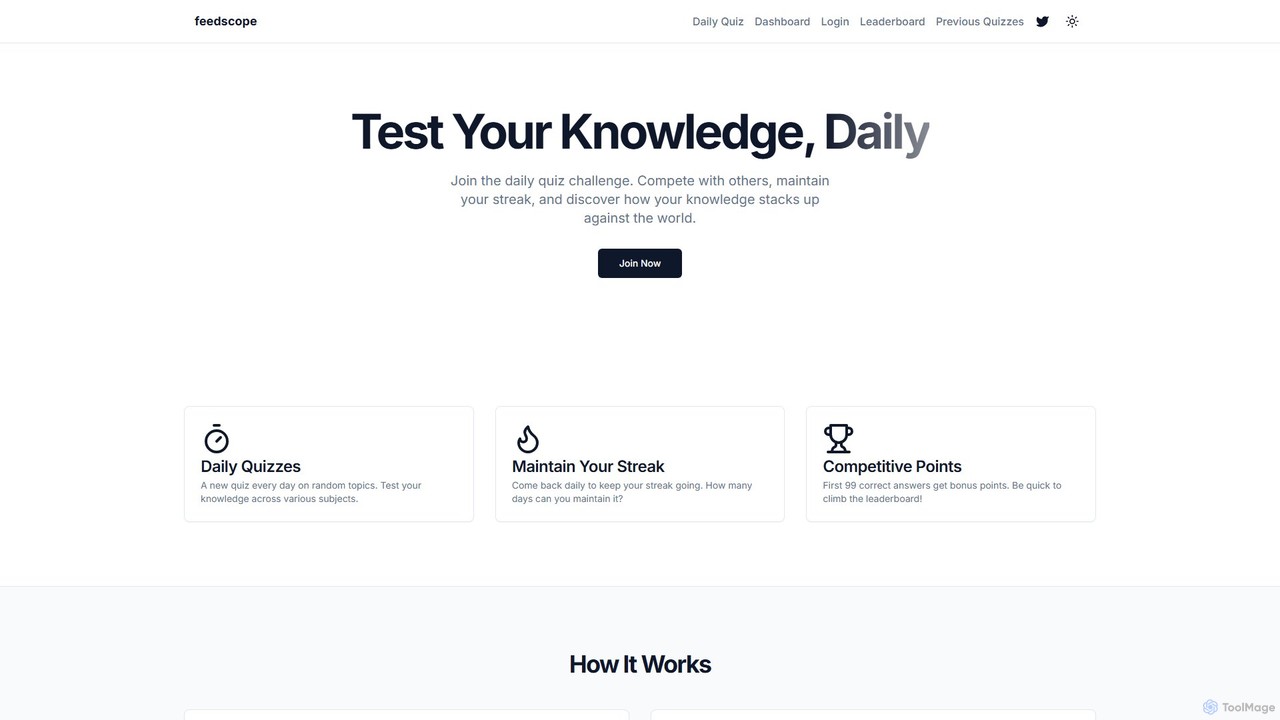
feedscope was an experimental daily quiz platform designed to test knowledge through competitive challenges. Users engaged in daily trivia on random topics, competed for high scores on a leaderboard, and maintained participation streaks. Although the project has been discontinued, it serves as an excellent case study in rapid development and gamified user engagement.
About Competition
AI Competition platforms are specialized online environments for hosting and participating in skill-based challenges, particularly in data science, machine learning, and programming. These platforms leverage automated systems to manage datasets, evaluate submissions, and maintain real-time leaderboards, fostering a competitive yet collaborative community. They provide a structured framework for individuals and teams to test their abilities against real-world problems, benchmark performance, and gain recognition. The core value lies in offering a standardized, fair, and scalable way to organize technical contests and crowdsource solutions.
Core Features
- Automated Leaderboards: Real-time ranking of participants based on performance metrics from submitted solutions.
- Dataset & Environment Hosting: Provides standardized datasets and secure, reproducible coding environments to ensure a level playing field.
- Automated Submission Evaluation: Systems that automatically score participant submissions against a hidden test set for unbiased assessment.
- Community Forums: Integrated discussion boards for participants to share ideas, ask questions, and collaborate after competitions end.
- Prize Management: Facilitates the distribution of monetary prizes, job offers, or other rewards to winners.
Use Cases
These platforms are widely used by data scientists and machine learning engineers to hone their skills and build a professional portfolio. Companies utilize them for talent acquisition by identifying top performers in specific domains. Additionally, research institutions and businesses use public competitions to crowdsource innovative solutions to complex problems that are difficult to solve internally.
How to Choose
When selecting an AI Competition platform, consider the types of competitions hosted (e.g., data science, reinforcement learning, code optimization). Evaluate the size and engagement level of the community, as a more active community offers better learning opportunities. Also, assess the quality of the datasets and problem statements, the platform's reputation for fairness, and the structure of the prize pools or career opportunities offered.

CompetitionUse Cases
Developing Data Science Skills for Career Growth
A university student majoring in computer science uses an AI competition platform to bridge the gap between academic theory and real-world application. They participate in competitions involving tabular data prediction and computer vision. By analyzing the problem statements, implementing various machine learning models, and studying the code of top-ranked participants, they rapidly improve their practical skills. This hands-on experience allows them to build a strong project portfolio on their resume, which becomes a key differentiator when applying for data scientist internships, demonstrating proven problem-solving abilities to potential employers.
Sourcing Top Talent for a Tech Company
A human resources manager at a fast-growing tech firm partners with the engineering department to host a private coding competition. Their goal is to identify and hire skilled machine learning engineers. They design a challenge based on a real business problem the company faces, such as optimizing a recommendation algorithm. The platform allows them to invite candidates, provide a standardized environment, and automatically score submissions based on accuracy and efficiency. The top performers are fast-tracked to final-round interviews, significantly reducing hiring time and ensuring candidates possess the practical skills needed for the job.
Crowdsourcing a Solution for Scientific Research
A biomedical research institute launches a public competition to accelerate drug discovery. They provide a large, anonymized dataset of chemical compounds and their effectiveness against a specific disease. The goal is for participants worldwide to develop a predictive model that can identify promising new drug candidates. The platform handles the massive number of participants and submissions, providing a leaderboard that fosters intense competition. The winning models, often developed with novel techniques, provide the institute with valuable insights and algorithms that significantly advance their research, achieving results faster than their internal team could alone.
Benchmarking a New Machine Learning Algorithm
A team of researchers develops a new optimization algorithm for training deep neural networks. To validate its effectiveness, they use an established competition platform to test it on several benchmark datasets (e.g., image classification, natural language processing). They enter public competitions and compare their algorithm's performance against state-of-the-art models submitted by others. The platform's standardized evaluation protocol and public leaderboard provide an objective and transparent way to demonstrate their algorithm's superiority. The results are then published in a research paper, using the competition rankings as strong evidence of their innovation's impact.
Enhancing University AI Courses with Practical Challenges
A university professor teaching an 'Introduction to Machine Learning' course creates a private competition for their students. Instead of a traditional final exam, students must build a model to solve a real-world prediction task using a dataset provided by the professor. The platform's live leaderboard introduces a gamified element, motivating students to iterate and improve their models throughout the semester. This approach transforms learning from passive listening to active problem-solving, helping students solidify their understanding of concepts like feature engineering, model selection, and hyperparameter tuning in a practical, engaging, and competitive setting.
Driving Brand Engagement with a Developer Community
A software company launches a new API for geospatial data analysis and wants to promote it to developers. They host a public competition focused on creating innovative data visualizations or predictive models using their API. The competition serves as a powerful marketing tool, encouraging developers to learn and experiment with the new product in a fun and rewarding way. The company offers API credits and cash prizes. The best projects are showcased on the company's blog and social media, generating organic buzz, providing excellent usage examples, and fostering a loyal community of developers around their product.