ToolMage
Sign in

Best 2 Model Sharing AI tools for Community

Popular Model Sharing AI tools in Community include SeaArt and LiblibAI, helping you work more efficiently.

SeaArt
Freemium

SeaArt

SeaArt is an all-in-one AI creativity platform and community for generating high-quality images, videos, audio, and interactive characters. It offers a vast library of models, advanced tools like ComfyUI, and custom model training, catering to everyone from beginners to professional artists and developers.

Voice Synthesis
Visits 18.3MFavorites 118Likes 121
LiblibAI
Freemium

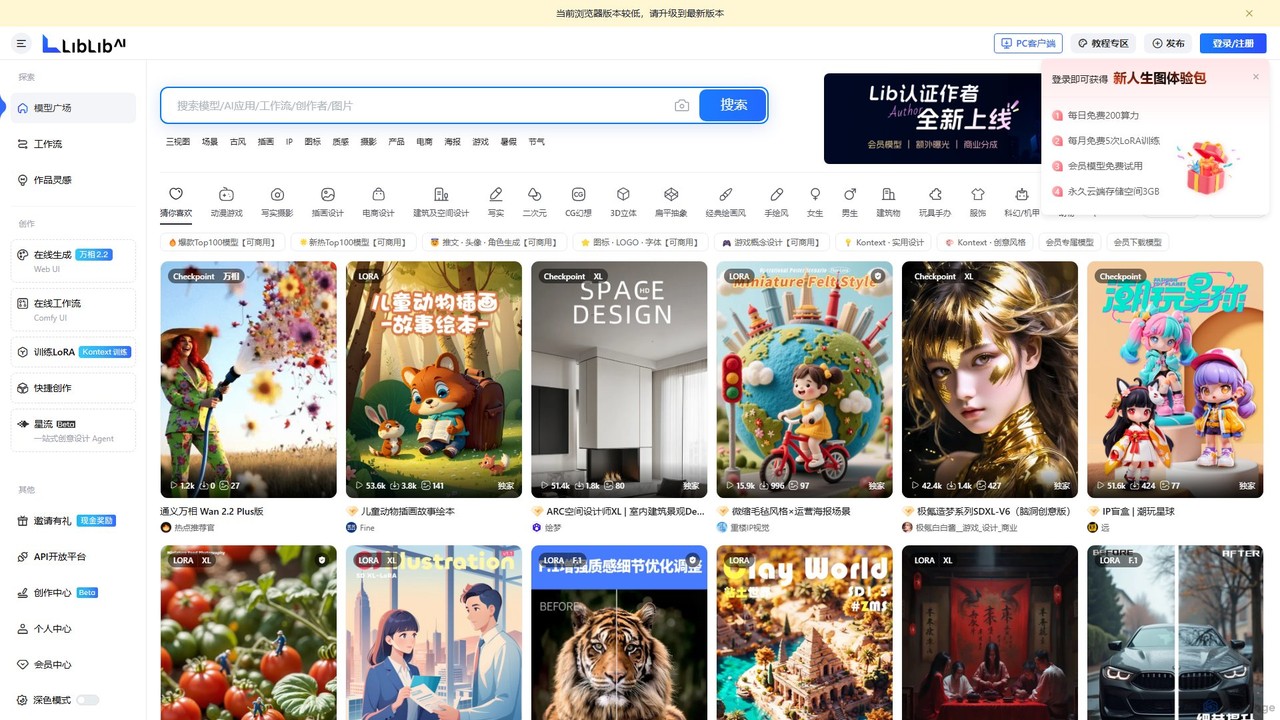
LiblibAI

LiblibAI is a leading AI creation platform and community, focusing on AI model sharing for image generation. It offers a vast library of Stable Diffusion models, including Checkpoints and LoRAs, with a special emphasis on anime, gaming, and unique Chinese artistic styles. Users can generate images online or download models for local use.

Ai Art
Visits 2.2MFavorites 102Likes 118

About Model Sharing

Model Sharing platforms are centralized hubs for discovering, downloading, and contributing pre-trained AI models. These platforms function as collaborative repositories, providing tools for model versioning, documentation, and performance evaluation. They accelerate AI development by allowing researchers and developers to build upon existing work rather than training complex models from scratch. As a key part of the AI community, these hubs democratize access to powerful models and foster open-source innovation.

Core Features

  • Extensive Model Library: A vast, searchable collection of pre-trained models for diverse tasks like natural language processing, image generation, and audio analysis.
  • Version Control: Tools to track model changes, manage different versions, and ensure the reproducibility of results.
  • In-Browser Inference: The ability to test models directly on the platform via a simple interface or API call without local setup.
  • Community Collaboration Tools: Features like discussion forums, model cards (documentation), and collaborative spaces for users to share feedback and improvements.
  • Dataset Hosting: Access to a wide range of datasets often used to train or benchmark the hosted models.

Use Cases

These platforms are essential for machine learning engineers, data scientists, AI researchers, and application developers. They are used to find base models for fine-tuning on specific tasks, benchmark new algorithms against established standards, and integrate state-of-the-art AI capabilities into software products with minimal overhead.

How to Choose

When selecting a Model Sharing platform, consider the variety and domain focus of its models (e.g., NLP, computer vision). Evaluate the quality of documentation and the activity level of the community. Check for robust APIs, SDKs, and integration with popular ML frameworks like PyTorch or TensorFlow. Finally, carefully review the licenses associated with models to ensure they align with your project's usage requirements (commercial vs. research).

Featured tool rankings

Model Sharing use cases

1

Accelerating NLP Application Development

An NLP engineer at a startup needs to build a sentiment analysis feature for customer feedback. Instead of training a large language model from scratch, which could take weeks and significant computational resources, they browse a model sharing platform. They find a pre-trained, fine-tuned sentiment analysis model like DistilBERT. By downloading this model and further fine-tuning it on their specific dataset for a few hours, they can rapidly deploy a high-performing feature. This approach saves over 95% of development time and cost, allowing the team to launch faster.

2

Exploring Creative Styles in Image Generation

A digital artist wants to experiment with various artistic styles using diffusion models. They access a model sharing hub focused on generative art. Here, they can discover and download dozens of community-trained models, such as checkpoints or LoRAs, each specialized in a unique style like 'cyberpunk', 'van gogh', or 'photorealistic'. This allows the artist to generate a wide array of high-quality, stylized images by simply loading different models, without needing any knowledge of model training. It serves as a powerful tool for creative exploration and concept art generation.

3

Benchmarking New Research Algorithms

A PhD student in computer vision develops a new algorithm for object detection. To validate its effectiveness, they need to compare it against established, state-of-the-art models. They use a model sharing platform to access and download the official implementations and pre-trained weights for models like YOLO and Faster R-CNN. By running these benchmark models on standard datasets (e.g., COCO) and comparing the performance metrics with their own, they can provide a credible, reproducible evaluation of their research. This process is crucial for academic publications and advancing the field.

4

Sharing and Collaborating on an Open-Source Model

An open-source AI developer creates a new, efficient language model. To share it with the community, they upload the model files, code, and a detailed 'model card' to a model sharing platform. This card explains the model's architecture, training data, intended use, and limitations. Other developers can then easily download and use the model. They can also provide feedback, report issues, or even contribute improvements through the platform's community features. This collaborative environment accelerates the model's development, increases its adoption, and builds the creator's reputation.

5

Integrating Voice Recognition into a Mobile App

A mobile app developer wants to add a voice command feature to their application. Building a speech recognition system is highly complex. Instead, they search a model sharing hub for a pre-trained automatic speech recognition (ASR) model suitable for on-device deployment, like a quantized version of Whisper. Using the platform's provided API documentation and libraries, they can integrate this powerful model into their app within days. This allows them to add a sophisticated AI feature without needing specialized expertise in speech processing, significantly enhancing user experience.

6

Fine-Tuning a Model for a Niche Industry

A data scientist at a legal tech company needs to classify legal documents. General-purpose language models lack the specific vocabulary for this task. They download a powerful base model, like Llama 3, from a model sharing platform. Then, they fine-tune this model on their company's private dataset of legal contracts and case files. The resulting model becomes highly specialized and achieves much higher accuracy in understanding legal jargon and classifying documents correctly compared to the original model. This creates a valuable, domain-specific asset for the company.

Model Sharing FAQ

What are AI Model Sharing platforms?

AI Model Sharing platforms are online repositories designed for hosting, discovering, and sharing pre-trained machine learning models. Think of them as a 'GitHub for AI models,' where developers and researchers can upload their creations and others can download them to use in their own applications. These platforms significantly reduce the time and cost of AI development by providing access to powerful, ready-to-use models for tasks like language understanding, image generation, and more, fostering a collaborative and open-source community.

How do I choose the right Model Sharing platform?

To choose the right platform, consider these key factors:

  • Model Focus: Determine if the platform specializes in the type of models you need, such as NLP, computer vision, or generative models.
  • Community and Documentation: Look for an active community with good support, discussions, and comprehensive 'model cards' that explain how to use each model.
  • Tools and Integration: Check for features like in-browser testing (inference APIs), SDKs, and easy integration with frameworks like PyTorch, TensorFlow, or JAX.
  • Licensing: Always verify the license of a model to ensure it permits your intended use, especially for commercial projects.
What's the difference between a Model Sharing platform and a code repository like GitHub?

The primary difference lies in their optimization. While both can store files, a Model Sharing platform is specifically designed for the machine learning workflow. Key differences include:

  • File Handling: They are optimized for storing and versioning very large files (model weights), which can be gigabytes in size, often using systems like Git LFS by default.
  • Metadata: They feature 'model cards'—structured documentation covering a model's architecture, performance, biases, and intended use.
  • Interactivity: Many platforms offer built-in inference widgets or APIs to test models directly in the browser, a feature not native to code repositories.
  • Discovery: They provide search and filtering capabilities tailored to ML-specific criteria, like task, framework, and dataset.
What types of models can I find on these platforms?

You can find a vast and growing variety of models. Common categories include:

  • Natural Language Processing (NLP): Large Language Models (LLMs) like BERT and GPT for tasks such as text classification, translation, and summarization.
  • Computer Vision: Models for object detection (e.g., YOLO), image segmentation, and image classification (e.g., ResNet).
  • Generative AI: Diffusion models like Stable Diffusion for text-to-image generation, as well as models for audio and video generation.
  • Audio Processing: Models for automatic speech recognition (e.g., Whisper) and text-to-speech synthesis.
Do I need to be an expert to use models from these platforms?

Not necessarily. While expertise is required for training models from scratch or complex fine-tuning, these platforms make AI more accessible. Many models can be used through simplified APIs or libraries with just a few lines of code. Additionally, features like in-browser inference widgets allow non-technical users to experiment with models directly. The goal of these platforms is to lower the barrier to entry, enabling a wider range of developers, creators, and researchers to leverage the power of AI without deep ML knowledge.