
Pastors.ai
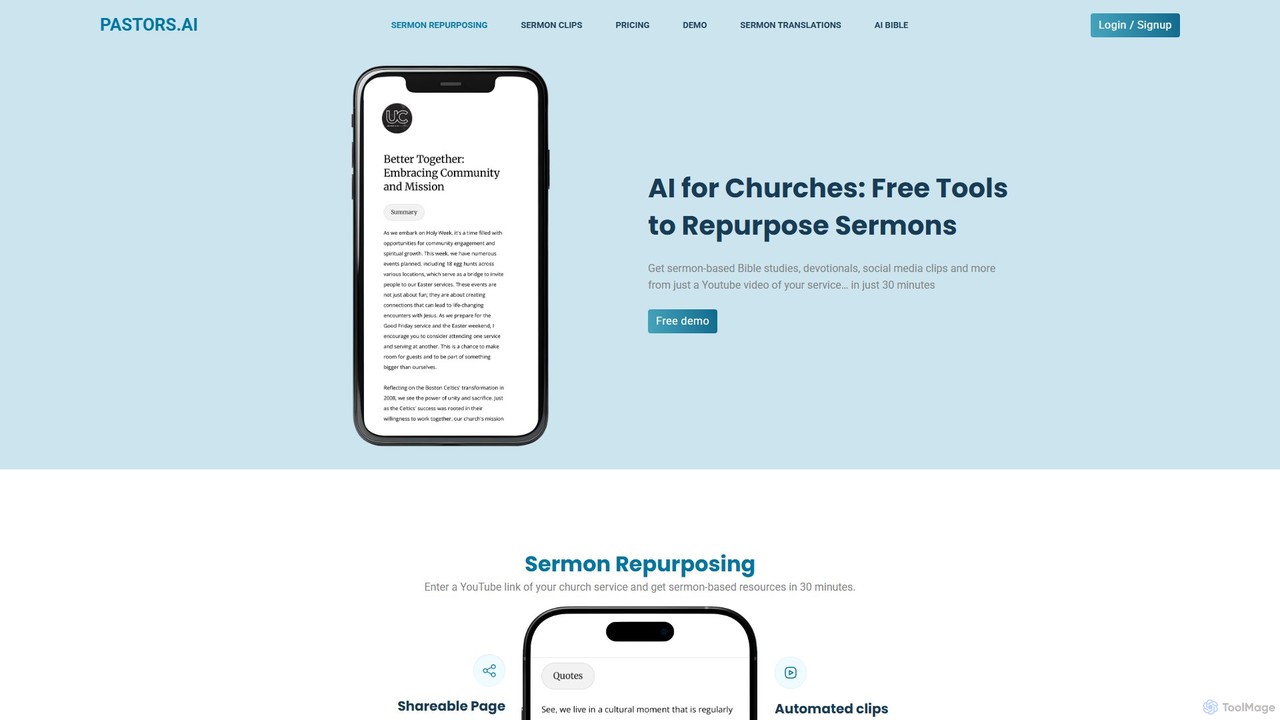
Pastors.ai is an AI-powered platform designed for churches and ministries. It automatically transforms sermon recordings into a comprehensive …
Pastors.ai is an AI-powered platform designed for churches and ministries. It automatically transforms sermon recordings into a comprehensive suite of resources, including detailed study guides, small group materials, social media clips, devotionals, and a custom AI chatbot trained on your church's content to enhance congregation engagement and streamline ministry workflows.
About Religion
AI Religion tools are specialized applications designed to assist in the study, practice, and administration of religious and spiritual activities. These tools leverage natural language processing (NLP) and machine learning to analyze sacred texts, generate content, and facilitate community engagement. They serve as digital assistants for clergy, scholars, and individuals seeking to deepen their understanding or manage faith-based communities. Their primary value lies in making vast theological resources more accessible and streamlining content creation for spiritual outreach.
Core Features
- Scripture Analysis: Provides in-depth analysis of religious texts, including cross-referencing, thematic searches, and commentary summarization.
- Sermon & Content Generation: Assists in drafting sermons, study guides, prayers, and social media posts based on specific themes or passages.
- Theological Q&A: Deploys AI chatbots trained on specific doctrines to answer questions from community members or the public.
- Personalized Spiritual Guidance: Delivers customized daily devotionals, prayer plans, or meditation guides based on user preferences.
Use Cases
These tools are primarily used by religious leaders (pastors, imams, rabbis) for sermon preparation and research. Theological students and scholars use them for academic analysis of texts. Additionally, faith-based organizations utilize them for creating digital content and engaging with their communities online. Individuals also use them for personal study and spiritual growth.
How to Choose
When selecting an AI Religion tool, consider the theological accuracy and the sources of its training data. Evaluate the depth of its analytical features for scripture study. For content creation, assess the quality and customizability of the generated text. Finally, consider the user interface's simplicity and whether it aligns with your specific faith tradition and needs.
ReligionUse Cases
Sermon Preparation for Clergy
A pastor preparing for a weekly sermon uses an AI Religion tool to research a specific biblical passage. They input the verse and the tool instantly provides historical context, cross-references to other parts of the scripture, summaries of key theological commentaries, and linguistic analysis of the original Greek or Hebrew words. This process, which previously took hours of manual research across multiple books, is condensed into minutes, allowing the pastor to focus more on crafting a relevant and impactful message for their congregation.
Personalized Daily Devotionals
An individual seeking daily spiritual guidance uses an AI-powered app. Based on their stated preferences for specific topics (e.g., 'hope', 'forgiveness') and preferred scripture versions, the app generates a unique daily devotional. Each morning, it delivers a relevant scripture passage, a short, AI-generated reflection on that passage, and a concluding prayer. This provides a personalized and consistent spiritual practice that adapts to the user's evolving spiritual journey, making ancient texts feel more accessible and relevant to modern life.
Theological Q&A for Seekers
A religious organization embeds an AI chatbot on its website to engage with visitors and seekers. The chatbot is trained on the organization's specific doctrines, sacred texts, and published materials. It can answer common questions 24/7, such as 'What are your core beliefs?', 'What is the meaning of this specific holiday?', or 'Where can I find resources on prayer?'. This provides immediate, accurate information to curious individuals and frees up staff to handle more complex pastoral inquiries, acting as a welcoming first point of contact.
Academic Research in Theology
A theology scholar is studying the evolution of a specific doctrine over several centuries. They use an advanced AI Religion tool to analyze a vast corpus of digitized historical texts, including writings from various theologians and council documents. The AI can identify linguistic shifts, track the frequency of key terms, and map out conceptual connections that would be nearly impossible for a human to detect manually. The tool generates visualizations of these trends, providing new insights and evidence for the scholar's research paper on doctrinal development.
Creating Study Guides for Small Groups
A volunteer leader of a religious study group needs to create weekly discussion materials. Using an AI content generator, they input the week's topic or scripture passage. The AI then generates a structured study guide, complete with an introduction, a summary of the text, a series of thought-provoking discussion questions tailored to different levels of understanding, and a concluding prayer. This automates the content creation process, ensuring high-quality, consistent materials for the group each week and saving the volunteer leader significant preparation time.
Translating Ancient Religious Texts
A team of linguists and scholars is working on a new translation of an ancient religious text. They use an AI tool trained on historical languages and translation principles. The AI provides initial draft translations, identifies potential ambiguities in the source text, and suggests multiple phrasing options in the target language, each with a confidence score. While human experts make the final decisions, the AI significantly accelerates the process by handling the repetitive aspects of translation and providing data-driven insights into complex passages, ensuring a more accurate and nuanced final version.