Backgammon Buddy
A comprehensive online backgammon platform featuring a powerful AI opponent (GnuBG), multiplayer mode, and in-depth game analysis. Ideal …
A comprehensive online backgammon platform featuring a powerful AI opponent (GnuBG), multiplayer mode, and in-depth game analysis. Ideal for all skill levels, from beginners learning the rules to experts honing their strategy. Offers a freemium model with a Pro plan for advanced features like move appraisal and blunder tracking.
whatbeatsrock
whatbeatsrock is a creative AI-powered word game where players challenge an AI by finding concepts that 'beat' a …
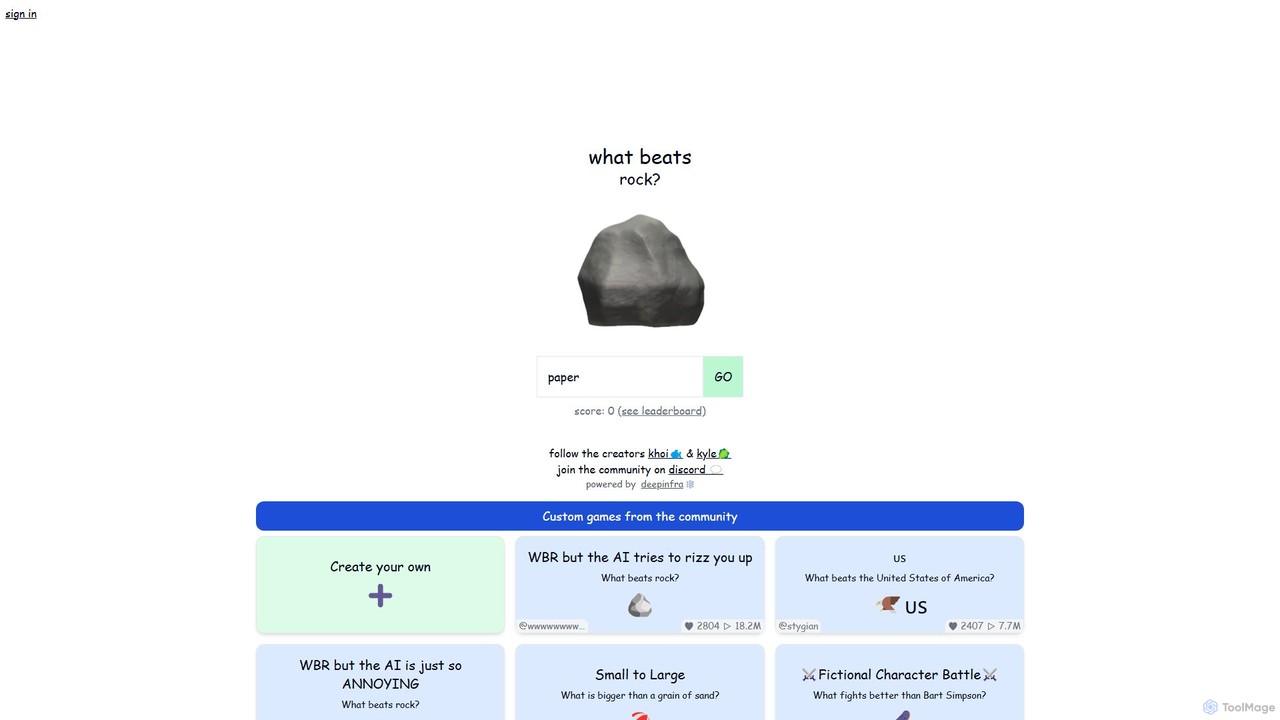
whatbeatsrock is a creative AI-powered word game where players challenge an AI by finding concepts that 'beat' a given prompt, starting with 'rock'. It features endless gameplay, community-created custom games, and leaderboards. Test your creativity and wit against a clever AI judge in this simple yet addictive web-based game.
About Social Gaming
Social Gaming tools are AI-powered platforms designed to enhance player interaction, community building, and overall engagement within multiplayer online games. These tools leverage advanced algorithms to personalize experiences, moderate content, and optimize social dynamics, making gaming environments more vibrant and inclusive. As a specialized segment within the broader Community category, Social Gaming AI focuses specifically on the social fabric of gaming, from matchmaking to in-game communication.
Core Features
- AI-Powered Matchmaking: Analyzes player data to create balanced teams and socially compatible groups, improving game fairness and enjoyment.
- Automated Content Moderation: Detects and filters toxic language, spam, and inappropriate user-generated content in real-time across chat and forums.
- Personalized Social Recommendations: Suggests friends, guilds, events, or content based on player behavior, preferences, and social network.
- Dynamic NPC Interaction: Enables non-player characters to engage in more natural, context-aware conversations and reactions, enriching the social game world.
- Anti-Cheat and Abuse Detection: Identifies suspicious patterns in player behavior to prevent cheating, botting, and other forms of abuse, ensuring fair play.
Applicable Scenarios
Game developers and community managers utilize Social Gaming AI to cultivate thriving player communities. This includes enhancing player retention by ensuring positive interactions, scaling moderation efforts across large user bases, and personalizing social pathways to keep players engaged and connected within the game ecosystem.
How to Choose
When selecting Social Gaming AI tools, consider their integration capabilities with your existing game engine and platforms, scalability to handle peak player loads, and the level of customization offered for specific game genres or community needs. Evaluate the accuracy of their moderation and matchmaking algorithms, as well as their data privacy and security protocols to protect player information.
Social GamingUse Cases
Enhancing Player-NPC Social Interactions
Game designers can leverage Social Gaming AI to create non-player characters (NPCs) with dynamic personalities and conversational abilities. For instance, an AI companion could learn a player's preferences, offer context-aware advice during quests, or even develop a unique relationship arc based on player choices. This deepens immersion and provides a more personalized, engaging social experience beyond human-to-human interaction.
Optimizing Player Matchmaking for Fair Play
Game developers and platform administrators use Social Gaming AI to create highly balanced and enjoyable matches. By analyzing player skill levels, playstyles, and even social compatibility metrics, the AI ensures that players are grouped with suitable teammates and opponents. This reduces frustration from imbalanced games and fosters a more positive competitive or cooperative environment, leading to higher player satisfaction and retention.
Automated Moderation for Healthy Communities
Community managers for online multiplayer games use AI tools to automatically detect and address toxic behavior, hate speech, or cheating in real-time. By analyzing chat logs, voice communications, and in-game actions, AI can flag or even temporarily ban disruptive players, ensuring a safe and welcoming environment. This significantly reduces the manual workload for moderators and promotes positive player interactions.
Automating Community Moderation and Safety
Community managers in online gaming environments face the challenge of maintaining a safe and respectful space for millions of players. Social Gaming AI tools automatically detect and filter toxic language, hate speech, spam, and other inappropriate content in real-time across chat, voice, and user-generated content. This significantly reduces the manual workload for moderators, ensures compliance with community guidelines, and protects players from harassment, fostering a healthier community.
Personalized Social Event & Content Recommendations
Game publishers and marketing teams utilize AI to analyze player data, including playstyle, social connections, and past event participation. Based on this, the AI recommends personalized in-game social events, guilds, or content that aligns with individual player interests. This boosts engagement, encourages players to join relevant communities, and increases participation in social activities, leading to higher retention rates.
Personalizing Social Connections and Content
To keep players engaged, game platforms use Social Gaming AI to offer personalized social recommendations. Based on a player's in-game activities, friend list, guild affiliations, and content consumption, the AI can suggest new friends with similar interests, relevant in-game events, or personalized content feeds. This helps players discover new social opportunities and content tailored to their preferences, deepening their connection to the game and its community.
Dynamic Group Formation for Cooperative Play
Developers of cooperative or team-based games employ AI-driven matchmaking systems that go beyond simple skill matching. These systems consider players' preferred roles, communication styles, and even past team dynamics to form more cohesive and enjoyable groups. This reduces friction, enhances teamwork, and ensures that players are paired with compatible teammates for a more satisfying social gaming experience.
Enhancing In-Game Social Events and Engagement
Game studios leverage Social Gaming AI to design and manage more engaging in-game social events. The AI can analyze player demographics, activity patterns, and historical event participation to suggest optimal timing, themes, and rewards for community events. This ensures that events are well-attended and resonate with the player base, fostering a stronger sense of community and increasing overall player engagement with the game's social features.
Generating Adaptive Social Quests & Challenges
Story designers and quest developers can use Social Gaming AI to create dynamic social quests that adapt to player groups and their progress. For example, an AI could generate a unique cooperative challenge for a guild based on its members' combined skills and current in-game achievements. This keeps the social gameplay fresh, encourages collaboration, and provides endless, personalized content for groups.
Detecting and Preventing Social Engineering Attacks
In online social gaming, players can be vulnerable to social engineering attacks like phishing, scams, or impersonation. Social Gaming AI can monitor communication patterns and player interactions for suspicious language or behaviors indicative of such attacks. By flagging or blocking malicious attempts in real-time, the AI protects players from financial loss, account compromise, and emotional distress, thereby maintaining a trustworthy and secure social environment within the game.
Fostering Player-Created Content & Social Sharing
AI tools can assist players in creating and sharing their own in-game content, fostering a more vibrant social ecosystem. For instance, an AI could help players design custom social spaces, generate unique emotes, or even suggest ideas for community events. This empowers players to become active contributors, share their creations with friends, and deepen their social ties within the game.
Generating Dynamic Social Narratives and Quests
For games with rich lore and social elements, Social Gaming AI can generate dynamic social narratives and quests that adapt to player choices and interactions. Instead of static storylines, the AI creates evolving quests that involve other players or AI-driven NPCs in meaningful ways, fostering emergent storytelling. This provides a unique and highly personalized social adventure for each player, enhancing replayability and the depth of social engagement within the game world.