ToolMage
Sign in

Best 1 Content Marketing AI tools for Content Creation

Popular Content Marketing AI tools in Content Creation include Sprites, helping you work more efficiently.

Sprites
Freemium

Sprites

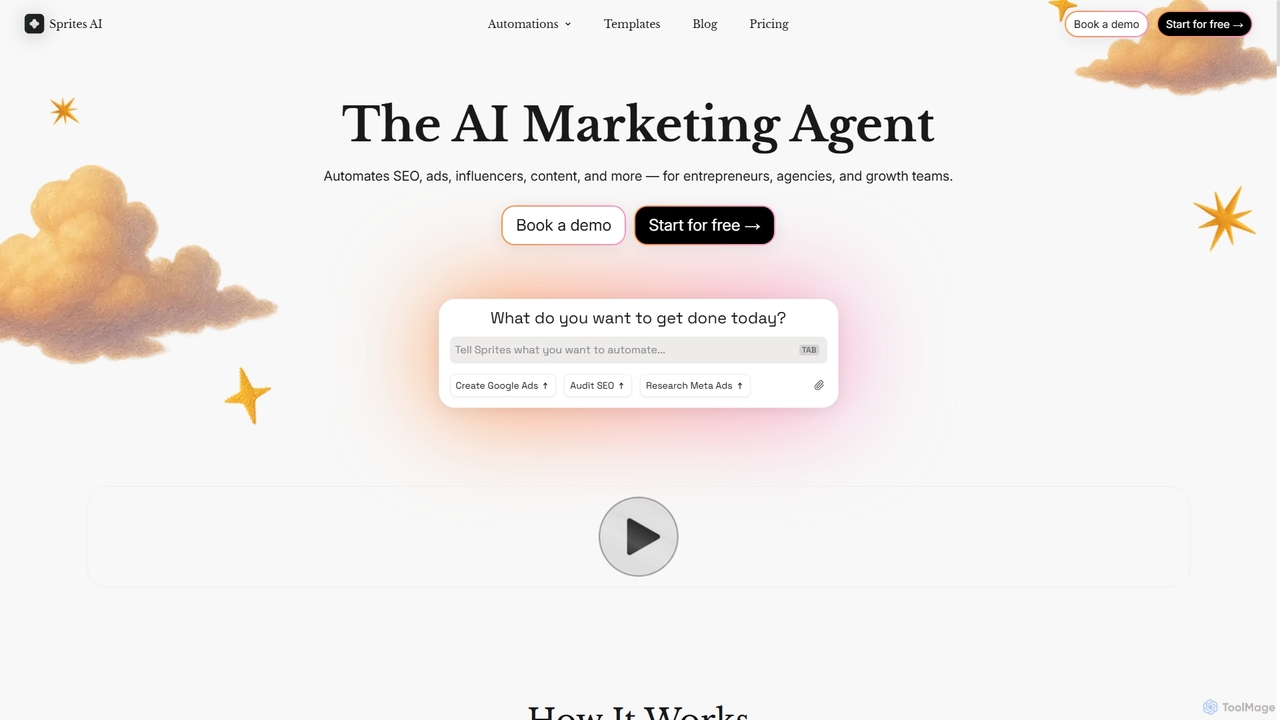
Sprites is an AI marketing agent that automates SEO, advertising, influencer outreach, and content creation for entrepreneurs, SMBs, and growth teams. It streamlines complex marketing tasks into efficient, autopilot workflows, delivering results in seconds.

Content Marketing
Visits 15.7KFavorites 151Likes 141

About Content Marketing

AI Content Marketing tools are specialized platforms that leverage artificial intelligence to streamline and enhance various aspects of content marketing strategies. These tools utilize advanced natural language processing (NLP) and machine learning algorithms to assist with content ideation, creation, optimization, distribution, and performance analysis. Their primary value lies in boosting efficiency, ensuring content relevance, and driving better engagement and conversion rates for marketing campaigns by automating repetitive tasks and providing data-driven insights.

Core Features

  • Intelligent Content Generation: Automatically drafts a wide range of marketing content, including blog posts, social media updates, ad copy, email newsletters, and landing page text, based on user prompts, target keywords, and audience profiles.
  • Advanced SEO Optimization: Offers comprehensive keyword research, competitive analysis, content brief generation, and real-time suggestions to optimize content for search engine visibility, readability, and ranking potential.
  • Strategic Content Repurposing: Efficiently transforms existing long-form assets like webinars, podcasts, or whitepapers into diverse marketing formats such as social media snippets, video scripts, infographics, or email sequences, maximizing content ROI.
  • Hyper-Personalization Engine: Analyzes audience data, behavioral patterns, and demographic information to tailor content messages, tones, and formats for specific customer segments, significantly improving relevance and engagement.
  • Performance Tracking & Analytics: Monitors key content metrics such as engagement rates, reach, conversion paths, and sentiment analysis, providing actionable insights for strategy refinement and identifying high-performing content types and channels.

Use Cases

Content marketing teams, digital agencies, and individual marketers extensively use these tools to accelerate their content pipelines, from brainstorming campaign ideas and developing comprehensive content calendars to publishing and analyzing results. They are particularly valuable for maintaining a consistent brand voice across channels, scaling content production for diverse audiences, and ensuring all marketing content is aligned with current SEO best practices and evolving audience interests.

How to Choose

When selecting an AI Content Marketing tool, consider the breadth and quality of its content generation capabilities, the accuracy and naturalness of its AI-generated output, and its seamless integration with your existing marketing platforms (e.g., CRM, CMS, social media schedulers). Evaluate its advanced SEO features, customization options for brand voice and style guides, the depth of its analytics reporting, and the scalability of its plans to ensure it aligns perfectly with your specific marketing objectives, team size, and workflow.

Content Marketing use cases

1

Generating SEO-Optimized Blog Posts

A content marketer needs to consistently publish high-ranking blog posts. Using an AI content marketing tool, they input target keywords and topics. The AI generates a structured outline, drafts engaging paragraphs, and suggests internal links, significantly reducing research and writing time while ensuring SEO best practices are embedded from the start.

2

Automate Social Media Content Creation

Social media managers can use AI content marketing tools to generate daily posts, captions, and relevant hashtags for platforms like Instagram, Facebook, and X. By inputting a topic or a few keywords, the AI drafts engaging content that aligns with the brand's voice, significantly increasing posting frequency and maintaining a consistent online presence without extensive manual effort.

3

Generate SEO-Optimized Blog Posts

Content marketers can leverage AI tools to research high-ranking keywords, outline article structures, and draft SEO-friendly blog posts. The AI analyzes search intent and competitor content, then generates drafts that include relevant headings, meta descriptions, and internal links, helping businesses attract more organic traffic and improve their search engine rankings for specific marketing campaigns.

4

Creating Diverse Social Media Content

A social media manager for an e-commerce brand needs daily posts across Instagram, Facebook, and Twitter. The AI tool takes a product description or a blog post link and generates multiple unique captions, hashtags, and even image ideas tailored for each platform, ensuring consistent brand messaging and saving hours of manual content creation.

5

Personalize Email Campaign Copywriting

Email marketers can use AI to create highly segmented and personalized email subject lines and body copy. By feeding the AI customer data and behavioral patterns, the tool generates variations of messages that resonate with different audience segments, leading to higher open rates, click-through rates, and ultimately, improved conversion rates for targeted email marketing campaigns.

6

Personalizing Email Marketing Campaigns

An email marketer aims to increase open and click-through rates for a new product launch. They use an AI tool to analyze customer segments and past engagement data. The AI then crafts personalized subject lines and body copy variations for different segments, making each email feel highly relevant to the individual recipient and boosting campaign performance.

7

Optimize Ad Copy for A/B Testing

Advertising specialists can employ AI content marketing tools to generate numerous ad copy variations for A/B testing across platforms like Google Ads and Facebook. The AI can quickly produce headlines, descriptions, and calls-to-action tailored to different target audiences or campaign objectives, allowing marketers to efficiently identify the most effective ad creatives that drive higher click-through rates and conversions.

8

Repurposing Long-Form Content into Snippets

A marketing team has a comprehensive whitepaper but needs to extract value for various channels. An AI content marketing tool can automatically identify key takeaways, generate short video scripts, create infographic text, and draft LinkedIn posts from the whitepaper, maximizing the reach and impact of the original content without extensive manual effort.

9

Developing Targeted Ad Copy Variations

An advertising specialist needs to test multiple ad creatives for a Google Ads or Facebook Ads campaign. The AI tool generates dozens of compelling headlines, descriptions, and calls-to-action based on product features, target audience pain points, and desired campaign goals, allowing for rapid A/B testing and optimization to find the highest-converting copy.

10

Predict Content Performance and Optimize Strategy

Content strategists can utilize AI tools to analyze past content data, predict future performance trends, and receive recommendations for optimizing existing content or identifying new content opportunities. By processing vast amounts of data on engagement, conversions, and audience behavior, AI helps refine content strategies, ensuring that future content investments are data-driven and more likely to achieve marketing objectives.

11

Analyzing Content Performance and Identifying Gaps

A content strategist wants to understand why certain blog posts underperform. An AI tool integrates with analytics platforms to identify content gaps, analyze competitor strategies, and suggest new topics or content formats that resonate with the target audience, providing data-driven recommendations to improve future content marketing efforts and ROI.

12

Localize Marketing Content for Global Audiences

Global marketing teams can use AI content marketing tools to efficiently translate and localize marketing content for different regional markets. This includes adapting website copy, product descriptions, and campaign messages to ensure cultural relevance and linguistic accuracy. AI streamlines the localization process, enabling brands to quickly reach diverse international audiences with tailored content, significantly reducing time-to-market for global campaigns.

Content Marketing FAQ

What are AI Content Marketing tools?

AI Content Marketing tools are software applications that use artificial intelligence, primarily natural language processing (NLP) and machine learning, to automate and enhance tasks within content marketing workflows. They help marketers with content ideation, creation, optimization for SEO, distribution, and performance analysis, aiming to improve efficiency, relevance, and campaign effectiveness.

What are AI Content Marketing tools?

AI Content Marketing tools are software applications that use artificial intelligence to automate, optimize, and personalize content creation, distribution, and analysis specifically for marketing objectives. They leverage technologies like natural language processing (NLP) and generative AI to produce marketing copy, analyze performance, and tailor content to specific audiences, aiming to improve engagement, conversions, and overall marketing ROI.

How to choose the right AI tool for content marketing?

When selecting an AI content marketing tool, consider several key factors. First, evaluate its core functionalities: does it offer content generation, SEO optimization, personalization, or analytics? Second, assess its integration capabilities with your existing marketing stack (CRM, CMS, email platforms). Third, check the quality and consistency of the AI-generated content, ensuring it aligns with your brand's voice and style. Finally, consider scalability, ease of use, and the pricing model to match your team's needs and budget.

How do AI Content Marketing tools differ from general AI Content Creation tools?

While both use AI to generate content, AI Content Marketing tools are specifically designed with marketing objectives in mind. They often include features like SEO optimization, audience targeting, conversion rate optimization, and performance analytics. General AI Content Creation tools might focus more broadly on text generation, image creation, or video editing without the inherent marketing strategy integration found in content marketing-specific solutions.

What are the key benefits of using AI in Content Marketing?

Using AI in content marketing offers several key benefits: significantly increased content production speed and volume, enhanced personalization for target audiences, improved SEO performance through data-driven optimization, better content consistency across channels, and deeper insights into content performance. This leads to more efficient resource allocation and higher ROI for marketing campaigns.

What are the main benefits of using AI in content marketing?

The main benefits of using AI in content marketing include significant efficiency gains, enhanced personalization, and data-driven decision-making. AI automates repetitive tasks like content generation and scheduling, freeing up marketers' time. It enables hyper-personalization by tailoring content to individual user preferences, leading to higher engagement and conversion rates. Furthermore, AI provides deep insights into content performance and market trends, allowing for more strategic and effective marketing campaigns and improved ROI.

How can I choose the best AI Content Marketing tool for my needs?

To choose the best tool, consider your specific marketing goals (e.g., SEO, lead generation, brand awareness), the types of content you need to create (blogs, social, email), and your budget. Evaluate the AI's output quality, its integration capabilities with your existing tech stack, the robustness of its SEO and analytics features, and the level of customization it offers for brand voice and style. A free trial can also be very helpful.

What are the limitations or challenges of AI in content marketing?

While powerful, AI in content marketing has limitations. A key challenge is maintaining a unique brand voice and human touch; AI-generated content can sometimes sound generic or lack genuine creativity. Ethical concerns regarding data privacy and potential biases in AI algorithms also exist. Furthermore, AI tools require careful oversight and refinement by human marketers to ensure accuracy, relevance, and compliance with brand guidelines. Over-reliance on AI without human intervention can lead to content that fails to truly connect with the audience.

How do AI Content Marketing tools differ from general AI Content Creation tools?

While AI Content Marketing tools are a subset of general AI Content Creation, their primary distinction lies in their specific focus and objectives. Content Marketing AI tools are designed with marketing KPIs (Key Performance Indicators) in mind, such as lead generation, conversion rates, and brand awareness. They often include features for SEO optimization, audience segmentation, personalized messaging, and performance analytics. General Content Creation tools, on the other hand, might focus more broadly on generating text, images, or videos without an inherent marketing strategy or performance tracking built into their core functionality.

Can AI Content Marketing tools help with SEO?

Absolutely. AI Content Marketing tools are highly effective for SEO. They can perform advanced keyword research, analyze competitor content, generate SEO-optimized content briefs, suggest relevant topics, and even optimize existing content for better search engine rankings. Many tools also provide real-time feedback on content readability, keyword density, and overall SEO score, directly contributing to improved organic visibility.