dreamspace.art
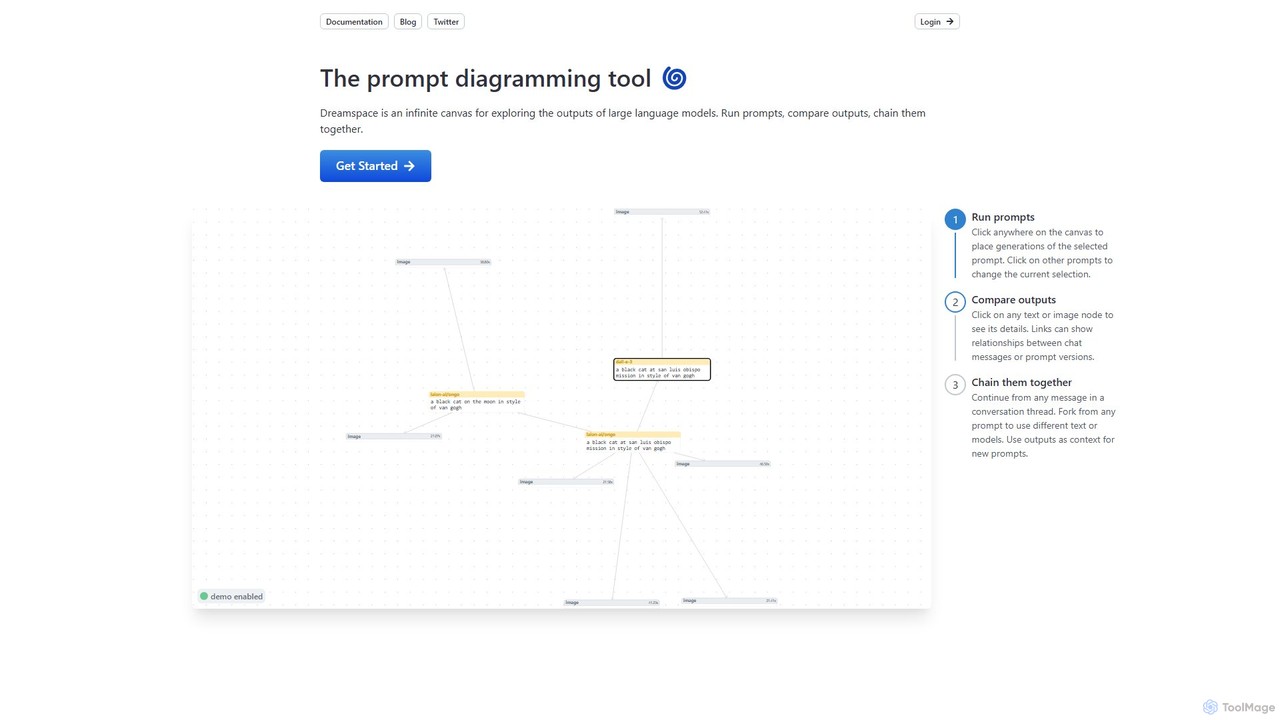
Dreamspace is a visual prompt diagramming tool with an infinite canvas, designed for exploring, comparing, and chaining outputs …
Dreamspace is a visual prompt diagramming tool with an infinite canvas, designed for exploring, comparing, and chaining outputs from large language models. It allows users to visually organize prompt experiments, connect to various AI models like OpenAI and Claude, and build complex workflows in a node-based interface.
About Experimentation
AI Experimentation tools are a specialized category of content creation software designed to generate a wide array of creative variations from a single prompt or idea. These tools leverage generative models to explore diverse styles, tones, and structures, producing multiple distinct outputs simultaneously. Their primary value lies in facilitating brainstorming, overcoming creative blocks, and discovering novel concepts that might not be immediately obvious. This approach allows creators to rapidly prototype and compare different creative directions before committing to a final version.
Core Features
- Multi-Variant Generation: Produces numerous unique versions of text, images, or audio from a single input, enabling broad exploration.
- Parameter Control: Allows users to fine-tune variables like style, mood, complexity, or specific elements to guide the creative output.
- Conceptual Divergence: Intentionally generates unexpected or unconventional ideas to break creative patterns and spark new inspiration.
- Rapid Ideation: Quickly creates a large volume of drafts or mockups, accelerating the initial stages of the creative process.
Use Cases
These tools are particularly useful for roles that require extensive ideation, such as concept artists, copywriters, brand strategists, and product designers. They are applied in early-stage creative development, campaign brainstorming sessions, and any scenario where exploring a wide possibility space is more important than producing a single, polished piece of content.
How to Choose
When selecting an AI Experimentation tool, consider the content type it supports (e.g., text, image, sound). Evaluate the depth of parameter control it offers for steering the output. Assess the diversity and quality of the generated variations. Finally, consider its integration capabilities with other tools in your creative workflow and its pricing model, especially for high-volume generation.

ExperimentationUse Cases
Exploring Ad Copy Variations for A/B Testing
A digital marketer needs to create a new ad campaign for a product launch. Instead of manually writing a few headlines, they use an AI Experimentation tool. By inputting the core product features and target audience, the tool generates over 50 distinct ad headlines and body texts in various tones (e.g., humorous, professional, urgent). The marketer can then select the top 10 most promising variations to run in an A/B test, quickly identifying the most effective messaging without hours of brainstorming.
Visual Concept Development for a Brand Identity
A graphic designer is tasked with creating a new logo for a tech startup. The brief is broad, with keywords like "innovative," "secure," and "user-friendly." Using an AI Experimentation tool for images, the designer inputs these keywords and explores hundreds of visual concepts in minutes. The tool generates abstract shapes, varied color palettes, and different typographic styles. This massive pool of ideas serves as a powerful mood board, helping the designer and client to quickly align on a visual direction before any detailed design work begins.
Brainstorming Plot Twists for a Screenplay
A screenwriter is working on a thriller and has reached a point of writer's block. They input the current plot summary into an AI Experimentation tool focused on narrative. The tool then generates 20 different potential plot twists, character betrayals, and unexpected events. While many are discarded, a few provide a fresh perspective, such as a secondary character being the secret antagonist. This process doesn't write the script, but it injects new possibilities into the creative process, helping the writer break through the block and explore new narrative paths.
Generating Diverse Musical Motifs and Harmonies
A music composer is looking for a catchy melody for a new song's chorus. Using an AI Experimentation tool for music, they input a basic chord progression and specify a tempo and mood (e.g., 'upbeat pop'). The AI generates dozens of short melodic variations and harmonic layers that fit the criteria. The composer can listen through these options, combining elements from different variations or using one as a starting point for further development. This accelerates the search for a strong musical hook, a process that could otherwise take days of trial and error.
Exploring UI Layouts for a Mobile App
A UX/UI designer is in the early stages of designing a new mobile application. To avoid settling on the first idea, they use an AI Experimentation tool to generate multiple layout concepts for the home screen. By defining key components like 'search bar,' 'featured items,' and 'navigation menu,' the tool produces various arrangements—some conventional, some experimental. This allows the designer to visually compare different user flows and information hierarchies, facilitating a more informed decision on the most effective and intuitive layout before building detailed wireframes.
Ideating Character Designs for a Video Game
A concept artist for a video game studio needs to design a new character described as a "steampunk alchemist from a floating city." This prompt is fed into an AI Experimentation tool. The tool generates a hundred different visual interpretations, varying costume details, gadget designs, and character poses. The artist reviews this gallery of ideas, not to find a final design, but to pick and mix elements—the goggles from one, the coat from another, the prosthetic arm from a third—to synthesize a unique and compelling final concept. This drastically shortens the initial ideation phase.