Contextminds
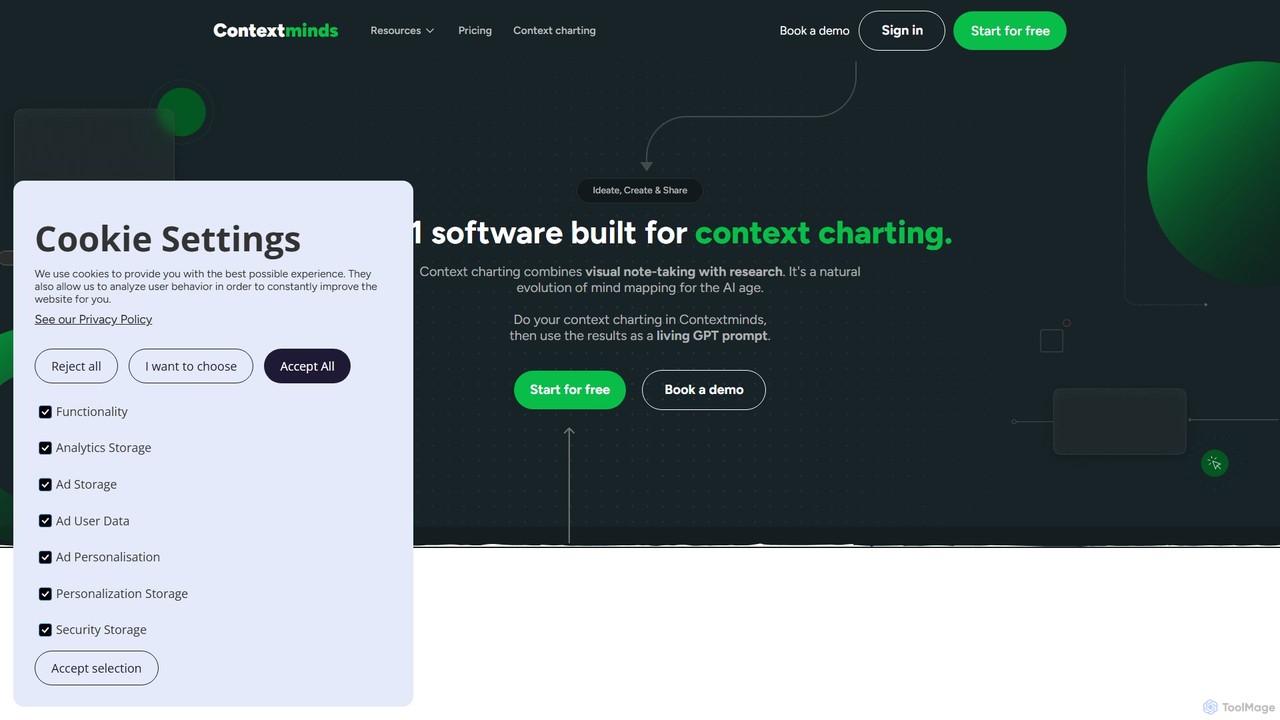
Contextminds is an AI-powered visual research and content planning tool. It uses the 'context charting' method to help …
Contextminds is an AI-powered visual research and content planning tool. It uses the 'context charting' method to help users brainstorm, organize ideas, discover related topics and keywords, and build comprehensive content outlines on an infinite visual canvas.
About Outline Generation
Outline Generation tools are AI-powered utilities that create structured frameworks for written or spoken content. By analyzing a topic or set of keywords, these tools use natural language processing to identify key themes, sub-topics, and logical sequences, organizing them into a hierarchical outline. This process provides a clear roadmap for content creation, helping to overcome writer's block, ensure comprehensive topic coverage, and establish a coherent narrative flow from the start. They are a crucial first step in the content creation workflow, focusing specifically on planning and structure before the actual writing begins.
Core Features
- Hierarchical Structuring: Generates multi-level outlines with main headings (H1, H2) and sub-points, creating a logical content hierarchy.
- Topic Analysis: Analyzes a core topic to suggest relevant sections, talking points, and questions to address.
- Customizable Depth: Allows users to specify the desired level of detail, from a simple high-level structure to a comprehensive, detailed plan.
- Keyword Integration: Suggests and incorporates relevant keywords into the outline's headings and sub-points for SEO purposes.
- Export Options: Enables exporting the generated outline to various formats like text, Markdown, or directly to writing applications.
Use Cases
These tools are widely used by content marketers for structuring blog posts and articles, students and academics for planning essays and research papers, and business professionals for preparing reports and presentations. For example, a YouTuber can use it to map out a video script, or an author can use it to organize chapters for a book, ensuring all key points are covered logically.
How to Choose
When selecting an Outline Generation tool, consider the quality and relevance of the generated structures for your niche. Evaluate the level of customization available—can you adjust the outline's depth and complexity? Check for integrations with your existing writing software, such as Google Docs or Notion. Also, assess the input flexibility; some tools can generate outlines from a simple phrase, while others can analyze existing content or URLs for more context.

Outline GenerationUse Cases
Structuring Long-Form Blog Posts
A content marketer needs to create a comprehensive guide on 'Sustainable Urban Farming'. Instead of starting from a blank page, they input the topic into an AI Outline Generation tool. The tool returns a detailed, multi-level outline including sections for an introduction, 'What is Urban Farming?', 'Benefits of Sustainability', 'Key Techniques (e.g., Hydroponics, Vertical Farming)', 'Case Studies', and a 'Conclusion'. This structured framework saves hours of research and planning, ensures all critical aspects are covered, and provides a logical flow for the writer to follow, resulting in a well-organized and SEO-friendly article.
Planning Academic Research Papers
A university student is tasked with writing a research paper on 'The Psychological Effects of Social Media on Adolescents'. Feeling overwhelmed by the scope, the student uses an outline generator. They input their thesis statement and key research questions. The AI generates a standard academic structure: 1. Abstract, 2. Introduction (including problem statement and hypothesis), 3. Literature Review, 4. Methodology, 5. Results, 6. Discussion, and 7. Conclusion. It even suggests sub-points for the literature review, such as 'Impact on Self-Esteem' and 'Correlation with Anxiety'. This provides a clear, actionable plan, making the daunting task of writing the paper manageable and structured.
Developing a Video Script Framework
A YouTuber plans to create an educational video titled 'A Beginner's Guide to Investing'. To ensure the content is easy to follow, they use an AI outliner. The tool generates a script structure with key segments: a hook for the introduction, a section explaining basic concepts (stocks, bonds), a step-by-step guide on how to start, a segment on common mistakes to avoid, and a call-to-action for the conclusion. This outline acts as a storyboard, helping the creator organize their talking points, plan visuals for each segment, and maintain a consistent pace, ultimately leading to a more engaging and professional video.
Preparing Business Reports and Presentations
A project manager needs to present a quarterly project review to stakeholders. They use an AI outline generator to structure the presentation. By inputting the project name and key performance indicators, the tool creates a logical flow: 1. Executive Summary, 2. Project Goals vs. Achievements, 3. Budget Analysis, 4. Challenges and Solutions Implemented, 5. Next Quarter's Roadmap, and 6. Q&A. This ensures the presentation is comprehensive, professional, and easy for stakeholders to digest. It also serves as a checklist, preventing the manager from forgetting crucial data points during the high-pressure presentation.
Designing an Online Course Curriculum
An online educator wants to create a new course on 'Digital Marketing Fundamentals'. To organize the vast amount of information, they use an AI outline generator. They input the course title and target audience. The AI proposes a curriculum broken down into modules, such as 'Module 1: Introduction to Digital Marketing', 'Module 2: SEO Basics', 'Module 3: Social Media Marketing', and 'Module 4: Email Campaigns'. Within each module, it suggests specific lesson topics, like 'On-Page vs. Off-Page SEO' or 'Creating a Content Calendar'. This provides a solid foundation for the course, ensuring a logical progression of learning and helping the educator to plan video lessons, quizzes, and assignments efficiently.
Organizing Chapters for a Non-Fiction Book
An author is writing a book about the history of artificial intelligence. The topic is complex, with many interconnected events and figures. To create a coherent narrative, the author uses an outline generator. They input the book's central theme. The AI suggests a chronological structure, breaking the history into key eras: 'The Early Years (1950s-70s)', 'The AI Winter', 'The Rise of Machine Learning (1990s-2000s)', and 'The Deep Learning Revolution'. For each chapter (era), it proposes sub-sections on key algorithms, influential researchers, and landmark achievements. This high-level map allows the author to tackle the book one section at a time without losing sight of the overall structure.