ToolMage
Sign in

Best 1 Voiceover Generation AI tools for Content Creation

Popular Voiceover Generation AI tools in Content Creation include Text to Speech.im, helping you work more efficiently.

Text to Speech.im
Freemium

Text to Speech.im

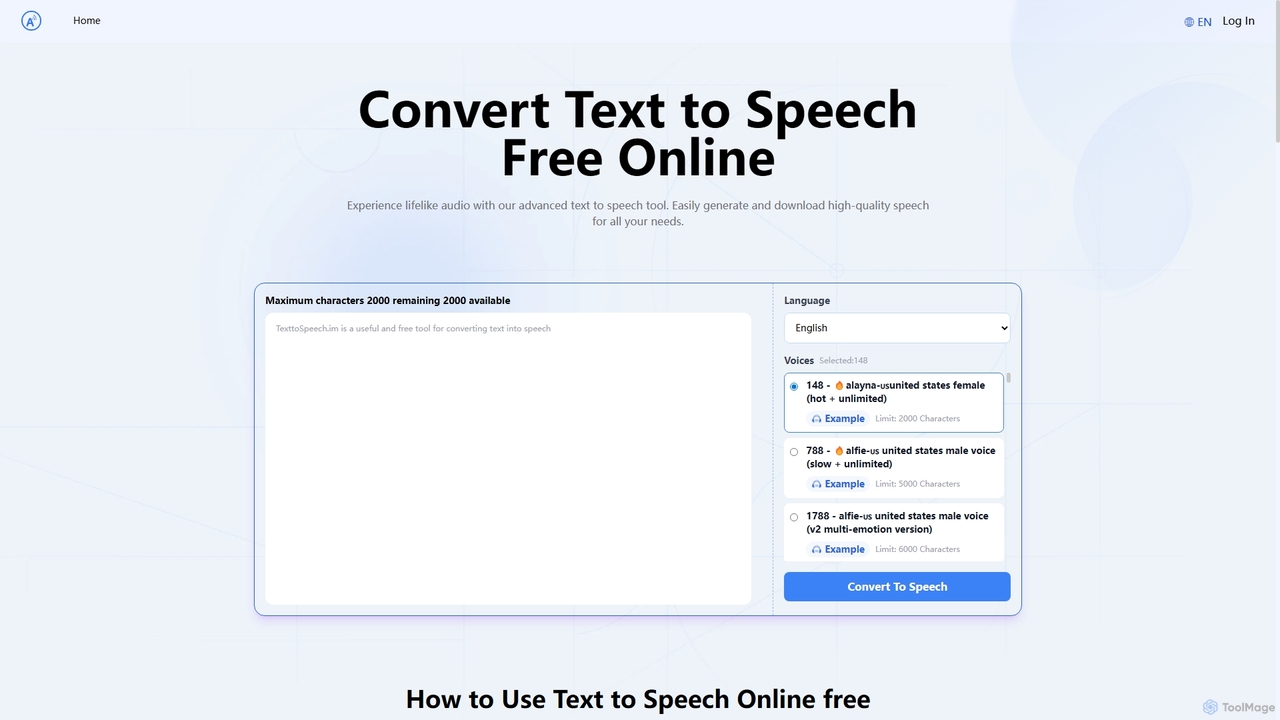
Text to Speech.im is a free online AI tool that converts text into natural-sounding speech. It supports a vast array of languages and voices, allowing users to generate high-quality audio for videos, e-learning, accessibility, and more. Customize voice speed and volume, then easily download the generated audio as an MP3 file.

Speech Synthesis
Visits 13.5KFavorites 95Likes 102

About Voiceover Generation

Voiceover Generation tools are AI-powered platforms that convert written text into natural-sounding spoken audio. Leveraging advanced text-to-speech (TTS) technology and deep learning models, these tools enable creators to produce high-quality audio narration for videos, podcasts, and e-learning materials without needing human voice actors. This significantly reduces production time and costs while offering a wide range of customizable voices, languages, and emotional tones, making professional audio content accessible to everyone within the broader field of content creation.

Core Features

  • Text-to-Speech Conversion: Transforms written scripts into lifelike spoken words using AI algorithms.
  • Voice Customization: Offers a diverse selection of voices, accents, and speaking styles, often allowing pitch, speed, and volume adjustments.
  • Multi-language Support: Provides the ability to generate voiceovers in numerous languages and dialects, facilitating global content reach.
  • Emotion and Tone Adjustment: Allows users to infuse generated speech with specific emotions like joy, sadness, or anger, or adjust the overall tone.
  • SSML (Speech Synthesis Markup Language) Support: Enables fine-grained control over pronunciation, pauses, emphasis, and other speech attributes for highly nuanced output.

Use Cases

These tools are invaluable for content creators, marketers, educators, and developers seeking efficient and scalable audio production. They streamline the creation of audio tracks for explainer videos, online courses, marketing advertisements, and even interactive voice response (IVR) systems, providing a consistent and professional audio experience across various digital platforms.

How to Choose

When selecting a Voiceover Generation tool, consider the naturalness and quality of the generated voices, the breadth of language and accent options, and the level of voice customization available. Evaluate the pricing model, integration capabilities with existing workflows, and the ease of use of the platform's interface to ensure it meets your specific production needs and budget.

Voiceover Generation use cases

1

Creating Narration for Educational Videos

Educators and e-learning developers can utilize voiceover generation tools to quickly produce clear and engaging narration for online courses, tutorials, and instructional videos. By simply inputting text scripts, they can generate consistent, professional-sounding audio in multiple languages, saving significant time and resources compared to hiring voice actors or recording themselves, ensuring a high-quality learning experience for students globally.

2

Generating Voiceovers for Marketing Campaigns

Marketing professionals and advertisers can leverage AI voiceover tools to create compelling audio for promotional videos, social media ads, and product demonstrations. This allows for rapid iteration of ad creatives with different voices or languages, enabling A/B testing and targeted messaging. The ability to quickly adapt voiceovers helps brands connect with diverse audiences and respond swiftly to market trends, enhancing campaign effectiveness.

3

Producing Audio Versions of Blog Posts and Articles

Content creators and publishers can transform written articles into engaging audio content, expanding their audience reach to listeners who prefer consuming information on the go. By converting blog posts into podcasts or audio articles, they can cater to different consumption habits, improve accessibility, and boost SEO by offering diverse content formats. This provides a convenient way for users to engage with content while commuting or exercising.

4

Localizing Video Content for Global Audiences

Businesses and media companies can efficiently localize their video content by generating voiceovers in multiple target languages. Instead of costly and time-consuming re-recording with human voice actors, AI tools provide a scalable solution to create accurate and culturally appropriate narrations. This enables rapid market expansion, ensures consistent brand messaging across regions, and makes content accessible to a wider international audience.

5

Developing Interactive Voice Response (IVR) Systems

Developers and customer service teams can use voiceover generation to create natural-sounding prompts and responses for IVR systems, chatbots, and virtual assistants. This ensures a consistent and professional brand voice across all customer touchpoints. The flexibility to quickly update scripts and generate new audio responses improves the agility of customer service operations, enhancing user experience and reducing operational costs.

6

Crafting Character Voices for Games and Animations

Game developers and animators can employ AI voiceover tools to generate unique and consistent character voices for their projects. This is particularly useful for prototyping, indie game development, or for non-player characters (NPCs) where a large volume of dialogue is required. It allows for creative experimentation with different voice styles and tones, accelerating the development process and bringing characters to life without extensive voice acting budgets.

Voiceover Generation FAQ

What are Voiceover Generation tools?

Voiceover Generation tools are AI-powered software applications that convert written text into spoken audio, simulating human speech. They leverage advanced text-to-speech (TTS) technology to produce natural-sounding narration. These tools are primarily used to create audio tracks for videos, podcasts, e-learning modules, and other multimedia content, offering a cost-effective and time-efficient alternative to traditional voice acting. They often feature customizable voices, languages, and emotional tones.

How do AI voiceover generators work?

AI voiceover generators work by employing sophisticated text-to-speech (TTS) engines, often powered by deep learning models like neural networks. Users input text, which the AI then analyzes for pronunciation, intonation, and rhythm. The system synthesizes this information to generate audio waveforms that mimic human speech. Advanced tools also incorporate features like Speech Synthesis Markup Language (SSML) to allow users to control pauses, emphasis, and emotional nuances, resulting in highly realistic and expressive voiceovers.

What's the difference between AI voiceovers and human voice actors?

The primary difference lies in the source and flexibility. AI voiceovers are generated synthetically from text, offering speed, scalability, and cost-effectiveness, especially for large volumes or multiple languages. They provide consistent quality and can be easily edited by changing text. Human voice actors, however, bring unique emotional depth, nuanced delivery, and artistic interpretation that AI currently struggles to fully replicate. While AI is excellent for efficiency and consistency, human voice actors excel in conveying complex emotions and delivering highly personalized performances for critical projects.

What factors should I consider when choosing an AI voiceover tool?

When selecting an AI voiceover tool, prioritize voice quality and naturalness, ensuring the output sounds human-like and engaging. Look for a wide range of languages, accents, and voice styles to match your target audience. Consider customization options like pitch, speed, volume, and emotional expression. Evaluate the pricing model, including character limits or subscription tiers, and check for integration capabilities with your existing video editing or content creation software. Finally, assess the user interface for ease of use and efficiency.

Can AI voiceover tools express emotions?

Yes, many modern AI voiceover tools are capable of expressing a range of emotions, though the sophistication varies by platform. Through advanced deep learning and neural TTS models, these tools can be prompted to generate speech with specific emotional tones such as joy, sadness, anger, excitement, or even a neutral tone. Some tools allow users to fine-tune emotional intensity or apply SSML tags to emphasize certain words, making the synthetic voices more expressive and suitable for diverse content types.