ToolMage
Sign in

Best 1 Crm AI tools for Customer Service

Popular Crm AI tools in Customer Service include Amplafide, helping you work more efficiently.

Amplafide
Paid

Amplafide

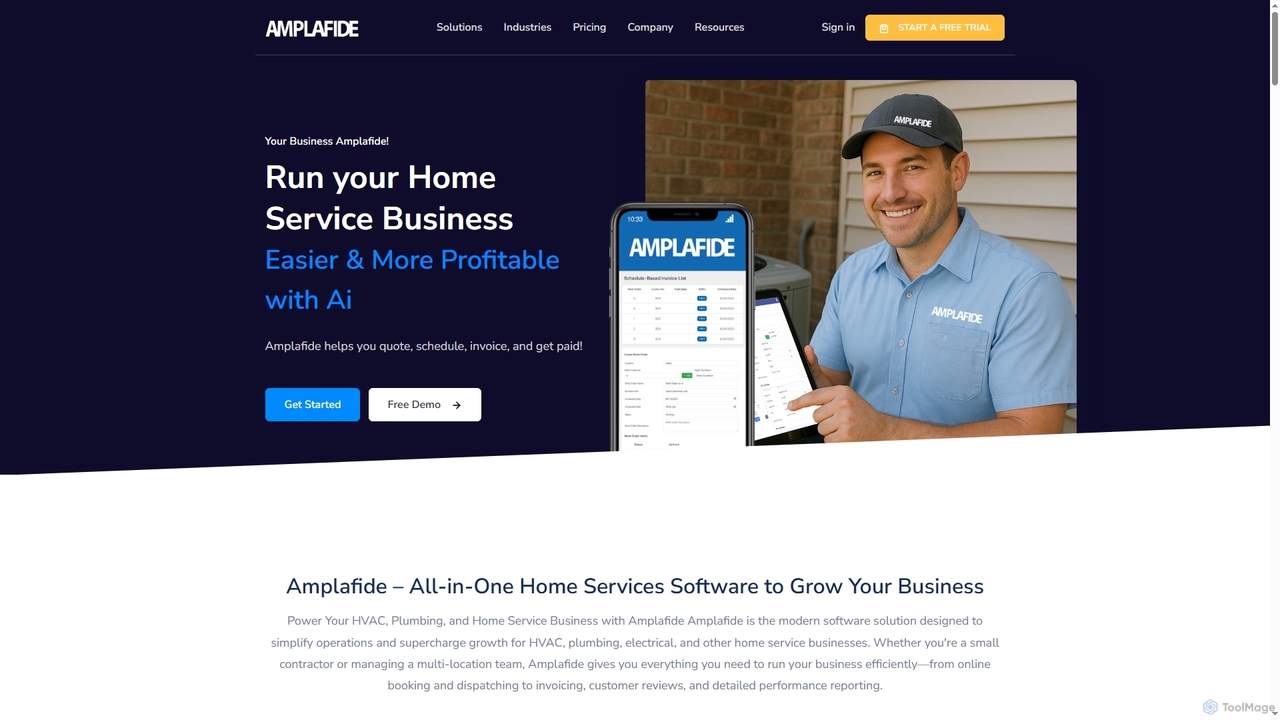
Amplafide is an all-in-one AI-integrated SaaS platform designed for home service professionals. It streamlines operations like scheduling, dispatching, invoicing, customer relationship management, and job costing for trades such as HVAC, plumbing, and electrical. The platform aims to boost efficiency, customer satisfaction, and profitability for growing service companies.

3D
Visits 5.5KFavorites 110Likes 117

About Crm

AI-powered CRM (Customer Relationship Management) tools are sophisticated platforms designed to manage and analyze customer interactions and data throughout the entire customer lifecycle. These systems leverage artificial intelligence, including machine learning and natural language processing, to automate and optimize sales, marketing, and customer service processes, significantly enhancing efficiency and personalization. They empower businesses to build stronger customer relationships, improve customer satisfaction, and drive sales growth by providing a unified, intelligent view of customer data and predicting future behaviors.

Core Features

  • Intelligent Customer Data Integration: Automatically collects, organizes, and analyzes customer data from multiple channels to form a 360-degree customer view.
  • Sales Process Automation: Automates lead management, sales forecasting, quotation generation, and contract creation, accelerating the sales cycle.
  • Personalized Marketing: Utilizes AI to analyze customer preferences, automatically sending tailored emails and product recommendations to boost marketing effectiveness.
  • Smart Customer Service: Provides 24/7 efficient customer support through AI chatbots, intelligent knowledge bases, and automated ticket management.
  • Behavioral Prediction & Insights: Predicts customer churn risk and purchase intent, offering data-driven decision support.

Use Cases

Sales teams utilize AI CRM to automate lead assignment, track sales progress, and receive intelligent sales recommendations, boosting overall efficiency. Customer service departments enhance response times and quality through AI-driven knowledge bases and automated replies. Marketing teams design and execute highly personalized campaigns based on AI-analyzed customer segments and behavior patterns.

How to Choose

When selecting an AI CRM, evaluate the depth of its AI capabilities in data analysis, prediction, automation, and personalization. Assess its integration and scalability with existing business systems like ERP or marketing automation platforms. Consider user-friendliness and ease of operation to minimize employee training costs. Finally, ensure robust data security and compliance with regulations such as GDPR.

Crm use cases

1

Automating Sales Lead Management and Nurturing

Sales teams leverage AI CRM to automatically capture potential customer information from websites, social media, and other channels. AI algorithms then score and prioritize these leads. The system automatically sends personalized emails or notifies sales representatives for follow-up based on lead interaction behavior, significantly shortening the sales cycle and increasing conversion rates.

2

Improving Customer Service Response Speed and Quality

Customer service departments deploy AI-driven CRM systems to handle common customer inquiries via intelligent chatbots, providing 24/7 instant responses. For complex issues, AI quickly analyzes customer history, intelligently routes tickets to the most suitable service representative, and provides relevant knowledge base articles, greatly improving first-contact resolution rates and customer satisfaction.

3

Implementing Precise Personalized Marketing Campaigns

Marketing teams utilize AI CRM to analyze customer purchase history, browsing behavior, and preferences, automatically segmenting customers. Based on these insights, the system can automatically generate and send highly personalized product recommendations, promotional messages, or content, ensuring marketing messages reach the most relevant audience and increasing marketing campaign ROI.

4

Predicting Customer Churn and Proactive Intervention

Businesses use AI CRM's predictive analytics to identify customers at high risk of churn. The system analyzes data such as interaction frequency, service requests, and purchase patterns, issuing early warnings. Sales or customer service teams can then proactively contact these customers, offering exclusive deals or solutions, effectively reducing customer attrition rates.

5

Optimizing Sales Forecasting and Performance Management

Sales managers use AI CRM for more accurate sales forecasting. AI models analyze historical sales data, market trends, and sales activities to provide data-driven sales predictions, helping managers allocate resources and set targets effectively. The system also tracks sales performance in real-time, identifying bottlenecks and offering improvement suggestions.

6

Unified Management of Multi-channel Customer Interactions

Enterprises use AI CRM to integrate data from all customer touchpoints, including phone, email, social media, and live chat. Regardless of the channel a customer uses, the system provides a complete interaction history and customer information, ensuring all team members have a consistent and comprehensive customer view, thereby enhancing the continuity of the customer experience.

Crm FAQ

What are AI-powered CRM tools?

AI-powered CRM (Customer Relationship Management) systems combine traditional CRM functionalities with artificial intelligence technologies. They leverage machine learning, natural language processing, and predictive analytics to automate and optimize customer data management, sales, marketing, and customer service processes. Their core purpose is to help businesses understand customers more deeply, enhance personalized interactions, and drive stronger customer relationships and business growth through intelligent analysis and predictions.

How do I choose the right AI CRM tool for my business?

When selecting an AI CRM, consider several factors: First, evaluate its AI capabilities (e.g., intelligent lead scoring, predictive analytics, marketing automation) to ensure they align with your business needs. Second, check its integration capabilities with existing systems like ERP or marketing automation platforms. Third, assess user-friendliness and potential employee training costs. Finally, prioritize robust data security and privacy protection measures to ensure compliance with industry regulations.

What are the main differences between AI CRM and traditional CRM?

Traditional CRM primarily focuses on storing, organizing, and manually managing customer data, along with basic process automation. AI CRM, however, builds upon this by adding intelligent analysis, prediction, and automated decision-making capabilities through AI technologies. For instance, AI CRM can automatically identify sales opportunities, predict customer churn, personalize product recommendations, and provide smart customer service, going far beyond the passive data management and rule execution of traditional CRM.

What specific benefits can businesses gain from using AI CRM?

Using AI CRM offers numerous benefits. It significantly boosts sales efficiency by accelerating transactions through intelligent lead management and sales forecasting. In marketing, it enables more precise customer segmentation and personalized promotions, increasing ROI. For customer service, it provides faster, smarter responses, enhancing customer satisfaction. Furthermore, AI-driven insights help businesses better understand market trends and customer needs, supporting data-driven strategic decisions.

What should I consider when implementing an AI CRM?

When implementing an AI CRM, first ensure high data quality, as AI effectiveness heavily relies on accurate and clean data. Second, clearly define business objectives and expected outcomes to select appropriate tools and functionalities. Employee training and adoption are crucial and require ample support. Additionally, implement it gradually, starting with small-scale pilots, and continuously monitor and optimize system performance to adapt to business evolution.