
Dream Chat
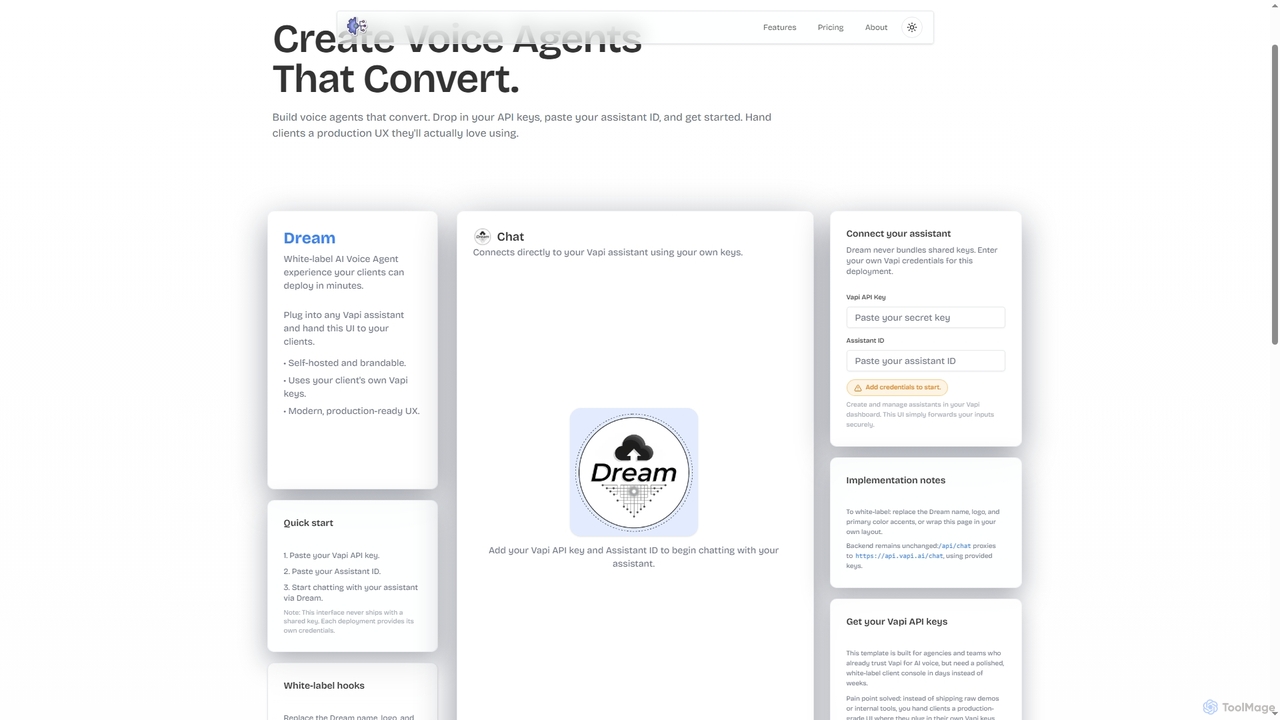
Dream Chat is a white-label AI Voice Agent interface designed for agencies and teams to rapidly deploy production-ready, …
Dream Chat is a white-label AI Voice Agent interface designed for agencies and teams to rapidly deploy production-ready, branded AI voice experiences. It allows clients to connect their Vapi assistants using their own API keys, offering a modern, self-hosted, and fully customizable user experience without extensive frontend development.
About Voice Assistants
Voice Assistants are AI-powered tools that interpret human speech and respond with relevant information or actions. Leveraging advanced natural language processing (NLP) and speech recognition, these assistants enable hands-free interaction, automating tasks and providing instant support. Within customer service, they enhance user experience by offering immediate, personalized assistance, streamlining communication, and improving accessibility for diverse users.
Core Features
- Speech Recognition: Accurately converts spoken language into text for processing.
- Natural Language Understanding (NLU): Interprets user intent, context, and entities from spoken input.
- Text-to-Speech (TTS): Generates natural-sounding spoken responses from text.
- Contextual Awareness: Maintains conversation context across multiple turns for more natural interactions.
- Integration Capabilities: Connects with CRM, ERP, and other business systems to access and update information.
Use Cases
Voice assistants are widely adopted in customer service centers for automating routine inquiries, in smart homes for device control, and in automotive systems for navigation and entertainment. They also serve as productivity tools in enterprise environments, enabling hands-free data entry and task management for field workers or professionals.
How to Choose
When selecting a voice assistant, consider its accuracy in speech recognition and NLU, the breadth of supported languages, and its integration capabilities with existing platforms. Evaluate customization options for branding and specific workflows, as well as scalability to handle varying user loads and future expansion needs.
Voice AssistantsUse Cases
Automated Customer Support Hotline
A customer service department deploys a voice assistant to handle a high volume of incoming calls. The assistant greets callers, identifies their intent (e.g., checking order status, billing inquiry, technical support) through natural conversation, and provides immediate answers or routes complex issues to the appropriate human agent, significantly reducing wait times and operational costs.
In-Car Infotainment and Navigation
Automotive manufacturers integrate voice assistants into vehicle systems, allowing drivers to control navigation, music playback, climate settings, and make calls using voice commands. This hands-free interaction enhances safety by minimizing driver distraction and improves the overall user experience during commutes and long journeys.
Smart Home Device Management
Individuals use voice assistants to control various smart home devices, such as lights, thermostats, security cameras, and entertainment systems. By simply speaking commands, users can adjust their home environment, play media, or check device statuses, creating a convenient and interconnected living space.
Hands-Free Productivity in Enterprise
Field service technicians or healthcare professionals utilize voice assistants on mobile devices to log data, access information, or update records while performing tasks that require their hands. This enables efficient data capture and information retrieval in dynamic environments, improving workflow efficiency and accuracy.
Accessibility for Users with Disabilities
Voice assistants provide crucial accessibility features for individuals with visual impairments, motor disabilities, or other challenges that make traditional input methods difficult. They can read out screen content, execute commands, and facilitate communication, empowering users to interact with technology more independently.
Multilingual Customer Interaction
Global businesses implement voice assistants capable of understanding and responding in multiple languages. This allows them to offer consistent, high-quality customer support to a diverse international customer base without needing a large, multilingual human agent team, improving global reach and customer satisfaction.