ToolMage
Sign in

Best 1 Surveys & Feedback AI tools for Customer Support

Popular Surveys & Feedback AI tools in Customer Support include Opinion Stage, helping you work more efficiently.

Opinion Stage
Freemium

Opinion Stage

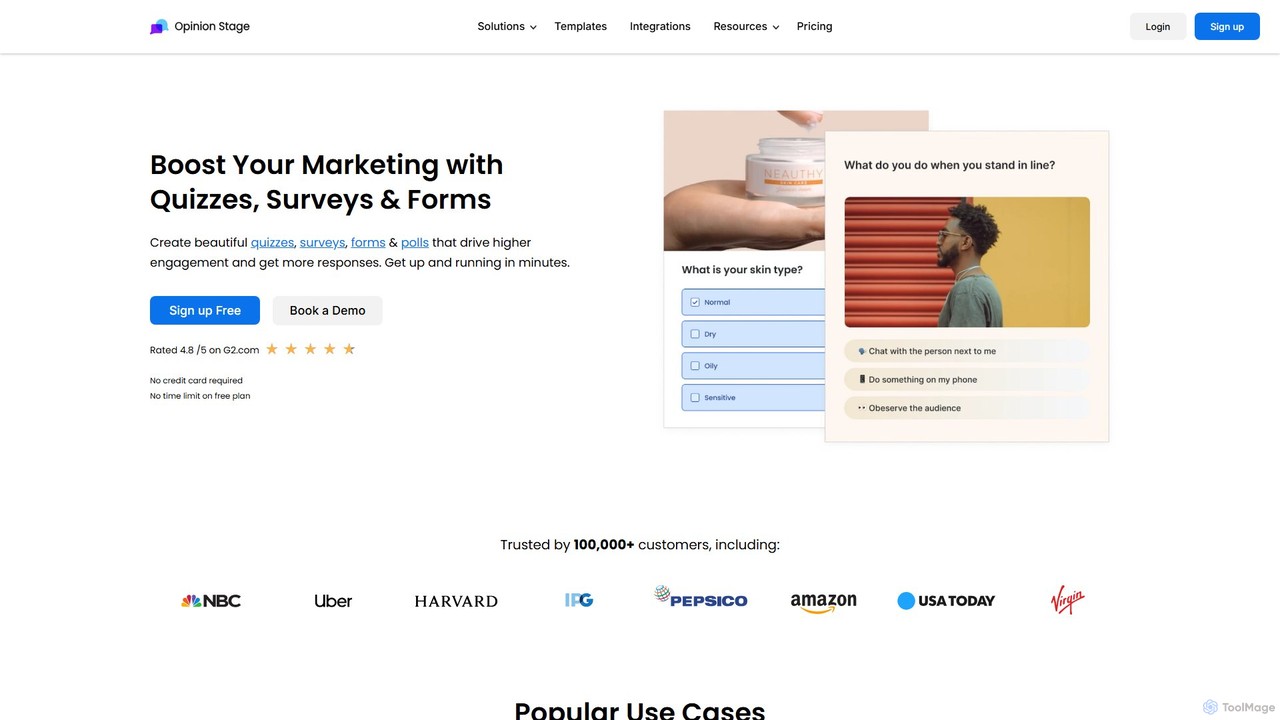
Opinion Stage is an AI-powered platform for creating engaging quizzes, surveys, forms, and polls to boost marketing efforts. It helps businesses increase audience engagement, generate up to 5x more qualified leads, and gather valuable feedback. With an intuitive builder, extensive templates, and deep customization, you can create interactive content that aligns with your brand in minutes. It's designed to turn passive audiences into active participants and drive measurable results.

Surveys & Feedback
Visits 216.9KFavorites 140Likes 139

About Surveys & Feedback

AI Surveys & Feedback tools are a class of applications designed to automate the collection, analysis, and interpretation of qualitative and quantitative feedback. These tools leverage Natural Language Processing (NLP) and machine learning to analyze open-ended responses, identify sentiment, and cluster common themes from large volumes of text data. Their primary value lies in transforming unstructured feedback from customers or employees into actionable, structured insights, significantly reducing manual analysis time. This enables organizations to quickly understand user opinions, prioritize improvements, and make data-driven decisions within their customer support and product development cycles.

Core Features

  • Sentiment Analysis: Automatically categorizes text feedback as positive, negative, or neutral to gauge overall opinion.
  • Topic & Keyword Extraction: Identifies and groups recurring themes, topics, and keywords from open-ended responses.
  • AI-Powered Survey Generation: Creates relevant and dynamic survey questions based on initial inputs or previous answers.
  • Predictive Insights: Analyzes feedback trends to forecast potential issues or predict customer churn risk.
  • Automated Reporting: Generates visual dashboards and summaries of key findings from survey data.

Use Cases

These tools are widely used by product managers to analyze feature requests, marketing teams to measure campaign effectiveness, and HR departments to understand employee engagement. For instance, a SaaS company can use an AI feedback tool to automatically categorize thousands of user comments from an NPS survey, instantly highlighting the most requested features and common complaints without manual reading.

How to Choose

When selecting an AI Surveys & Feedback tool, consider the depth of its analytical capabilities, such as the accuracy of its sentiment analysis and topic modeling. Evaluate its integration options with your existing systems like CRMs or helpdesks. Also, assess the user-friendliness of its survey builder and reporting dashboard, and ensure its data security protocols comply with your organization's standards.

Surveys & Feedback use cases

1

Automate Analysis of Customer Satisfaction Surveys

A Customer Success Manager for a B2B software company needs to analyze feedback from their quarterly Net Promoter Score (NPS) survey, which includes thousands of open-ended comments. Instead of manually reading and tagging each comment, they use an AI feedback tool. The tool automatically processes all text responses, performs sentiment analysis to gauge overall satisfaction, and clusters comments into key themes like 'Feature Requests,' 'UI/UX Issues,' and 'Pricing Concerns.' This provides an immediate, data-backed overview of customer priorities, allowing the manager to create a concise report for the product team in hours instead of weeks.

2

Prioritize Product Features from User Feedback

A product manager is planning the next development sprint and needs to decide which new features to prioritize. They collect feedback from various channels: in-app suggestions, support tickets, and a dedicated feedback survey. Using an AI analysis tool, they aggregate all this unstructured text data into a single dashboard. The AI identifies the most frequently requested features, highlights the pain points associated with existing workflows, and even segments requests by user type (e.g., 'Power Users' vs. 'New Users'). This allows the product manager to make an informed decision backed by quantitative evidence on user demand, ensuring development efforts are focused on what matters most to customers.

3

Uncover Insights from Market Research Surveys

A market research analyst conducts a large-scale survey with thousands of respondents to understand consumer perceptions of a new product concept. The survey contains several open-ended questions. Manually coding these responses would be extremely time-consuming and prone to bias. By uploading the dataset to an AI feedback platform, the analyst can instantly generate a topic model that reveals hidden themes and correlations. The AI might uncover an unexpected association between a specific demographic and a desire for sustainable packaging, an insight that was not explicitly asked about but emerged from the natural language of the responses. This allows for deeper, more nuanced findings than simple quantitative analysis.

4

Analyze Employee Engagement Survey Feedback

An HR department wants to improve workplace culture and runs an anonymous annual employee engagement survey. The survey generates hundreds of candid, open-ended comments about management, work-life balance, and career development. To protect anonymity and encourage honesty, they use an AI tool to analyze the text. The system identifies key concerns, such as 'lack of growth opportunities' and 'communication issues with leadership,' while also highlighting positive themes like 'strong team collaboration.' The HR team receives a comprehensive, aggregated report that pinpoints specific areas for improvement without revealing individual identities, enabling them to develop targeted action plans to boost morale and retention.

5

Summarize Post-Event Attendee Feedback Quickly

An event organizer for a large tech conference collects feedback via a post-event survey to improve future events. They receive hundreds of responses with detailed comments on sessions, logistics, and networking opportunities. With a tight deadline for the post-mortem report, they use an AI tool to rapidly process the feedback. The AI generates a summary report highlighting the highest-rated sessions, common logistical complaints (e.g., 'Wi-Fi issues'), and overall sentiment. It also extracts actionable suggestions, such as 'more workshops' or 'better signage.' This allows the organizer to present key takeaways to stakeholders within a day, enabling swift decisions for the next year's conference planning.

6

Synthesize User Experience (UX) Research Findings

A UX researcher conducts a series of usability tests and in-app surveys to evaluate a new mobile app feature. They gather hours of qualitative data, including user quotes and open-ended survey responses. To synthesize these findings efficiently, the researcher feeds the transcribed interviews and survey data into an AI analysis tool. The tool automatically tags mentions of usability issues, user frustrations, and positive comments. It then generates an affinity map, grouping related feedback together visually. This process transforms a mountain of raw qualitative data into a clear, organized summary of key UX themes, enabling the researcher to quickly identify patterns and present actionable design recommendations to the development team.

Surveys & Feedback FAQ

What are AI Surveys & Feedback tools?

AI Surveys & Feedback tools are software platforms that use artificial intelligence, particularly Natural Language Processing (NLP), to automate the analysis of survey responses and other forms of feedback. Unlike traditional survey tools that primarily collect data, these AI-powered platforms can interpret the meaning, sentiment, and key themes within open-ended text answers. Their main purpose is to quickly transform large volumes of unstructured qualitative data into structured, actionable insights, saving significant time on manual analysis.

How to choose the right AI survey tool for my business?

Choosing the right tool depends on your specific needs. Consider the following factors:

  • Analysis Depth: Does the tool offer basic sentiment analysis, or more advanced features like topic modeling, keyword extraction, and intent recognition? Choose based on the complexity of insights you need.
  • Integration Capabilities: Check if it integrates with your existing software stack, such as CRM (e.g., Salesforce), helpdesk (e.g., Zendesk), or communication tools (e.g., Slack), to streamline your feedback workflow.
  • Data Sources: Can the tool analyze feedback from multiple sources (surveys, reviews, social media, support tickets) or is it limited to its own survey builder?
  • Ease of Use: Evaluate the user interface for both creating surveys and interpreting the analysis dashboard. A good tool should present complex data in an understandable way.
What's the difference between AI survey tools and traditional survey platforms?

The primary difference lies in data analysis. Traditional survey platforms (like Google Forms or basic SurveyMonkey plans) are excellent for collecting data—they help you design and distribute surveys. However, they leave the analysis of open-ended text responses entirely up to you.

AI survey tools go a step further. While they also help collect data, their core strength is in automatically analyzing that data, especially qualitative feedback. They use machine learning to identify trends, sentiment, and topics from text, providing you with instant insights that would otherwise require hours or days of manual work to uncover.

What kind of insights can AI extract from open-ended feedback?

AI can extract a wide range of insights from unstructured text that are difficult to find manually. Key insights include:

  • Sentiment Analysis: Understanding the emotional tone (positive, negative, neutral) behind comments at scale.
  • Topic Clustering: Automatically grouping comments into themes, such as 'pricing,' 'customer service,' or 'product bugs,' without pre-defined categories.
  • Keyword & Phrase Extraction: Identifying the most frequently used words and phrases to pinpoint specific issues or praises.
  • Emerging Trends: Detecting new or growing topics of conversation over time that might indicate a new problem or a successful feature launch.
Who benefits most from using AI-powered feedback analysis?

While many roles can benefit, AI feedback analysis is particularly valuable for teams that handle large volumes of qualitative data and need to make decisions quickly. Key beneficiaries include:

  • Product Managers: To quickly identify user pain points and prioritize feature development based on aggregated feedback.
  • Customer Experience (CX) Teams: To monitor customer sentiment in real-time and identify key drivers of satisfaction or dissatisfaction.
  • Market Researchers: To accelerate the analysis of large-scale survey data and uncover deeper consumer insights.
  • HR Departments: To analyze employee engagement feedback confidentially and identify areas to improve workplace culture.