CircleCI
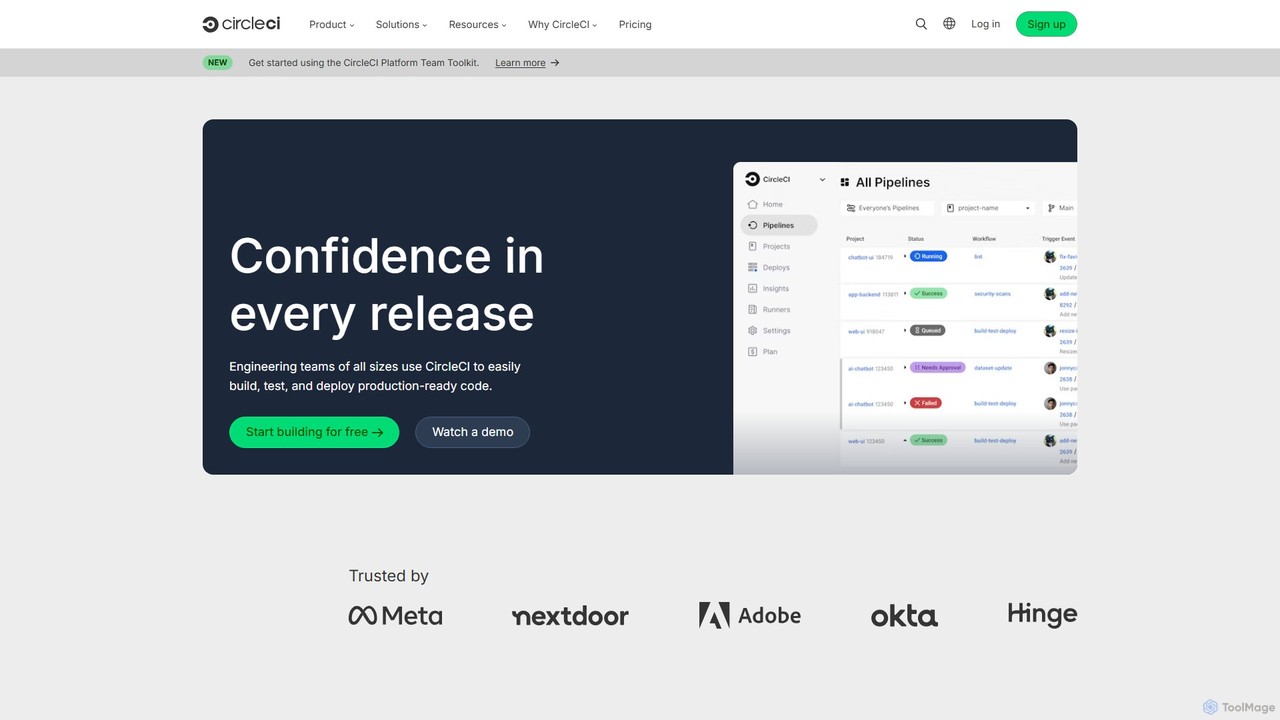
CircleCI is a leading continuous integration and continuous delivery (CI/CD) platform that automates the software development process. It …
CircleCI is a leading continuous integration and continuous delivery (CI/CD) platform that automates the software development process. It enables engineering teams to build, test, and deploy code quickly, reliably, and at scale, increasing productivity and confidence in every release.
Vairflow
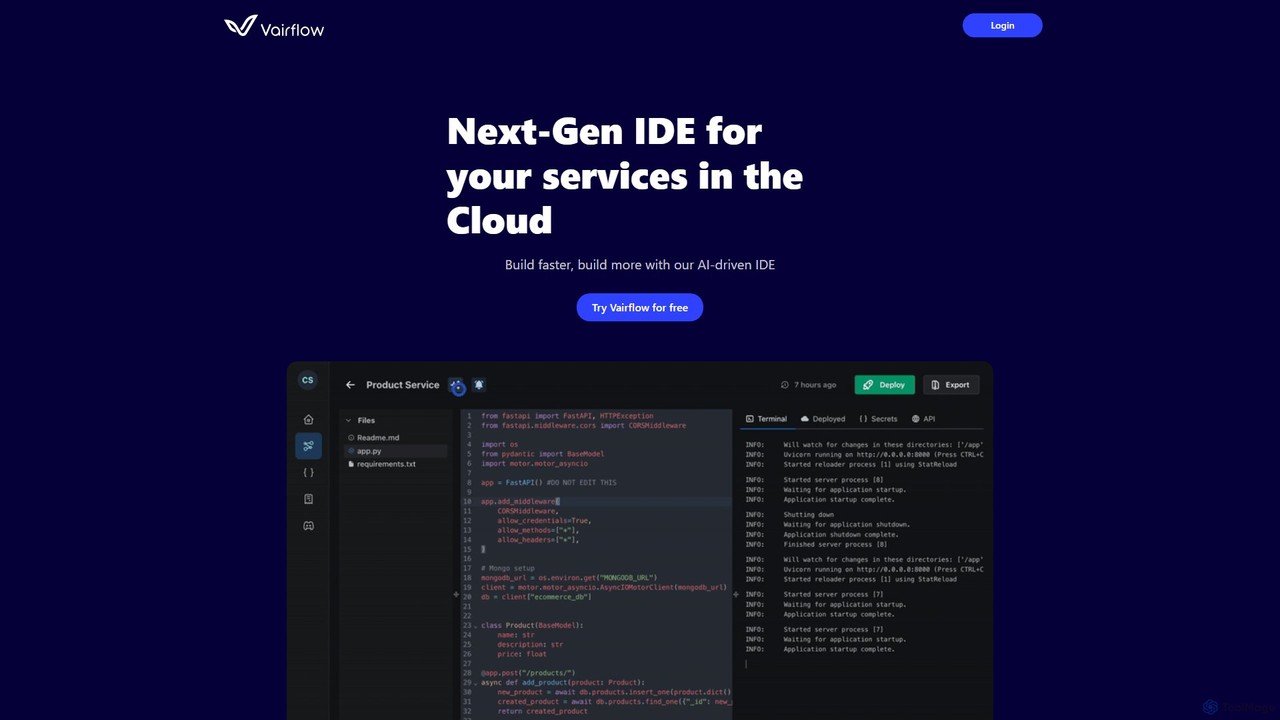
Vairflow is a next-generation, AI-driven Integrated Development Environment (IDE) designed for cloud services. It streamlines development by breaking …
Vairflow is a next-generation, AI-driven Integrated Development Environment (IDE) designed for cloud services. It streamlines development by breaking down complex ideas into reusable components, such as backend microservices and front-end UIs. With one-click deployment and upcoming AI-powered coding assistance, Vairflow helps developers build and deploy full-stack applications faster and more efficiently, eliminating local setup hassles.
About Deployment Automation
Deployment Automation tools are AI-powered solutions designed to streamline and accelerate the process of releasing software applications to various environments. These tools leverage intelligent algorithms to orchestrate complex deployment workflows, manage infrastructure configurations, and ensure consistent, error-free software delivery. By automating repetitive tasks and integrating seamlessly with CI/CD pipelines, they significantly reduce manual effort and improve release velocity for modern development teams.
Core Features
- CI/CD Pipeline Integration: Seamlessly connects with continuous integration and delivery systems to automate build, test, and deployment stages.
- Environment Provisioning: Automatically sets up and configures target environments, ensuring consistency across development, staging, and production.
- Configuration Management: Manages application and infrastructure configurations, applying changes consistently and tracking versions.
- Release Orchestration: Coordinates complex multi-stage deployments, managing dependencies and ensuring proper sequencing.
- Automated Rollbacks: Provides mechanisms to automatically revert to a previous stable state in case of deployment failures.
Applicable Scenarios
These tools are crucial for software development teams aiming for rapid iteration and reliable releases, particularly in cloud-native environments. They enable organizations to deploy microservices applications with high frequency and manage complex infrastructure as code, ensuring scalability and consistency across all stages of the software development lifecycle.
How to Choose
When selecting a Deployment Automation tool, consider its integration capabilities with existing CI/CD tools and cloud platforms. Evaluate its support for various deployment strategies (e.g., blue/green, canary), its configuration management features, and the robustness of its rollback mechanisms. Scalability, security features, and comprehensive auditing capabilities are also vital for long-term success and compliance.
Deployment AutomationUse Cases
Automate Microservices Deployment to Cloud
For development teams managing numerous microservices, deployment automation tools orchestrate the release of individual services to cloud platforms like AWS, Azure, or GCP. They handle containerization (e.g., Docker, Kubernetes), environment configuration, and traffic routing, ensuring zero-downtime updates and consistent service availability. This significantly reduces the operational overhead of managing complex distributed systems, allowing engineers to focus on feature development rather than manual deployment tasks.
Enable Continuous Delivery for Web Applications
Web development teams utilize deployment automation tools to implement continuous delivery, automatically deploying new features and bug fixes to production after successful testing. The tools manage version control, database migrations, and cache invalidation, ensuring a smooth and rapid release cycle. This allows for faster feedback loops, quicker time-to-market for new functionalities, and a more agile response to user needs and market changes.
Provision Infrastructure with Infrastructure as Code
DevOps engineers leverage deployment automation to provision and manage infrastructure using Infrastructure as Code (IaC) principles. Tools integrate with Terraform, CloudFormation, or Ansible to automatically create, update, and tear down environments based on defined code, ensuring consistency and reproducibility. This eliminates manual configuration errors, accelerates environment setup, and enables version control for infrastructure, treating it like any other codebase.
Manage Multi-Environment Software Releases
For enterprises with complex release processes involving development, staging, UAT, and production environments, deployment automation tools automate the promotion of software artifacts across stages. They enforce approval gates, run automated tests at each stage, and ensure that configurations are correctly applied for each specific environment, reducing human error and compliance risks while maintaining a clear audit trail.
Implement Automated Rollbacks and Disaster Recovery
In the event of a failed deployment or critical issue, deployment automation tools can automatically trigger a rollback to a previously stable version of the application or infrastructure. This minimizes downtime, reduces the impact of errors, and ensures business continuity. They also play a crucial role in disaster recovery by automating the restoration of services to a known good state, significantly improving resilience and recovery time objectives (RTO).
Deploy and Manage Serverless Functions
Developers working with serverless architectures (e.g., AWS Lambda, Azure Functions) use deployment automation tools to automate the deployment, versioning, and configuration of their functions. The tools handle packaging, dependency management, and API gateway integration, simplifying the operational aspects of serverless applications and enabling rapid iteration. This allows developers to focus purely on writing code without worrying about underlying infrastructure management.