
Dunoya
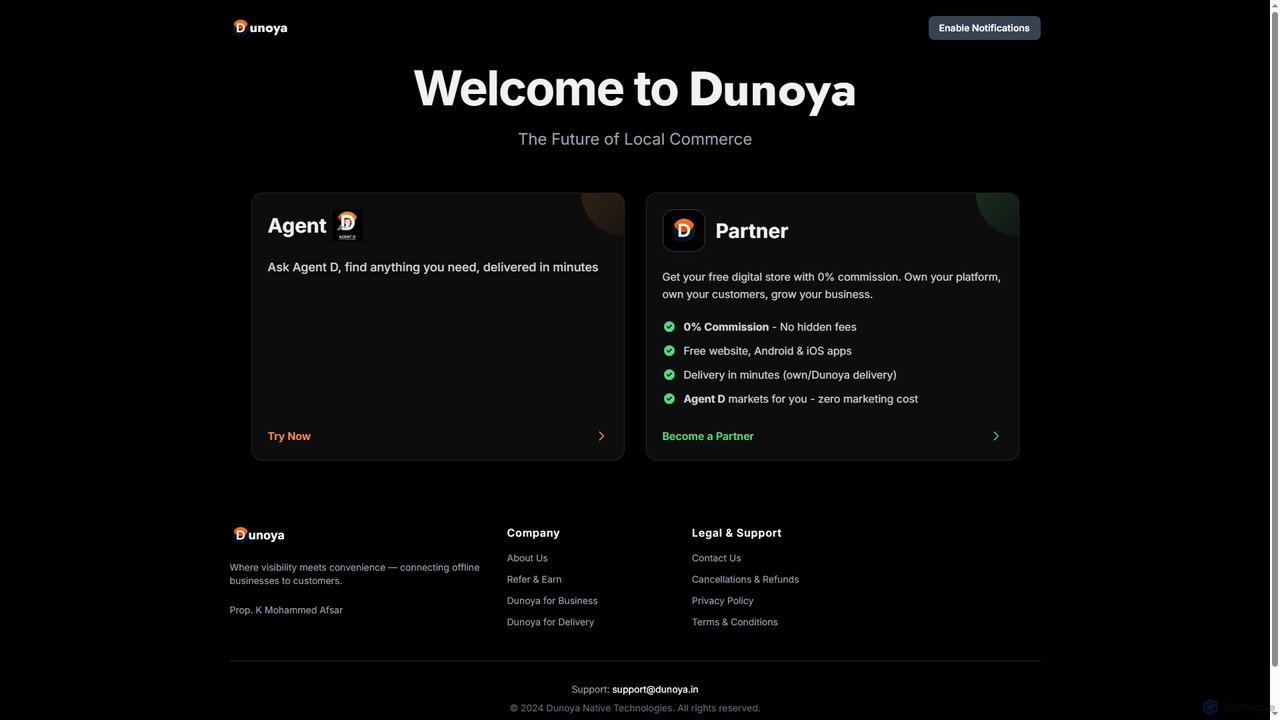
Dunoya is a revolutionary local commerce platform connecting customers with local businesses through an AI agent, Agent D. …
Dunoya is a revolutionary local commerce platform connecting customers with local businesses through an AI agent, Agent D. It offers partners a free digital store, Android & iOS apps, 0% commission, and AI-powered marketing to help them own their customer relationships and grow their business efficiently.
About Local Marketplace
AI Local Marketplace tools are platforms that use artificial intelligence to connect buyers and sellers within a specific geographic area. They leverage AI for features like location-based recommendations, dynamic pricing, and optimized delivery routes to facilitate hyperlocal commerce. These tools empower small businesses and service providers to reach nearby customers effectively, creating efficient, community-focused online markets. Unlike general e-commerce platforms, they specialize in managing the unique logistics and marketing challenges of geographically constrained transactions.
Core Features
- Geospatial Matching: Intelligently connects customers with the nearest available products or service providers.
- Dynamic Local Pricing: Adjusts prices based on local demand, supply, competitor rates, and even weather conditions.
- Optimized Logistics & Routing: Calculates the most efficient delivery routes or service schedules to minimize travel time and costs.
- Hyperlocal Demand Forecasting: Predicts demand for specific items or services in particular neighborhoods to optimize inventory and staffing.
- Automated Local Ad Targeting: Creates and manages marketing campaigns targeted at users within a defined radius or community.
Use Cases
These tools are ideal for businesses whose customer base is geographically concentrated. This includes local service providers like plumbers and electricians, restaurants offering delivery, small retail shops, and community initiatives like farmers' markets seeking to digitize their operations and streamline customer engagement.
How to Choose
When selecting an AI Local Marketplace tool, evaluate its geographic focus and accuracy. Consider its integration capabilities with local payment gateways and delivery services. Analyze the commission structure and pricing model. Finally, assess the strength of its AI-driven marketing and analytics features to ensure it aligns with your business growth goals.
Local MarketplaceUse Cases
Optimize Local Restaurant Deliveries
A small restaurant owner uses an AI Local Marketplace platform to manage online orders. When an order is placed, the system's AI automatically assigns it to the nearest available driver. It then calculates the most efficient delivery route in real-time, considering current traffic conditions and clustering multiple orders in the same neighborhood. This reduces average delivery time by up to 25% and lowers fuel costs, allowing the restaurant to serve more customers and improve satisfaction without hiring a dedicated dispatcher.
Match Homeowners with Local Service Providers
A homeowner needs an urgent plumbing repair. They use a local marketplace app to post their job requirements. The platform's AI analyzes the request, identifies the urgency and required skills, and instantly matches them with three top-rated, available plumbers within a 5-mile radius. The AI also provides an estimated cost based on historical data for similar jobs in that area. This process replaces hours of manual searching and calling, providing a reliable connection in minutes.
Forecast Demand for a Neighborhood Grocery Store
A local grocery store uses its marketplace platform's AI to manage inventory for perishable goods. The AI analyzes historical sales data, local weather forecasts, community events (like a neighborhood festival), and even social media trends. Based on this, it predicts a 40% increase in demand for barbecue supplies and fresh produce for the upcoming sunny weekend. The store manager adjusts their order accordingly, preventing stockouts, reducing food waste, and maximizing sales during a peak period.
Automate Hyperlocal Marketing for a Boutique
The owner of a new fashion boutique uses an AI marketplace tool to attract local customers. They define a target audience: females aged 20-40 within a 3-mile radius. The AI then automatically creates and runs targeted ad campaigns on social media and local news sites, showing ads only to users who fit this profile. It also sends push notifications to app users who are physically near the store, offering a small discount. This automated, hyperlocal approach increases foot traffic by 30% in the first month.
Manage Dynamic Pricing at a Farmers' Market
Vendors at a community farmers' market use a shared marketplace platform to manage sales. As the day progresses, the platform's AI monitors inventory levels and foot traffic data. Towards the end of the day, the AI suggests a 20% price reduction on perishable items like berries and leafy greens to vendors with high stock levels. This dynamic pricing strategy helps vendors sell off remaining inventory, reduce waste, and maximize their daily revenue, while customers benefit from end-of-day deals.
Optimize Scheduling for Local Tutors
A network of freelance tutors uses a local marketplace to manage their bookings. When a student requests a session, the AI considers the locations of both the student and available tutors. It then suggests optimal meeting times and public locations (like a library or café) that minimize total travel time for both parties. It also clusters appointments for tutors geographically, preventing them from traveling across town for back-to-back sessions. This intelligent scheduling increases a tutor's capacity by allowing for more sessions per day.