Review Insights Pro
Review Insights Pro is an AI-powered review management tool designed specifically for small businesses. It simplifies reputation management …
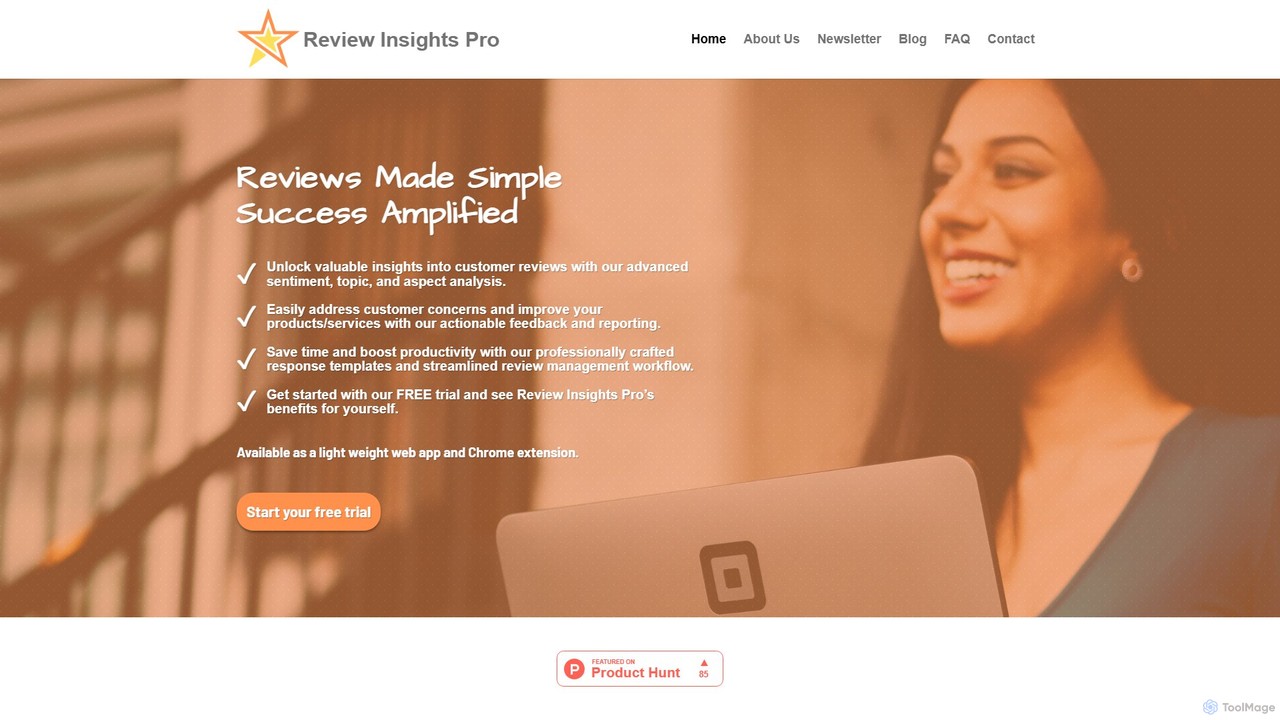
Review Insights Pro is an AI-powered review management tool designed specifically for small businesses. It simplifies reputation management through advanced sentiment, topic, and aspect analysis of customer reviews. Available as a web app and Chrome extension, it helps users understand feedback, address concerns, and craft professional responses efficiently, saving time and boosting productivity.
About Review Management
AI Review Management tools are specialized platforms that automate monitoring, analyzing, and responding to customer reviews across various channels. These tools leverage Natural Language Processing (NLP) to perform sentiment analysis, identify key topics, and generate context-aware response drafts. By centralizing feedback from e-commerce sites and other platforms, businesses can efficiently manage their online reputation, derive actionable insights from customer opinions, and improve service quality. This technology transforms reactive review monitoring into a proactive strategy for brand growth and customer retention.
Core Features
- Multi-Platform Aggregation: Consolidates reviews from e-commerce sites, social media, and review platforms into a single dashboard.
- AI Sentiment Analysis: Automatically categorizes reviews as positive, negative, or neutral to prioritize responses.
- Automated Response Generation: Creates personalized, brand-aligned draft replies for quick review and publishing.
- Insight & Trend Reporting: Identifies recurring themes and keywords in feedback to inform product and service improvements.
Applicable Scenarios
Primarily used in e-commerce, hospitality, and local service industries, these tools are vital for brand managers, customer support teams, and marketing professionals. They help online retailers track product feedback, restaurants manage their reputation on Google Maps and Yelp, and SaaS companies analyze user comments on platforms like G2 or Capterra.
Selection Criteria
When selecting a tool, consider the platforms it integrates with, the accuracy of its sentiment analysis, and the level of customization for response generation. Also evaluate its analytics capabilities, pricing structure (per location or review volume), and ease of integration with your existing CRM or helpdesk software.

Review ManagementUse Cases
E-commerce Reputation Management
An e-commerce store manager uses an AI review management tool to monitor product reviews across their Shopify store, Amazon, and social media channels. When a negative review appears, the system immediately flags it and analyzes the sentiment. The AI then generates a draft response that acknowledges the customer's issue and suggests a solution, allowing the manager to quickly edit and post a helpful reply. This process reduces response time by over 70% and helps turn dissatisfied customers into loyal ones by showing that their feedback is valued.
Hospitality Service Improvement Analysis
A hotel chain's operations team aggregates guest reviews from platforms like TripAdvisor, Booking.com, and Google. The AI tool analyzes thousands of reviews to identify recurring themes. It discovers a high frequency of negative comments related to 'slow check-in' and 'outdated gym equipment' across multiple locations. This data is presented in a clear dashboard, providing actionable insights. Based on this analysis, the management team invests in staff training for front desk efficiency and a budget for new gym equipment, directly addressing customer pain points and improving overall satisfaction scores.
SaaS Product Roadmap Prioritization
A product manager for a SaaS company uses a review management tool to collect feedback from G2, Capterra, and in-app surveys. The AI categorizes feedback into buckets like 'Feature Request,' 'Bug Report,' and 'UI/UX Suggestion.' It further analyzes the 'Feature Request' category to identify the most frequently requested features, such as 'dark mode' or 'API integration.' This quantitative data helps the product manager prioritize the development roadmap based on genuine user demand, ensuring that engineering resources are allocated to features that will have the highest impact on user satisfaction and retention.
Automating Review Solicitation for Local Businesses
The owner of a local restaurant chain wants to improve their Google Maps ranking. They use a review management tool that integrates with their point-of-sale (POS) system. The tool automatically identifies customers who had a positive experience (e.g., left a high rating in a post-meal survey) and sends them a personalized email or SMS message a few hours later. The message thanks them for their visit and provides a direct link to leave a review on Google. This automated and targeted approach significantly increases the volume of positive reviews, boosting their local SEO and attracting more new customers.
Multi-location Brand Consistency Monitoring
A marketing director for a national retail franchise monitors brand perception across hundreds of locations. The AI review management tool provides a comparative analysis of sentiment scores, average ratings, and key topics for each store. The director can quickly identify that stores in the West Coast region have significantly lower scores related to 'staff friendliness'. This insight allows them to work with regional managers to implement targeted customer service training, ensuring a consistent brand experience nationwide and addressing localized issues before they impact the broader brand reputation.
Competitive Analysis via Public Reviews
A market analyst for a consumer electronics brand uses a review management tool to not only track their own product reviews but also those of their top three competitors. The AI aggregates and analyzes reviews for competing products, identifying their common strengths and weaknesses mentioned by customers, such as 'excellent battery life' or 'confusing software interface'. This competitive intelligence provides a real-world perspective on market positioning and helps the brand identify opportunities to highlight their own product's advantages in marketing campaigns or to inform future product development.