Rispose
Rispose is a platform that allows you to create and embed custom AI agents on any website for …
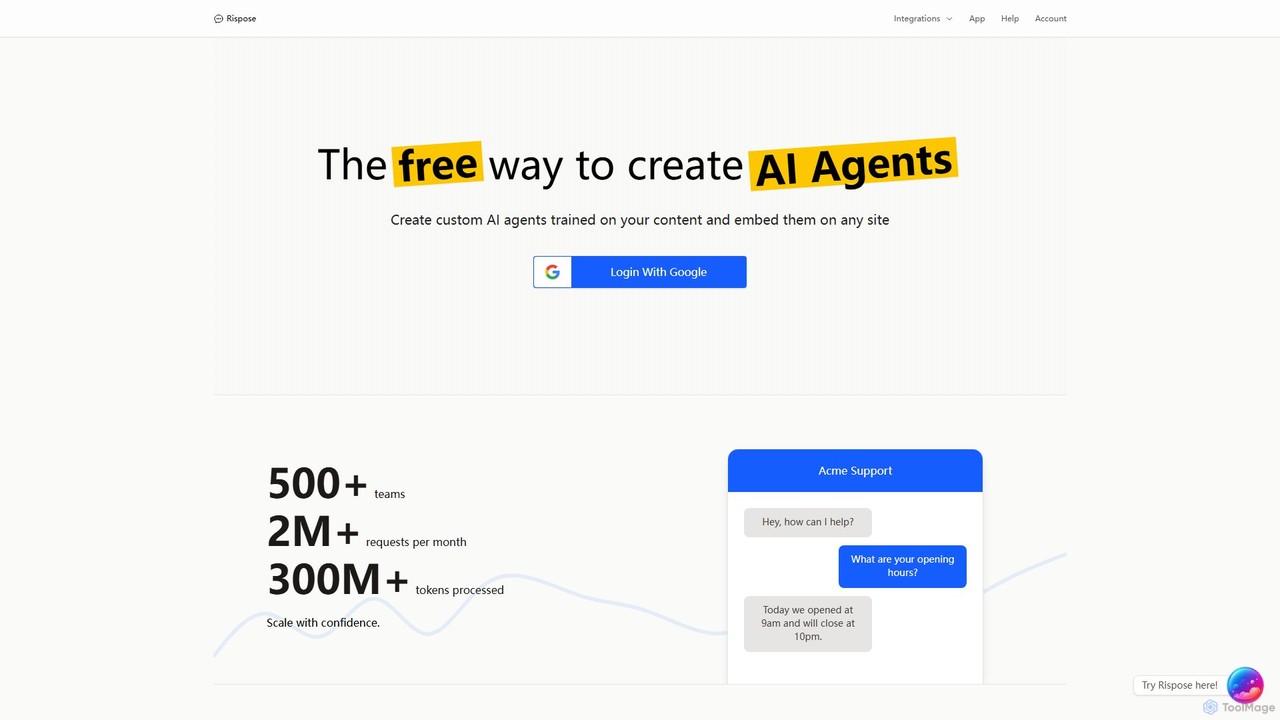
Rispose is a platform that allows you to create and embed custom AI agents on any website for free. Train your chatbot on your own documents, files, and data to provide instant, accurate support, answer questions, or act as a 24/7 sales assistant. It's easy to set up and integrates with platforms like Shopify, Notion, and more.
About Sales
AI Sales tools are a class of software that leverages artificial intelligence to automate, optimize, and enhance various stages of the sales process. These tools utilize machine learning models for predictive forecasting and lead scoring, and Natural Language Processing (NLP) to analyze customer communications. Their primary value lies in increasing sales team efficiency, improving forecast accuracy, and shortening the sales cycle by focusing efforts on the most promising leads. They transform raw sales data into actionable insights for smarter decision-making.
Core Features
- Predictive Lead Scoring: Analyzes historical data and customer attributes to rank leads based on their likelihood to convert.
- Sales Automation: Automates repetitive tasks like email follow-ups, meeting scheduling, and data entry into CRMs.
- Conversation Intelligence: Records, transcribes, and analyzes sales calls and meetings to provide coaching insights and identify best practices.
- Revenue Forecasting: Uses AI models to predict future sales outcomes with greater accuracy than manual methods.
- Data Enrichment: Automatically updates and enriches contact and account information within a CRM system.
Use Cases
AI Sales tools are widely adopted by B2B technology companies, SaaS providers, and financial services firms. Sales Development Representatives (SDRs) use them for lead prioritization, while Account Executives (AEs) leverage them for automated outreach and conversation analysis. Sales managers rely on these tools for accurate forecasting and team performance coaching.
How to Choose
When selecting an AI Sales tool, first consider its integration capabilities with your existing CRM (e.g., Salesforce, HubSpot). Evaluate the specific features you need most, such as lead scoring, conversation intelligence, or forecasting. Assess the tool's ease of use and the level of training required for your team. Finally, compare pricing models to ensure it aligns with your budget and expected return on investment.

SalesUse Cases
Automated Lead Qualification for SaaS
A Sales Development Representative (SDR) at a SaaS company is tasked with handling hundreds of inbound leads from website forms daily. Using an AI Sales tool, the system automatically analyzes each lead against an ideal customer profile, scoring them based on company size, industry, job title, and online behavior. The SDR can then ignore low-scoring leads and focus their time exclusively on the top 10-20% of prospects who are most likely to convert, increasing their meeting booking rate significantly.
Sales Call Coaching and Analysis
A sales manager wants to improve the performance of their junior account executives. Instead of manually listening to hours of call recordings, they use a conversation intelligence tool. The AI automatically transcribes calls, identifies keywords (like competitor mentions or pricing objections), and flags key moments. The manager can quickly review AI-generated summaries and analytics on talk-to-listen ratios to provide targeted, data-driven feedback to each team member, accelerating their skill development.
Accurate Quarterly Revenue Forecasting
A Head of Sales needs to provide a reliable revenue forecast to the board. Traditional methods based on salesperson estimates are often inaccurate. By implementing an AI forecasting tool, the system analyzes the entire sales pipeline, historical win rates, deal size, and sales cycle length. It then generates a probabilistic forecast, showing the most likely outcome along with best-case and worst-case scenarios. This allows for more strategic planning and resource allocation based on data, not just intuition.
Personalized Email Outreach at Scale
An Account Executive needs to reach out to 100 new prospects. Writing a unique, personalized email for each is time-consuming. Using an AI sales tool, they can upload a list of contacts. The AI then scans each prospect's LinkedIn profile and company website to generate a hyper-personalized opening line for each email, referencing a recent company achievement or a shared connection. This allows the AE to send highly relevant emails at scale, dramatically improving open and response rates compared to generic templates.
Automating Meeting Scheduling
A salesperson spends significant time each week in back-and-forth emails trying to schedule demos. By using an AI scheduling assistant, they can simply CC the AI on an email to a prospect. The AI then takes over the conversation, interacting with the prospect via natural language to find a mutually available time, send a calendar invite, and add the event to the salesperson's CRM. This frees up several hours per week, allowing the salesperson to focus on preparing for demos and closing deals rather than on administrative tasks.
Dynamic CRM Data Enrichment
A sales team's CRM contains outdated or incomplete contact information, leading to wasted effort. An AI data enrichment tool is connected to the CRM. It continuously scans public sources like LinkedIn, company news, and professional directories. When a contact changes their job title or company, the AI automatically updates the record in the CRM and can even suggest new contacts at the prospect's former company. This ensures the sales team always has accurate, up-to-date information for effective outreach.