CTGT
CTGT is an enterprise AI platform that provides fine-grained control over AI models without retraining. It ensures accuracy, …
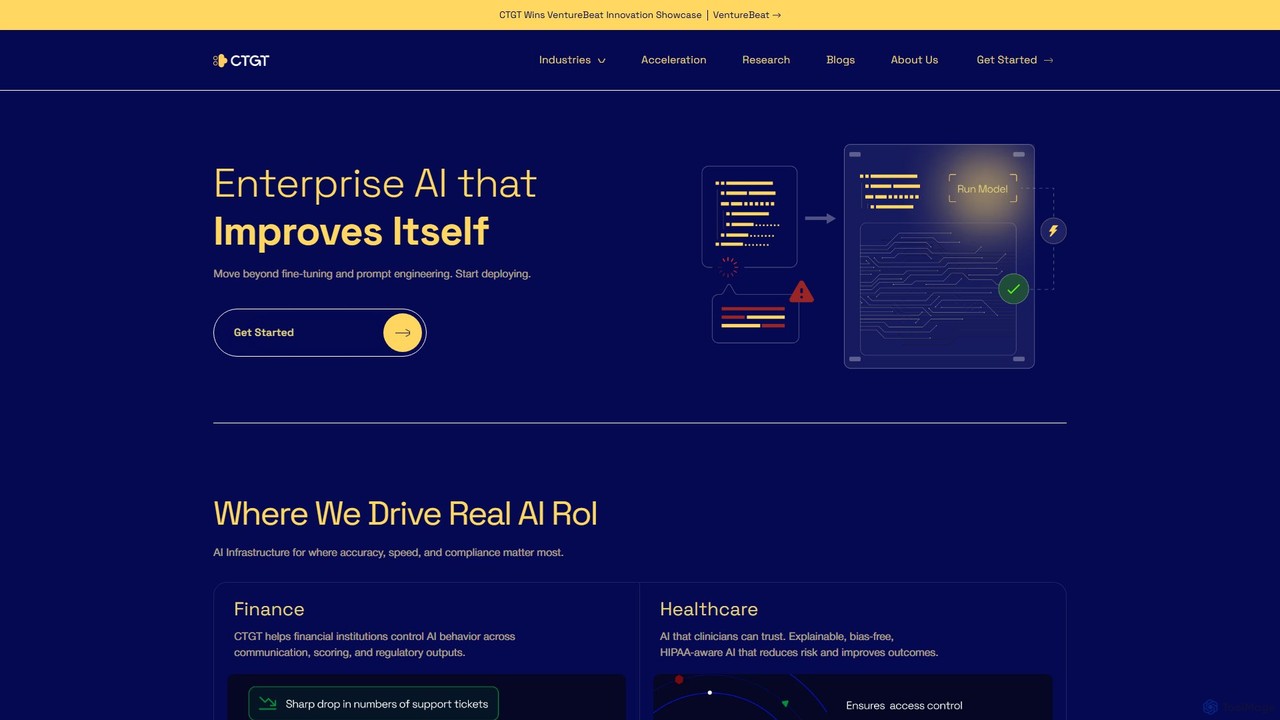
CTGT is an enterprise AI platform that provides fine-grained control over AI models without retraining. It ensures accuracy, compliance, and security for high-stakes industries like finance, healthcare, and legal by directly intervening in the model's internal processes, moving beyond traditional fine-tuning and prompt engineering.
About Ai Infrastructure
AI Infrastructure provides the foundational hardware and software stack required to build, train, deploy, and manage machine learning models at scale. It combines specialized compute resources like GPUs and TPUs with MLOps platforms to streamline the entire AI lifecycle. For enterprises, this infrastructure is crucial for transforming AI concepts into reliable, production-grade applications, enabling custom solutions beyond off-the-shelf APIs. It offers the power and control necessary for developing bespoke AI capabilities.
Core Features
- Managed Compute Resources: Provides on-demand access to powerful GPUs and TPUs optimized for AI workloads.
- MLOps & Experiment Tracking: Offers tools for versioning data, tracking training runs, and managing model registries.
- Scalable Model Serving: Includes infrastructure to deploy models as high-availability, low-latency APIs.
- Data Processing Pipelines: Features frameworks for efficiently preparing and transforming large datasets for training.
- Secure & Collaborative Environments: Enables teams to work together on sensitive data with robust access controls and security protocols.
Use Cases
AI Infrastructure is essential for machine learning teams, data scientists, and AI-focused enterprises. It's used to develop custom models in sectors like finance for fraud detection, healthcare for medical imaging analysis, autonomous driving for perception models, and e-commerce for advanced recommendation engines. It supports any organization moving from AI experimentation to production deployment.
How to Choose
When selecting an AI Infrastructure solution, consider the supported machine learning frameworks (e.g., TensorFlow, PyTorch), integration with your existing data stacks, and scalability options. Evaluate the MLOps capabilities for lifecycle management. Also, assess security and compliance certifications relevant to your industry and compare pricing models, such as pay-as-you-go versus dedicated clusters.

Ai InfrastructureUse Cases
Accelerating R&D for a Machine Learning Team
A data science team at a fintech startup needs to rapidly iterate on a new credit risk model. Instead of spending weeks setting up and configuring servers, they use a managed AI infrastructure platform. This allows them to instantly provision GPU-powered environments, use integrated notebooks for development, and leverage built-in experiment tracking to compare hundreds of model variations. The result is a 70% reduction in model development time, allowing them to deploy a more accurate model ahead of competitors.
Deploying a Real-Time Recommendation Engine
An e-commerce company wants to deploy a machine learning model that provides personalized product recommendations in real time. Their engineering team uses an AI infrastructure's model serving component to package the model into a container and deploy it as a scalable API endpoint. The platform automatically handles load balancing, auto-scaling to manage traffic spikes during sales events, and provides dashboards for monitoring latency and error rates. This ensures a reliable, low-latency service for millions of users without requiring a dedicated DevOps team.
Fine-Tuning Large Language Models (LLMs) Securely
A financial services firm needs to fine-tune a large language model on its proprietary customer data for an internal chatbot application. Due to strict data privacy regulations, they cannot use public cloud services. They deploy a private AI infrastructure within their own data center. This gives their data scientists access to the necessary GPU clusters for training while ensuring all sensitive data remains on-premise. The infrastructure's access control and auditing features help them maintain compliance throughout the model development lifecycle.
Managing the Lifecycle of Computer Vision Models
A manufacturing company uses computer vision models on its assembly line to detect product defects. These models need frequent retraining as new defect types emerge. They use an MLOps platform, a key part of their AI infrastructure, to automate this process. The platform automatically triggers a retraining pipeline when model performance degrades, versions the new model, runs it through a series of validation tests, and deploys it back to the factory floor with zero downtime. This ensures the quality control system is always up-to-date and effective.
Building a Scalable Data Annotation Pipeline
An autonomous vehicle company needs to process and annotate petabytes of sensor data (images, LiDAR) for training its perception models. They build a data pipeline on their AI infrastructure that automates data ingestion from vehicles, distributes annotation tasks to a team of labelers, and versions the resulting datasets. The infrastructure provides the scalable storage and compute needed to handle these massive datasets, and the pipeline ensures a consistent, high-quality flow of labeled data into their model training workflows, accelerating development cycles.
Providing AI-as-a-Service for Internal Teams
A large enterprise wants to empower its various business units (e.g., marketing, finance) to build their own AI solutions without deep technical expertise. The central IT team sets up a standardized AI infrastructure platform. This platform offers pre-configured templates for common tasks like forecasting and classification, a user-friendly interface for model building, and automated deployment. As a result, the marketing team can independently build a customer churn prediction model, reducing reliance on the central data science team and fostering innovation across the organization.