bosch_ai
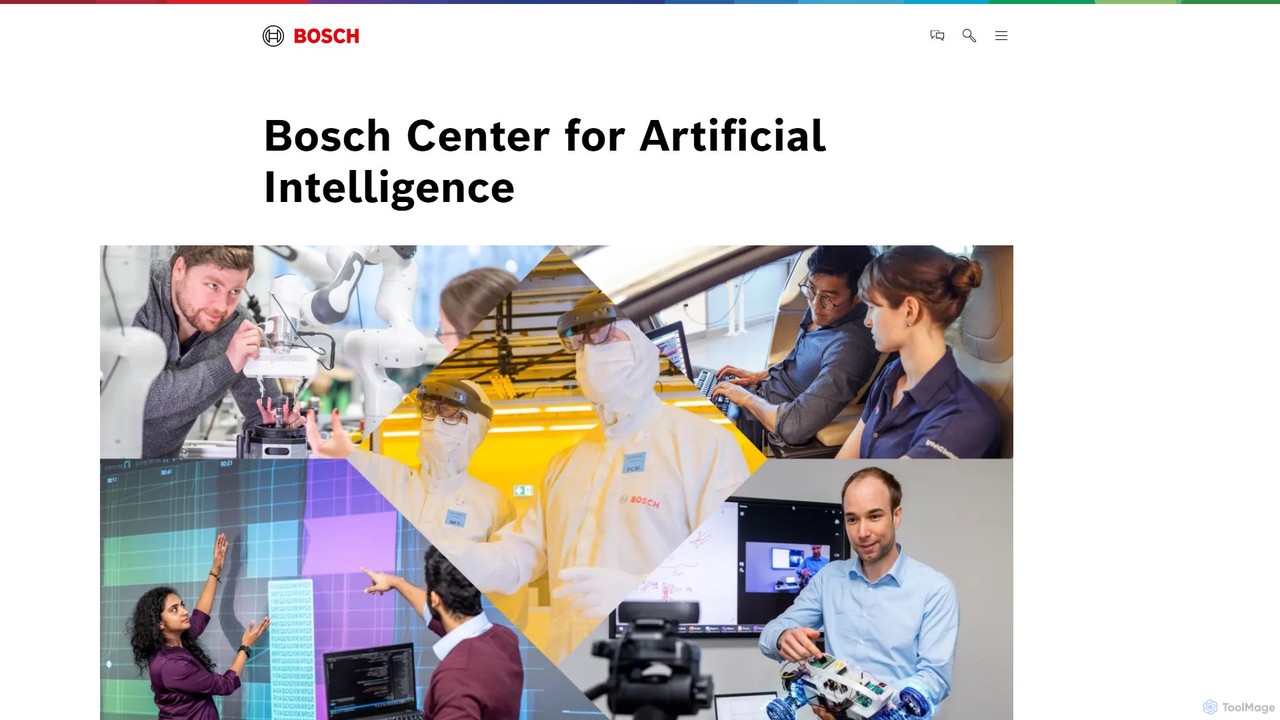
Bosch Center for Artificial Intelligence (BCAI) is Bosch's center of excellence for AI, driving the development and deployment …
Bosch Center for Artificial Intelligence (BCAI) is Bosch's center of excellence for AI, driving the development and deployment of safe, robust, and explainable AI solutions across industrial sectors. It bridges fundamental research with real-world applications in manufacturing, automotive, and supply chain management.
About Research & Development
Research & Development AI tools are specialized applications that leverage artificial intelligence to accelerate and enhance various stages of the R&D lifecycle within enterprises. These tools utilize advanced machine learning, natural language processing, and computer vision to automate data analysis, simulate experiments, and generate insights. They empower scientists, engineers, and innovators to streamline discovery processes, optimize product development, and bring innovations to market faster, contributing significantly to enterprise growth and competitiveness.
Core Features
- Automated Data Analysis: Rapidly process and interpret vast datasets from experiments, literature, and simulations to identify patterns and correlations.
- Predictive Modeling: Develop and validate models to forecast material properties, drug efficacy, or system performance, reducing the need for extensive physical testing.
- Knowledge Discovery: Extract and synthesize critical information from scientific literature, patents, and internal reports, uncovering novel connections and research opportunities.
- Simulation & Optimization: Enhance computational simulations and optimize parameters for product design, process efficiency, or experimental setups.
- Generative Design: Utilize AI to propose novel designs, molecular structures, or code snippets based on specified criteria and constraints.
Use Cases
These tools are crucial for enterprises engaged in scientific discovery, engineering innovation, and product lifecycle management. They are adopted by pharmaceutical companies for drug discovery, manufacturing firms for material science, and tech companies for software and hardware innovation. By automating repetitive tasks and providing data-driven insights, R&D AI tools significantly reduce time-to-market and improve the quality of innovations.
How to Choose
When selecting R&D AI tools, consider the specific research domain and data types (e.g., genomics, materials, code). Evaluate the tool's integration capabilities with existing R&D infrastructure and data pipelines. Assess the accuracy and interpretability of its AI models, and ensure it offers robust data security and compliance features. Finally, consider the vendor's expertise and support for your industry-specific challenges.

Research & DevelopmentUse Cases
AI-Driven Drug Candidate Identification
Pharmaceutical researchers use R&D AI tools to screen vast chemical libraries, predict molecular interactions, and identify potential drug candidates with high efficacy and low toxicity. This significantly reduces the time and cost associated with early-stage drug discovery, allowing for faster progression to preclinical trials and more targeted therapeutic development.
Predictive Modeling for Novel Materials
Material scientists leverage AI to predict the properties of new compounds or alloys before synthesis. By inputting desired characteristics, the AI can suggest optimal compositions and processing parameters, accelerating the discovery of advanced materials for aerospace, automotive, or electronics industries, and reducing costly experimental iterations.
AI-Assisted Code Generation and Bug Detection
Software development teams utilize R&D AI tools to generate boilerplate code, suggest optimizations, and proactively identify potential bugs or security vulnerabilities in large codebases. This enhances developer productivity, improves code quality, and shortens the software development lifecycle, leading to more robust and reliable applications.
Automated Knowledge Extraction from Research Papers
Academics and corporate researchers employ AI tools to rapidly scan, summarize, and extract key findings from thousands of scientific publications and patents. This helps them stay abreast of the latest advancements, identify emerging trends, and uncover overlooked connections, significantly reducing the manual effort in comprehensive literature reviews.
AI-Powered Process Parameter Optimization
Manufacturing engineers use R&D AI to analyze production data and simulate various process parameters to identify optimal settings for efficiency, yield, and quality. This leads to reduced waste, improved product consistency, and lower operational costs in complex manufacturing environments, from chemical production to semiconductor fabrication.
Generative Design for Product Innovation
Product designers and engineers utilize AI to explore a multitude of design variations for components or entire products based on performance requirements, material constraints, and manufacturing methods. This generative approach allows for rapid iteration, discovery of unconventional yet optimal designs, and faster time-to-market for innovative products.