Entertainment Best in category 3 results Simulation AI Tool

Popular AI tools in the Simulation field of Entertainment include Showrunner、World Simulator、DigitalDogs, etc., helping you quickly improve efficiency.

World Simulator

World Simulator

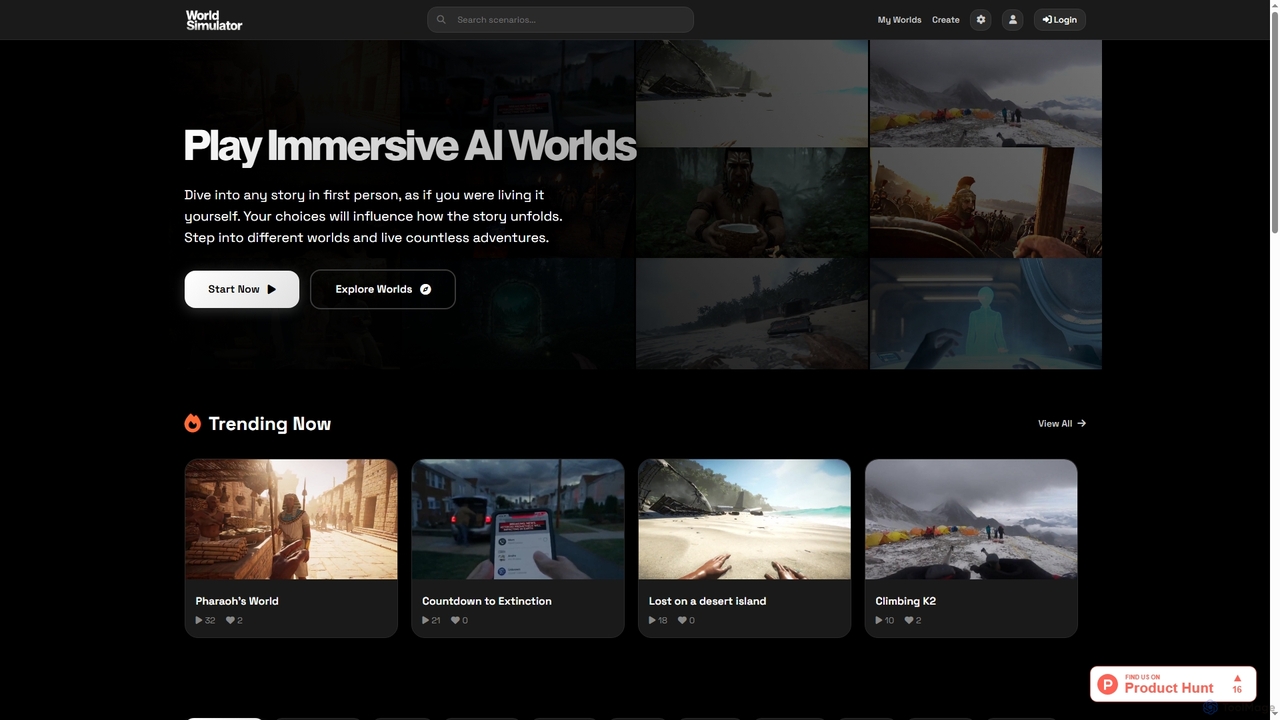
World Simulator is an innovative AI tool that allows users to create and play immersive, interactive AI-generated worlds. …

11.2K
DigitalDogs

DigitalDogs

DigitalDogs is an advanced AI platform offering hyper-realistic virtual pet dogs. Users can adopt, train, and interact with …

2.4K
Showrunner

Showrunner

Showrunner is a revolutionary AI platform by Fable Simulation that lets you create animated shows and scenes from …

52.0K

About Simulation

AI Simulation tools are a class of software that use artificial intelligence to create dynamic, realistic, and interactive virtual environments. They leverage machine learning models, such as reinforcement learning and generative AI, to model complex systems, predict outcomes, and generate emergent behaviors. These tools are primarily used in entertainment to create intelligent NPCs, realistic physics, and procedurally generated worlds, offering players deeply immersive and unpredictable experiences. Their ability to go beyond pre-scripted events makes virtual worlds feel more alive and responsive.

Core Features

  • Dynamic NPC Behavior: Creates non-player characters with adaptive, non-scripted actions and decision-making abilities.
  • Procedural Content Generation (PCG): Automatically generates vast and unique game worlds, levels, or assets based on rules and algorithms.
  • Realistic Physics & Environmental Modeling: Simulates complex physical interactions and environmental changes with high fidelity.
  • Reinforcement Learning Environments: Provides sandboxes for training AI agents through trial-and-error, leading to intelligent opponents or collaborators.

Use Cases

AI Simulation tools are predominantly used in game development, virtual reality (VR) experiences, and interactive storytelling. Game designers utilize them to build living, breathing worlds with intelligent inhabitants, while VR developers create realistic training or entertainment scenarios that react dynamically to user input.

How to Choose

When selecting an AI Simulation tool, consider the specific focus of the simulation (e.g., physics, social behavior, world generation). Evaluate its integration capabilities with major game engines like Unity or Unreal, the level of customization available for AI models, and the computational performance requirements for your target platform.

SimulationUse Cases

1

Creating Intelligent NPCs for RPGs

A game developer uses an AI simulation tool to design enemy factions in a role-playing game. Instead of scripting every action, they define high-level goals and personality traits for the NPCs. The AI then generates emergent group tactics in real-time, such as flanking maneuvers, strategic retreats, and adaptive responses to player actions. This makes combat encounters feel dynamic and unpredictable, significantly enhancing replayability as no two fights are exactly the same.

2

Procedural Generation of Open-World Maps

An indie game studio needs to create a massive, explorable world on a limited budget. They use an AI simulation tool with PCG capabilities. By setting parameters for terrain elevation, biomes, resource distribution, and climate, the AI generates a vast and logically consistent world map. It can simulate erosion to create natural-looking mountains and rivers, and place settlements in strategically sensible locations, saving thousands of hours of manual design work.

3

Simulating Realistic Crowd Behavior

For a city-building game or a large-scale battle scene, developers use AI simulation to manage thousands of individual agents. Each agent in the crowd has simple goals, like reaching a destination or fleeing from danger. The simulation engine manages their interactions, leading to complex, emergent crowd behaviors like traffic jams, orderly queues, or panicked stampedes. This creates a believable and dynamic urban environment without needing to animate each character by hand.

4

Training AI Opponents in Racing Games

A racing game developer uses a reinforcement learning framework within a simulation environment. They train AI drivers by rewarding them for fast laps, clean overtakes, and avoiding collisions, while penalizing them for going off-track. Over millions of simulated races, the AI learns optimal racing lines and human-like driving styles that are far more sophisticated and challenging than a simple path-following algorithm. This results in opponents that can adapt to different tracks and player skill levels.

5

Designing Interactive Narrative Experiences

A writer for an interactive story uses an AI simulation tool to manage character relationships and plot progression. Instead of a rigid branching tree, the story is driven by a simulation of characters' motivations, memories, and feelings. Player choices influence these internal states, causing characters to react dynamically and leading to organic storylines that are unique to each playthrough. The AI can ensure plot consistency while allowing for a high degree of player freedom.

6

Virtual Reality Environment Simulation

A VR developer creates a realistic training or entertainment scenario, such as a historical city tour or a fantasy adventure. They use an AI simulation tool to populate the world with characters that react believably to the user's presence and actions. The AI also controls environmental factors like weather and time of day, creating a dynamic simulation that enhances immersion. For example, virtual pedestrians might comment on the user's attire or seek shelter when it starts to rain, making the world feel truly alive.

SimulationFrequently Asked Questions