Cfundle
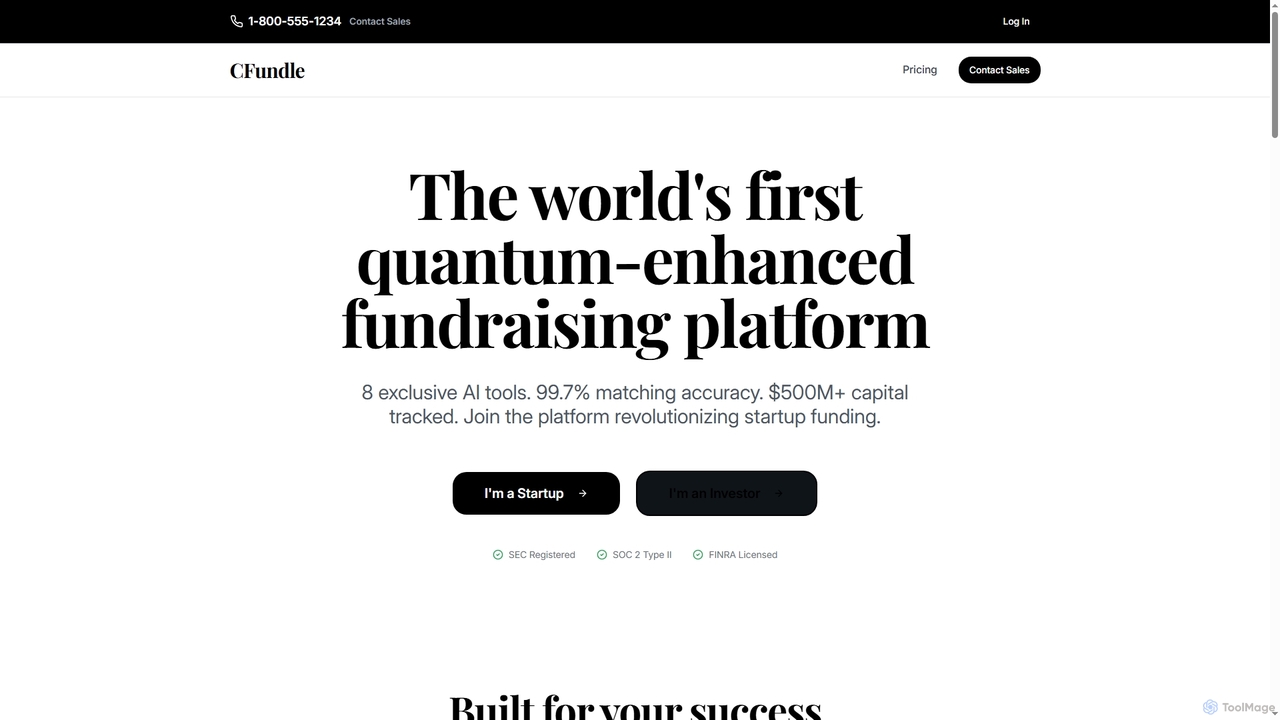
Cfundle is an online platform accessible via cfundle.com. Based on the limited information available, it appears to be …
Cfundle is an online platform accessible via cfundle.com. Based on the limited information available, it appears to be a digital presence, though its specific functionalities and purpose are not detailed on the provided webpage. Users can visit the domain to explore its offerings.
About Platform
AI Platforms are integrated environments designed for building, deploying, and managing artificial intelligence applications. They provide a comprehensive suite of tools, pre-trained models, and infrastructure, often accessible via APIs and SDKs. This allows developers and businesses to accelerate the AI development lifecycle, from experimentation to production, without managing complex underlying hardware. AI Platforms centralize resources, streamline workflows, and enable the creation of scalable, custom AI solutions.
Core Features
- Model Hub & APIs: Access to a library of pre-trained models (e.g., LLMs, computer vision) and robust APIs for integration.
- Development Environment: Includes tools like notebooks, SDKs, and CLIs for training, fine-tuning, and testing models.
- MLOps & Deployment: Provides infrastructure for one-click deployment, automated scaling, monitoring, and lifecycle management of AI models.
- Data Management Tools: Offers capabilities for data ingestion, preprocessing, labeling, and storage to support model training.
- Security & Governance: Features for managing access control, ensuring compliance, and monitoring resource usage across teams.
Use Cases
AI Platforms are primarily used by developers, data scientists, and enterprises. They are ideal for building custom applications like specialized chatbots, creating proprietary recommendation engines, or integrating multiple AI capabilities into existing enterprise software. Startups also leverage them for rapid prototyping of AI-powered products with minimal upfront infrastructure investment.
How to Choose
When selecting an AI Platform, consider the breadth and quality of its model library and the flexibility of its APIs. Evaluate its MLOps capabilities for scalability and long-term management. Assess the pricing model (e.g., pay-as-you-go vs. subscription) in relation to your expected usage. Finally, consider the learning curve and the quality of documentation and community support, especially for your development team.

PlatformUse Cases
Build a Custom Customer Service Chatbot
A development team at an e-commerce company uses an AI Platform to create a specialized chatbot. They select a pre-trained language model from the platform's hub and fine-tune it with their own product information and customer support logs. Using the platform's API, they integrate the chatbot into their website and mobile app. The platform's MLOps features automatically manage server scaling during peak shopping seasons and provide performance monitoring, allowing the team to focus on improving the bot's conversational quality rather than managing infrastructure.
Develop a Product Recommendation Engine
A data science team aims to increase sales by implementing personalized product recommendations. They use an AI Platform's machine learning environment to process historical sales data and train a collaborative filtering model. The platform provides scalable computing resources for training on large datasets. Once the model is ready, they deploy it as a real-time API endpoint using the platform's deployment tools. This API is then called by their website to show personalized recommendations to each visitor, leading to improved user engagement and higher conversion rates.
Automate Document Data Extraction
A financial services company needs to process thousands of invoices and contracts daily. They use an AI Platform's API for Optical Character Recognition (OCR) and Natural Language Processing (NLP). Their developers build a workflow that automatically ingests scanned documents, calls the platform's API to extract text and identify key entities like invoice numbers, dates, and amounts. The structured data is then fed into their accounting system. This eliminates manual data entry, reduces errors by over 95%, and accelerates their entire accounts payable process.
Rapid Prototyping for an AI Startup
An early-stage startup has an idea for a new generative AI application but limited resources. They subscribe to an AI Platform to gain immediate access to state-of-the-art large language models (LLMs) and image generation APIs. Instead of building and training models from scratch, their small team focuses on creating a unique user interface and application logic that calls the platform's APIs. This approach allows them to build a functional prototype in weeks instead of months, enabling them to secure investor funding and validate their market hypothesis quickly.
Centralize Enterprise AI Development
A large corporation has multiple data science teams working on different AI projects. To improve governance and efficiency, they adopt a single AI Platform. This provides a unified environment where all teams can access approved datasets, share custom models, and use standardized deployment pipelines. The platform's administrative tools allow IT to manage user access, monitor resource consumption, and enforce security policies. This centralization prevents duplicated effort, ensures compliance, and gives leadership a clear overview of all AI initiatives across the organization.
Enhance Creative Workflows with Generative APIs
A digital marketing agency integrates a generative AI platform into its content creation workflow. Their designers use the platform's image generation API to quickly create multiple visual concepts for ad campaigns. Content writers use the text generation API to draft social media posts, ad copy, and blog outlines. By building simple internal tools that call these APIs, the agency empowers its creative team to explore more ideas in less time, significantly reducing the time from brief to final delivery and increasing the creative output for their clients.