
Huntware
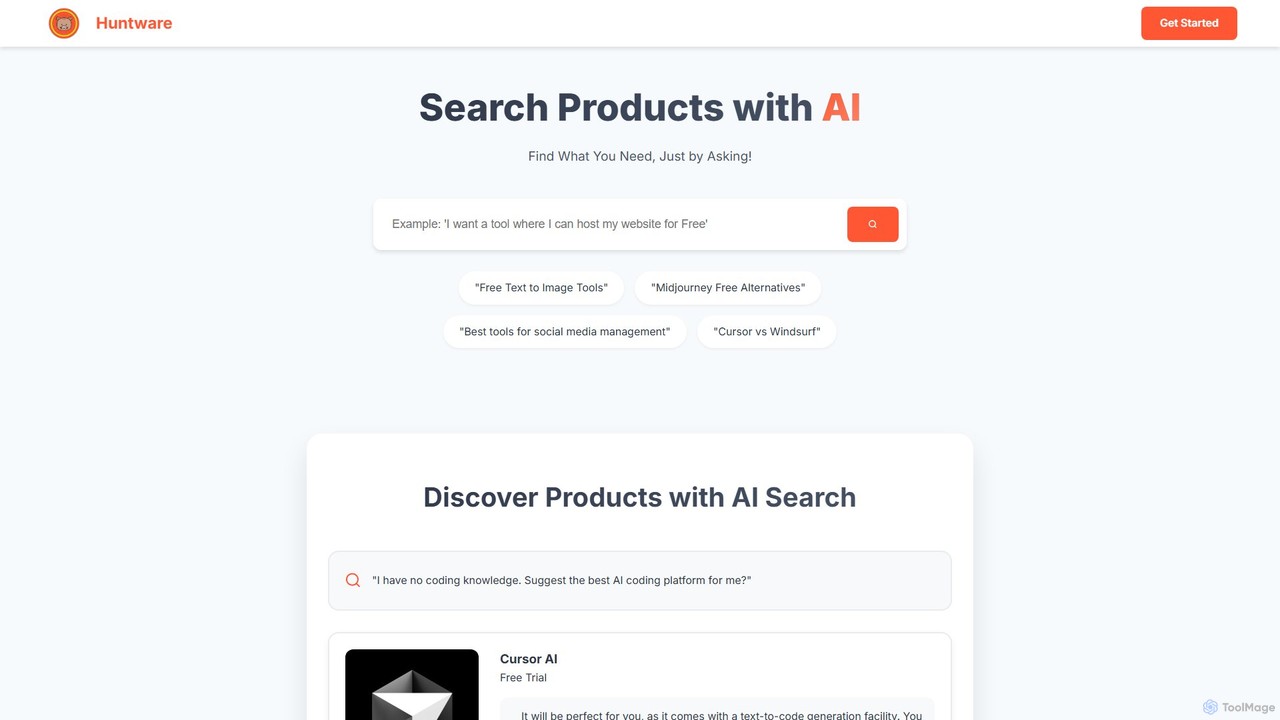
Huntware is an AI-powered search engine that helps you discover software and tools through natural language. Simply ask …
Huntware is an AI-powered search engine that helps you discover software and tools through natural language. Simply ask what you need, and Huntware provides personalized recommendations, comparisons, and detailed answers, making product discovery intuitive and efficient.
About Recommendation Engine
Recommendation Engines are AI-powered tools designed to predict user preferences and suggest relevant items, content, or services. These systems leverage advanced machine learning algorithms to analyze vast amounts of user behavior data, item characteristics, and contextual information. Their primary value lies in enhancing user experience, increasing engagement, and driving business growth by delivering highly personalized recommendations across various digital platforms.
Core Features
- Collaborative Filtering: Recommends items based on the preferences of similar users or items.
- Content-Based Filtering: Suggests items similar to those a user has liked in the past.
- Hybrid Recommendation Models: Combines multiple approaches to improve accuracy and address cold-start problems.
- Real-time Recommendation: Provides instant suggestions based on current user interactions and evolving preferences.
- Explainable AI (XAI): Offers insights into why a particular recommendation was made, building user trust.
Use Cases
Recommendation engines are crucial for businesses aiming to personalize user journeys. They are widely adopted in e-commerce to suggest products, in media streaming to recommend movies or music, and in news platforms to curate personalized content feeds. These tools help users discover new items while significantly boosting engagement and conversion rates for platforms.
How to Choose
When selecting a recommendation engine, consider its ability to integrate with existing data sources, the flexibility and variety of its algorithms, and its scalability to handle growing user bases and data volumes. Evaluate its real-time processing capabilities, the level of explainability provided for recommendations, and the ease of customization to specific business logic and user segments.
Recommendation EngineUse Cases
Enhancing E-commerce Product Personalization
E-commerce platforms utilize recommendation engines to analyze customer browsing history, purchase patterns, and demographic data. By suggesting highly relevant products, such as "customers who bought this also bought..." or "personalized for you" sections, businesses can significantly increase conversion rates, average order value, and customer loyalty, making shopping experiences more intuitive and engaging.
Optimizing Streaming Content Discovery
Streaming services like Netflix or Spotify deploy recommendation engines to analyze user viewing/listening habits, ratings, and genre preferences. These engines suggest movies, TV shows, or music tracks that align with individual tastes, helping users discover new content they'll love. This personalization is key to increasing user engagement, retention, and overall platform usage.
Providing Personalized News & Article Feeds
News outlets and content aggregators leverage recommendation engines to curate individualized news feeds. By understanding a user's reading history, preferred topics, and interaction patterns, these tools deliver articles and stories most relevant to their interests. This leads to higher click-through rates, longer session durations, and a more satisfying information consumption experience.
Improving Social Media Connection Suggestions
Social media platforms use recommendation engines to suggest potential friends, connections, or groups. By analyzing a user's existing network, shared interests, location, and interaction history, these engines identify relevant connections. This helps users expand their social circles, discover new communities, and increase their overall engagement with the platform.
Refining Job Matching on Recruitment Platforms
Recruitment websites employ recommendation engines to accurately match job seekers with suitable vacancies. By analyzing a candidate's skills, experience, career aspirations, and resume keywords against job descriptions, these engines provide highly relevant job recommendations. This streamlines the job search process for candidates and improves the quality of applications for employers.
Customizing Learning Paths & Course Recommendations
Online education platforms utilize recommendation engines to suggest personalized learning paths, courses, or educational resources. Based on a student's progress, learning style, past performance, and stated interests, the engine can guide them to the most effective next steps in their educational journey, enhancing learning outcomes and student retention.